Conservatory of the National Botanic Garden of Latvia (Oranžērija)
Salaspils, Salaspils Municipality
Entry updated on October 5, 2026
- Year
- 2015
- Architect
- Not documented (builder: SIA EKOTEH)
- Style
- Contemporary glass conservatory with four climate halls
- Status
- Open to the public
The National Botanic Garden of Latvia in Salaspils traces its history to a nursery founded in 1798 and became a botanic garden in 1956. As its old greenhouses lacked space and adequate winter heating, a new conservatory was built from 2013 by the company EKOTEH under a €3.4 million project financed by the European Regional Development Fund. Inaugurated on 23 April 2015, it opens four halls to the public (succulent, warm subtropical, cool subtropical and tropical), showing more than 2,100 taxa from every continent except Antarctica.
Affiliate links — booking through Verrière helps fund our research, at no extra cost to you.
History
1 min
The National Botanic Garden of Latvia traces its origins to a nursery established in 1798 by Johann Hermann Cigra. In 1836 Christian Wilhelm Schoch founded the horticultural firm C. W. Schoch in Riga, selling seeds and growing nursery stock; the expansion of the port of Riga led the firm to move to Salaspils in 1898. Before the First World War the Salaspils nursery sold 50,000 to 60,000 fruit trees a year. Nationalised in 1944, it became an experimental fruit and berry nursery and, in 1947, an experimental horticultural station.
On 1 September 1956 the site became the botanic garden of the Academy of Sciences, starting with more than 2,000 plant varieties inherited from the nursery. It gained research-institute status in 1968 and national botanic garden status in 1992; since 1 January 2026 it has been part of the Nature Conservation Agency.
The old greenhouses suffered from inadequate winter heating and a lack of space. A project financed by the European Regional Development Fund to create ex situ infrastructure for the conservation of biological diversity, worth €3.4 million, paid for a new conservatory, built by the company EKOTEH from 2013. The building was inaugurated on 23 April 2015 and welcomed visitors from 25 April, the day of the season's first plant fair.
Architecture and engineering
1 min
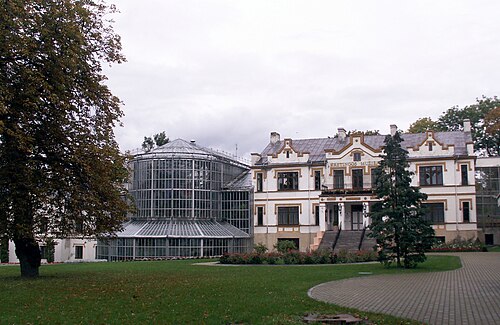
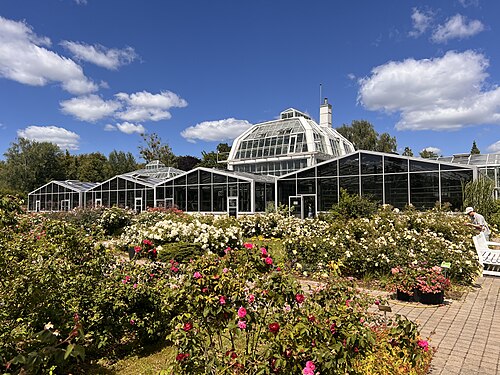
The conservatory is a large glass building fitted with modern technology that allows the climate to be adjusted to the needs of different groups of plants. Visitors walk through four halls with distinct conditions: the succulent hall, a warm subtropical hall, a cool subtropical hall and a tropical hall; in the subtropical halls a warm, humid climate is maintained all year.
The interior is laid out as a landscape, with paved paths, pools edged by winding walkways, small wooden bridges and large arches covered in climbing plants; in the tropical hall dozens of lianas twine around the arches and supports. Beyond the public areas, the complex includes ornamental plant collections, propagation facilities and a plant propagation and sanitation unit that serves as a CITES rescue centre.
Neither the floor area nor the name of an architect appears in the sources consulted; the building was constructed by the company SIA EKOTEH.
Plant collections
1 min
The conservatory displays more than 2,100 taxa from every continent except Antarctica; when it opened in 2015, over 1,200 species could be seen in the public halls. The succulent hall is its pride: the cactus collection alone exceeds 600 varieties, and medicinal aloes and agaves are each represented by more than 30 species, while the greenhouse collections also include over 50 varieties of crassulas, 40 of sedums and 20 of aeoniums.
In the subtropical halls bougainvilleas, strelitzias and cassias flower among chorisias, jacarandas and brachychitons, and ficuses are well represented, including several fig varieties. The tropical hall belongs to lianas (philodendrons, monsteras, epipremnums, rhaphidophoras) and to fruit trees: citrus, but also feijoas, psidiums, eriobotryas and papayas. According to its director at the time, Andrejs Svilāns, the conservatory also preserves the genetic resources of indoor plants bred in Latvia.
Visiting
1 min
The conservatory stands in the National Botanic Garden on Miera iela in Salaspils and is open all year, its heated halls as rewarding in winter as in summer. The rest of the garden, which covers 129 hectares and holds more than 14,000 taxa, is best explored from late spring to autumn. The calendar is punctuated by plant fairs, from the opening of the season in spring to the autumn fair in September, as well as art exhibitions, concerts and performances. Allow about an hour for the four halls, and longer for the outdoor collections.
56.86° N, 24.36° E
Greenhouses nearby
Do you have a good photo of this greenhouse? Suggest it for this page →