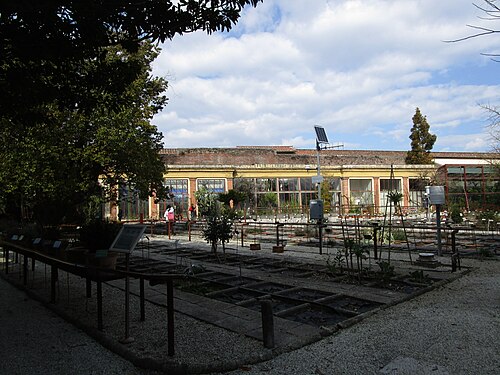
Serra Pedicino and succulent greenhouse, Orto Botanico di Portici
Portici (Metropolitan City of Naples), Campania
No freely licensed photo of this greenhouse yet. Do you have one? Suggest it for this page →
Sources checked October 2026
- Year
- 1877
- Style
- Iron-and-glass greenhouse against the Belvedere wall (1877); post-war heated succulent house
- Dimensions
- Succulent house c. 1,000 m² (Wikipedia)
- Status
- Garden open with the Reggia ticket (Tuesday to Sunday); succulent house on guided visits only; Serra Pedicino being refitted (official site, Oct. 2026)
In the upper park of the Reggia di Portici, the Royal Higher School of Agriculture founded a botanical garden in 1872, which Nicola Antonio Pedicino, its first professor of botany, laid out on two former pleasure gardens. In 1877 an iron-and-glass greenhouse was built against the boundary wall of the Belvedere: restored in 2000, the Serra Pedicino has housed epiphytes and is now being technically upgraded. The reconstruction begun in 1948 added a heated greenhouse for succulents, where more than 400 species from African and American deserts grow beside male and female Welwitschia mirabilis; it opens only on guided tours.
Affiliate links — booking through Verrière helps fund our research, at no extra cost to you.
History
The Reggia di Portici was built from 1738 for Charles of Bourbon and Maria Amalia of Saxony on a site chosen between the slopes of Vesuvius and the sea: Giovanni Antonio Medrano opened the works, Antonio Canevari took over around 1740 and some elements are credited to Luigi Vanvitelli. From 1758 the palace housed the Herculanense Museum, which gathered the finds from Herculaneum and Pompeii before their transfer to the archaeological museum in Naples. After the Bourbons left in 1860, the Royal Higher School of Agriculture moved into the estate in 1872 and founded a botanical garden in the upper wood.
Nicola Antonio Pedicino, the school's first professor of botany and director of the garden from 1873 to 1877, converted two pleasure gardens of about 9,000 m²: the Giardino Soprano for perennials, the Giardino Segreto for annuals and study plants. A first Index Seminum appeared in 1875, and in 1877 an iron-and-glass greenhouse was raised against the boundary wall of the Belvedere. Orazio Comes, who held the botany chair from 1877 to 1917, steered the garden towards agricultural experiment, including tobacco varieties; a plant-pathology garden was added in 1920 and, in the 1930s, exotic plants from the botanical garden of Palermo. The school joined the University of Naples in 1935.
Work stopped in 1943; the Allied occupation of the Reggia and its park, with its heavy vehicle traffic, destroyed a large part of the plants and installations. Reconstruction began in 1948 under Valeria Mezzetti Bambacioni: according to Wikipedia it extended the garden to 20,000 m² and created a fernery, a palm garden and a greenhouse for succulents. The Serra Pedicino was restored in 2000. A violent storm wrecked part of the trees on 16 June 2014; that same year the Centro MUSA, which runs the Reggia's museums, published the project of a 'Grande Serra' meant to replace the succulent shelters. The first recent restoration works dealt with the avenues, the central fountain, lighting and irrigation, ahead of the announced upgrading of the collections and the display greenhouses.
Architecture and engineering
The garden's historic greenhouse, known as the Serra Pedicino, dates from 1877: the official sources and Wikipedia describe it as an iron-and-glass construction raised against the boundary wall of the Belvedere, along the edge of the garden. Restored in 2000, it received a collection of epiphytes; the website of the Reggia's museums states that it is undergoing technical adaptation for a new exhibition layout.
The heated succulent house, born of the 1948 reconstruction plan, covers about 1,000 m² according to the encyclopaedias. A 2014 document from the Centro MUSA acknowledges that the succulent collection was then housed in a series of structures unsuited to the monumental and landscape setting, and proposes replacing them with a single building, the Grande Serra. It is planned on the longitudinal axis of the Reggia and the royal gardens, towards Vesuvius, in the garden's second square sector and against the wall of the 'Gioco del Pallone', treated as a scenic backdrop; a closed body whose base would be crossed by a path leading to the existing opening in the wall. The project drawing published on Wikimedia Commons credits it to the architect Donatella Mazzoleni.
Plant collections
The garden holds more than 4,000 specimens of about 1,000 species, and its main collection is that of desert plants. The official site counts more than 400 species from the deserts of Africa and the Americas in the succulent house, spread among Cactaceae, Aizoaceae, Euphorbiaceae, Didiereaceae and Apocynaceae; Wikipedia puts the whole desert collection at more than 600 species, including some 400 cacti, and adds the Agavaceae. Among the cacti are the genera Gymnocalycium, Mammillaria and Rhipsalis, with Alluaudia, Aloe and Kalanchoe for southern Africa and Madagascar, as well as Astrophytum and Ferocactus. The most admired specimens are a male and a female plant of Welwitschia mirabilis, native to the deserts of southern Africa.
After its 2000 restoration the Serra Pedicino displayed a collection of epiphytic plants. Outdoors, the palm grove gathers 25 species, among them Phoenix and Washingtonia; the cycads include Cycas revoluta and several Encephalartos; ferns, conifers, carnivorous plants, and edible and medicinal plants complete the collections.
Visiting
The botanical garden occupies the upper part of the royal estate, at Via Università 100, next to the agriculture department of the Federico II University. The Reggia ticket gives access to the royal apartment, the Herculanense Museum and the botanical garden, but the succulent house opens only during the guided visits offered at weekends. Allow half a day to link the palace, the garden and the agricultural science museums of the Centro MUSA, including the Orazio Comes botanical museum, then carry on into the lower park towards the sea or the upper park, also called Parco Gussone. The excavations of Herculaneum and the other Vesuvian archaeological sites are close by.
40.81° N, 14.34° E
Greenhouses nearby
More greenhouses — Italy
Do you have a good photo of this greenhouse? Suggest it for this page →
Sources (8)
- museireggiadiportici.it/it/scopri/orto-botanico-di-portici.html
- museireggiadiportici.it/it/info/orari-e-biglietti.html
- museireggiadiportici.it/images/La-Grande-Serra.pdf
- museireggiadiportici.it/it/ricerca/restauri/lorto-botanico.html
- it.wikipedia.org/wiki/Reggia_di_Portici
- it.wikipedia.org/wiki/Orto_botanico_di_Portici
- en.wikipedia.org/wiki/Orto_Botanico_di_Portici
- commons.wikimedia.org/wiki/File:Grande_Serra_Desertica_Orto_Botanico_di_Portici_2013.jpg
Affiliate links — booking through Verrière helps fund our research, at no extra cost to you.