Lamberton Conservatory (Highland Park)
Rochester, New York

Entry updated on October 5, 2026
- Year
- 1911
- Architect
- Unknown
- Style
- Early 20th-century glass-and-steel conservatory, rebuilt as a replica
- Dimensions
- Rebuilt section of about 1,800 sq ft (167 m²)
- Status
- Open to the public
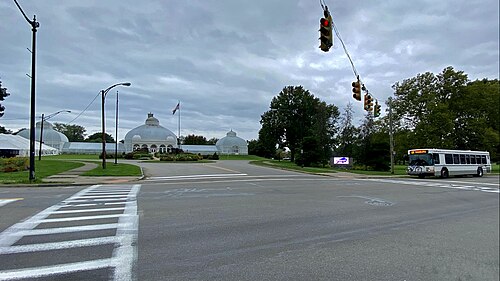
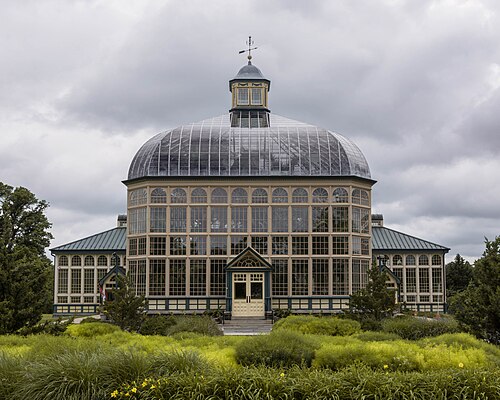
Built in 1911 in Highland Park, the Olmsted-designed arboretum of Rochester, the conservatory is named after Alexander B. Lamberton, president of the city's parks board from 1902 to 1915. Two rooms were added in 1985; the historic section, badly deteriorated, was dismantled in 2007 and rebuilt as a replica by Monroe County for about one million dollars. Five houses now show desert plants, a tropical dome, epiphytes, houseplants and seasonal displays.
Affiliate links — booking through Verrière helps fund our research, at no extra cost to you.
History
1 min
Highland Park began in 1883, when the nurserymen George Ellwanger and Patrick Barry gave the city of Rochester twenty acres of their nursery. The city hired the firm of F.L. & J.C. Olmsted, which shaped it into a picturesque arboretum that took in the adjacent city reservoir. In 1911 a conservatory was added, raising the horticultural standing of a park already known nationally; it was named in honour of Alexander B. Lamberton, president of the parks board from 1902 to 1915 and a park commissioner.
In 1985 two new rooms were built on either side of the building. Heat and humidity gradually damaged the structure, and by 2006 the original conservatory had deteriorated to the point where maintaining it was no longer cost-effective. In 2007 the Monroe County Parks Department raised about one million dollars for a complete teardown and historic reconstruction: the conservatory was dismantled down to its foundation and rebuilt as an exact replica in modern materials. The memorial to Lamberton was mounted again above the front doors. Highland Park has been listed on the National Register of Historic Places since 2003 as part of Rochester's municipal park system.
Architecture and engineering
1 min
The 2007 reconstruction closely followed the 1911 building. The old steel framework was taken down and used as a pattern for the new galvanised steel frame. Several original components were salvaged, refurbished and put back: the interior cypress gutter system, the operable ridge vent and the exterior cast-iron gutters.
The rebuilt section covers about 1,800 square feet (roughly 167 m²) and has nearly 1,000 new panes of glass formed specifically for this kind of structure. Today's complex combines this historic core, which holds the tropical dome, with the rooms added on each side in 1985. It is divided into five houses with distinct settings: desert, tropical dome, houseplants, epiphytes, and the seasonal display house.
Plant collections
1 min
Each of the five houses evokes a different environment. The epiphyte house gathers orchids, ferns and exotics, including a shaving brush tree believed to be more than a hundred years old. The tropical dome holds, among other plants, an 'Amstel King' fig and crotons beneath large palm fronds that staff must regularly cut back. The seasonal house stages five shows a year, among them a spring show.
The conservatory also has animal residents: three tortoises roam the paths freely, alongside red-eared slider turtles and quails, and the entrance area, nicknamed 'Shellville', is home to more than a dozen turtles and tortoises.
Visiting
1 min
The conservatory stands at 180 Reservoir Avenue in the middle of Highland Park, a 150-acre park. An hour is enough for the five houses. Spring is the best season: every May the Lilac Festival draws more than 500,000 visitors to the park's 1,200 or so lilacs, and the park also holds 35 magnolia varieties and 700 varieties of rhododendron. The pansy bed, a floral carpet of 10,000 plants redesigned every year, and the Poet's Garden, laid out in 1916 to honour Shakespeare, round off a walk. Supported by the volunteer Highland Park Conservancy, the conservatory welcomed nearly 70,000 visitors in a recent year, according to the local press.
43.13° N, 77.61° W
Greenhouses nearby
More greenhouses — United States
Do you have a good photo of this greenhouse? Suggest it for this page →