Sonnenberg Gardens Greenhouses (Palm House and Lord & Burnham complex)
Canandaigua, New York
Entry updated on September 30, 2026
- Year
- 1903-1915
- Architect
- Lord & Burnham
- Style
- Residential greenhouse complex in cypress, iron and steel, hollow-square plan
- Dimensions
- About 13,000 sq ft (≈1,200 m²)
- Status
- Open to the public in season (May to October)
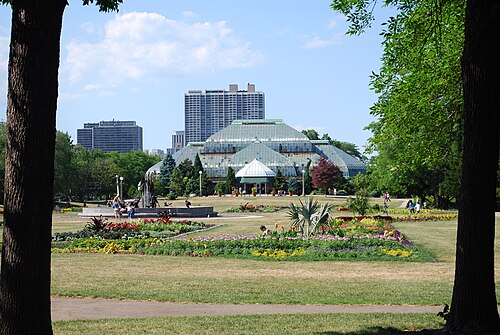
Commissioned in 1903 by Mary Clark Thompson from Lord & Burnham, the Sonnenberg greenhouse complex, built between 1903 and 1915, produced fruit, vegetables and flowers for the estate and for its owner's New York City residence. It consists of about a dozen structures laid out as a hollow square around potting sheds, including a domed palm house, two orchid houses and a cactus house. Neglected for decades after 1931, the estate was restored and reopened in 1973; the Palm House has had a restoration costing about $539,000.
Affiliate links — booking through Verrière helps fund our research, at no extra cost to you.
History
1 min
Frederick Ferris Thompson, a New York banker, and Mary Clark Thompson, daughter of a New York governor, bought a farmstead of about 300 acres called Sonnenberg near Canandaigua Lake in 1863, as newlyweds. A Queen Anne mansion designed by the Boston architect Francis R. Allen replaced the farmhouse in 1887. After Frederick's death in 1899, Mary began in 1902 to redesign the grounds as a living memorial to her husband; the gardens were completed in 1919.
In 1903 she commissioned the greenhouse complex from Lord & Burnham, built through 1915. All year round it supplied the estate and the Thompsons' New York residence with fruit, vegetables and fresh flowers.
Mary died in 1923; the estate was sold to the federal government in 1931 and became a veterans' hospital, followed by forty years of neglect and vandalism. The so-called Sonnenberg Bill transferred the property to a local non-profit in 1972, restoration began in 1973, and the gardens opened to the public in May of that year. New York State bought the property in 2005 according to Wikipedia, in 2006 according to the estate's website, and the non-profit still operates it. It has spent about $539,000 restoring the Palm House and is now working on two vineries.
Architecture and engineering
1 min
The complex covers about 13,000 square feet, close to 1,200 square metres, and is distinguished by a hollow-square plan organised around central potting sheds. The estate presents it as one of the few Lord & Burnham ranges still intact in the United States.
The firm's early greenhouses, Sonnenberg's among them, combined cypress wood with iron or steel. The complex keeps its original framework and climate-control systems. It includes about a dozen structures: two orchid houses, a cactus and succulent house, the domed conservatory or Palm House, five propagation houses run by an environmental team, and a headhouse with support buildings.
The two vineries now under restoration belong to those specialised structures whose wood, metal and glass framework demands constant upkeep.
Plant collections
1 min
The complex is still a working greenhouse. It houses horticultural collections (orchids, cacti and succulents, the palms of the Palm House) and grows thousands of annuals and perennials each year for the estate's nine historic gardens.
In the Thompsons' time production included fruit, vegetables and fresh flowers for the table and for Mary Clark Thompson's New York house. The two vineries under restoration recall this role in fruit growing.
The sources consulted do not give a detailed plant list for each house.
Visiting
1 min
The greenhouses stand within the Sonnenberg estate in Canandaigua, in the Finger Lakes region. The site is open only in season, from May to October. The estate suggests at least two hours to see the grounds, which include nine historic gardens designed by Mary Clark Thompson between 1902 and 1919, among them an Italian garden with fleur-de-lis parterres.
The bloom calendar runs from daffodils, hellebores and tulips in spring to roses and delphiniums in summer, then chrysanthemums in autumn. A visit combines with the Queen Anne mansion of 1887 and, more broadly, with the wine country and other Finger Lakes sites.
42.90° N, 77.27° W
Greenhouses nearby
More greenhouses — United States
Do you have a good photo of this greenhouse? Suggest it for this page →