Niagara Parks Butterfly Conservatory
Niagara Falls, Ontario

Sources checked September 2026
- Year
- 1996
- Style
- Contemporary climate-controlled dome greenhouse
- Dimensions
- 1,022 m², with 180 m of indoor trails
- Status
- Open to the public
Opened in December 1996 within the Niagara Parks botanical gardens, this climate-controlled greenhouse permanently houses more than 2,000 tropical butterflies flying freely along 180 meters of trails. Since captive butterflies live only two to four weeks, the facility imports up to 3,000 new chrysalises every month from farms in Costa Rica, El Salvador, the Philippines and Australia, while its own emergence room produces more than 45,000 a year. A special netting lines the inside of the glass dome to protect the insects from the cold near the walls.
Affiliate links — booking through Verrière helps fund our research, at no extra cost to you.
History
The Niagara Parks Commission built this butterfly conservatory on the grounds of its School of Horticulture, within the botanical gardens it maintains along the Niagara Parkway about nine kilometres north of the falls. It opened in December 1996.
Niagara Parks describes it as the largest facility of its kind in North America. In 2020 the Royal Architectural Institute of Canada gave it the Prix du XXe siècle, an award for Canadian buildings whose design quality has stood the test of time.
Architecture and engineering
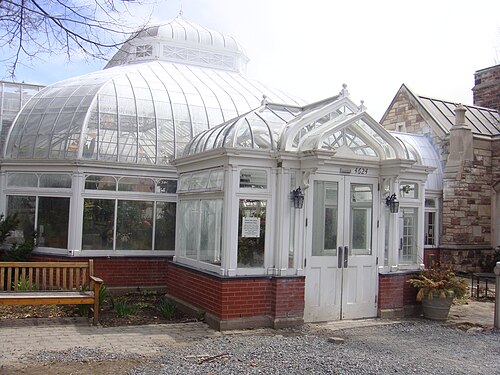
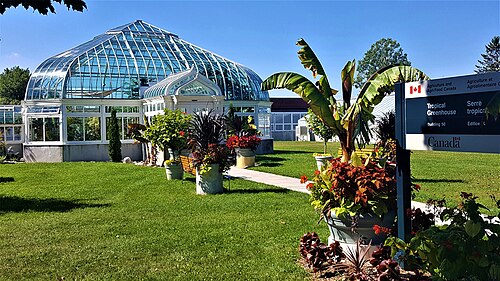
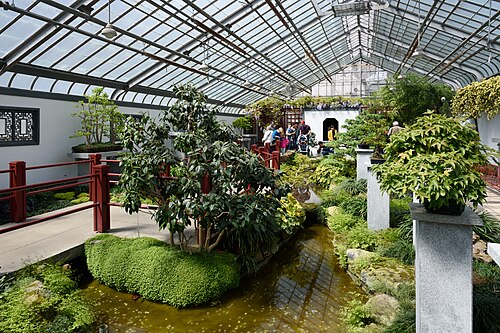
The heart of the building is a large climate-controlled greenhouse under a glass dome, covering about 1,022 square metres (11,000 sq ft). Some 180 metres of winding paths run between tall tropical plants, feeding stations and a waterfall that keeps the air as moist as a rainforest. Netting fixed along the inside of the glazing stops butterflies from sticking to the glass and dying of cold against it.
Around the display house the building contains a theatre, interpretive exhibits, laboratories and service greenhouses used for rearing butterflies and growing plants. The conservatory can handle up to 300 visitors an hour.
Plant collections
More than 2,000 butterflies, belonging to over 40 species, fly freely in the house, among them monarchs, blue morphos and several longwings. Because adult butterflies are short-lived, the population is constantly topped up with imports of up to 3,000 a month from butterfly farms in Costa Rica, El Salvador, the Philippines and Australia. Pupae hang behind an emergence window where visitors can watch butterflies break out and dry their wings. The planting, chosen to attract and feed them, is replaced every two to three weeks. Each year the Majestic Monarchs tag-and-release programme draws attention to the migration of the monarch, listed in Ontario as a species of special concern.
Visiting
The conservatory stands at 2565 Niagara Parkway, inside the 40-hectare Niagara Parks Botanical Gardens; the gardens are free to enter, while the conservatory charges admission. It is open all year and makes a warm tropical interlude in winter; arriving at least an hour before closing is advised. A visit extends naturally into the gardens, with their arboretum, a rose garden of more than 2,400 bushes, vegetable and herb gardens, tulips in spring and roses and peonies in summer.
43.14° N, 79.06° W
Greenhouses nearby
Architecture nearby
More greenhouses — Canada
Do you have a good photo of this greenhouse? Suggest it for this page →
Affiliate links — booking through Verrière helps fund our research, at no extra cost to you.