Orangeries of the Southern Federal University Botanical Garden (Oranzherei Botanicheskogo Sada YuFU)
Rostov-on-Don, Rostov Oblast
Entry updated on October 5, 2026
- Architect
- Unknown
- Style
- Pre-war glasshouses rebuilt after 1945, display house restored in 2017
- Dimensions
- 1,064 m² (four glasshouses)
- Status
- Open to the public (guided tours)
The Southern Federal University Botanical Garden, founded in 1927 in the Temernik valley, was the first botanical garden in the vast treeless zone of southern Russia. Its orangeries, built before the war, were destroyed together with their collections during the German occupation and later rebuilt. Four glasshouses covering 1,064 m² now hold about 1,000 species, varieties and forms from 85 families, from Africa, South-East Asia, the Americas, Australia and New Zealand. In 2017 the main display house received a new roof, new glazing and new heating.
Affiliate links — booking through Verrière helps fund our research, at no extra cost to you.
History
1 min
The idea of a botanical garden in Rostov first arose in 1915, when Warsaw University was evacuated there ahead of the German advance. Only in 1927, however, did the city allocate 74.11 hectares, at the initiative of professors V. F. Khmelevsky and V. N. Vershkovsky, for the garden of the North Caucasus University. Work began in 1929 and was largely complete by 1933, carried out entirely by hand with the help of thousands of residents. The first botanical garden in the huge treeless zone of southern Russia, it was meant to acclimatise plants from other parts of the world to the steppe, and by 1940 it held more than a thousand taxa.
The orangeries date from those pre-war years. During the German occupation they were destroyed together with the service buildings, and the glasshouse collections were lost entirely. Buildings and collections were rebuilt after the war.
In October 2017 local press reported that restoration of the main display house was complete, with visitors due back within a few weeks. The garden is now a teaching and research unit of the Southern Federal University and a protected natural area.
Architecture and engineering
1 min
The garden's original plan was based on a map of the North Caucasus: paths were to follow the outline of the region and its railway lines, with small squares standing for towns and stations. The orangery and hotbeds, like the service buildings, orchard and vineyard, lay outside this symbolic layout, in the working part of the estate.
Today's complex comprises four glasshouses with a total area of 1,064 m². The main display house was fully refurbished in 2017, with new heating pipes, a new roof, new glazing and tiled paths. The sources consulted give neither the dimensions of each house, nor the date of their post-war rebuilding, nor the names of their designers.
Plant collections
1 min
According to the city tourist office, the glasshouse collection, the largest of tropical and subtropical plants in southern Russia, brings together about 1,000 species, varieties, cultivars and forms from 85 families, native to Africa, South-East Asia, Central and South America, Australia and New Zealand; Wikipedia gives a figure of nearly 1,600 species and forms.
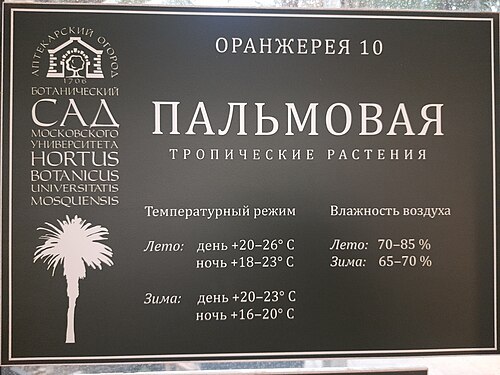
Visitors see many palms, including the date palm, cacti and succulents such as euphorbias, as well as agaves, ficus, bananas, bamboos, strawberry guava and bay laurel. Around thirty rare or endangered species are the subject of conservation work, and the houses are also used for student classes.
Visiting
1 min
The garden covers more than 160 hectares in north-western Rostov, in Zheleznodorozhny district along the Temernik river, with its entrance on Botanichesky Spusk lane. The glasshouses are seen on guided tours lasting up to an hour and a half, which combine the tropical collection with exotic trees in the arboretum and an insect collection.
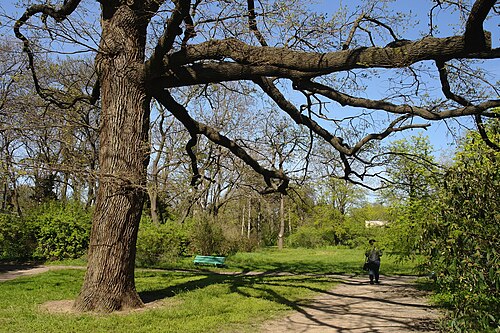
In the grounds, an oak growing since 1888 and the mineral spring dedicated to St Seraphim of Sarov, with its bathing font, are worth a detour; on 18 and 19 January the Epiphany immersions there draw large numbers of worshippers.
47.23° N, 39.66° E
Greenhouses nearby
More greenhouses — Russia
Do you have a good photo of this greenhouse? Suggest it for this page →