Greenhouse of the Botanical Garden Kralingen (De Kas)
Rotterdam, South Holland
No freely licensed photo of this greenhouse yet. Do you have one? Suggest it for this page →
Sources checked October 2026
- Year
- 2010 (replaces the garden's original greenhouse; garden created in 1912-1913)
- Style
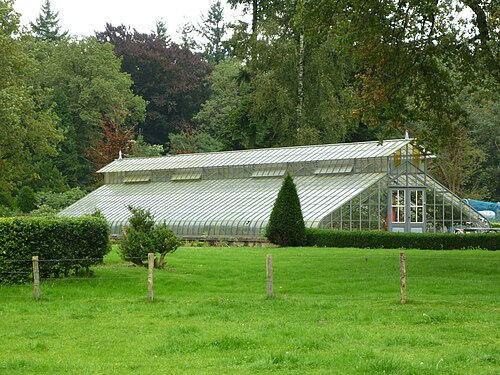
- Small heated gabled greenhouse, walls and roof of large clear panels in white frames, in a listed school garden
- Dimensions
- About 100 m² cadastral footprint; garden of 0.54 ha
- Status
- Open to the public with the garden (free admission, Tuesday to Friday); the back of the greenhouse is used to raise seedlings
Near the Kralingen lake in Rotterdam, the Botanical Garden Kralingen, a 0.54-hectare school garden created in 1912-1913 and listed as a national monument, has a small greenhouse opened in 2010 to replace the original one. It holds palms, a few cacti and carnivorous plants, educational crops (coffee, tea, cardamom, melon sage) and, in winter, the garden's potted citrus trees, which gives it the role of an orangery. The back is used to raise seedlings. The garden is free to enter from Tuesday to Friday.
Affiliate links — booking through Verrière helps fund our research, at no extra cost to you.
History
The Botanical Garden Kralingen owes its land to a bequest. In 1910 the Rotterdam shipping agent Willem Simon Burger gave the city the grounds of his country house on the Oudedijk, on condition that they be used for "some work of public utility". The garden was laid out for the neighbouring school, the 2nd HBS, later the Libanon Lyceum, which opened on 2 September 1913; the garden's website has it existing from 1912, while the Rotterdam heritage-day programme gives 1913. Several clues point to the school's architect, Marinus Jan Granpré Molière, as the designer.
From the start the garden had a greenhouse, donated by a biology teacher, Dr E. van Rijckevorsel, and a seed house (1914). The first gardener, Simon Bezemer, turned it into a small supply centre: some 135 schools regularly received seeds, more than 2,700 packets sent between February and October. Open to the public since 1984, the garden is a Rijksmonument (listed in 1996 according to the garden's website; entered in the national register on 11 February 1997), and the description cites "a small greenhouse (broeikas) and a wooden seed house".
The present greenhouse dates from 2010. After a long preparation, the old one was replaced by a new building, on the initiative of the garden's Friends foundation.
Architecture and engineering
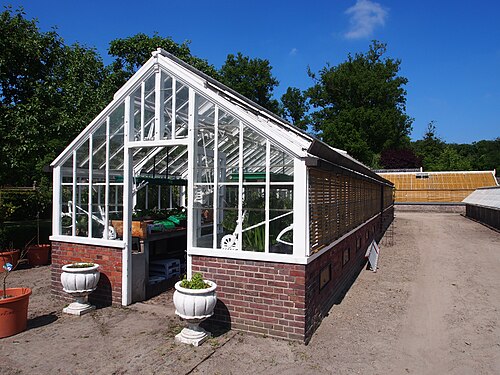
The greenhouse stands on the garden's small square, next to the seed house, where coffee and tea are served on event days ("het plein bij de kas"). In the photograph published by the garden's website it is a small gabled building whose walls and roof are made of large clear panels in white frames, with a glazed door on the entrance side; a broad-leaved plant can be seen through the sides. The cadastral footprint carried over to OpenStreetMap is about 100 m², about twelve metres in its longest dimension.
The greenhouse is heated ("verwarmde kas" on the Rotterdam parks website) and has a display part and a back part reserved for raising seedlings from seed, much used in spring. No architect, builder or official dimensions are given. The monument register, written before 2010, still describes the old greenhouse; today's one succeeds it.
Plant collections
The greenhouse serves three purposes. Plants shown for their educational interest: coffee, tea, cardamom, melon sage "and so on", according to the garden's website. Palms, a few cacti and carnivorous plants, which the website of Natuurstad, the garden's manager, lists as what can be seen there. And in winter the large potted plants that spend the summer in the garden, orange, mandarin and lemon trees, take shelter in it: the greenhouse then plays the role of an orangery. The back part is used to raise plants from seed.
Around it the 0.54-hectare garden holds more than 1,000 species (the Rotterdam heritage-day programme counts more than 1,200) of trees, shrubs and plants, in plots and themed gardens: a rose garden, a fern garden, a medicinal herb garden, and uncommon ferns on the boundary wall along Cederstraat. The garden exchanges seeds with botanical gardens around the world.
Visiting
The greenhouse is at the heart of a 0.54-hectare garden between the Kralingen lake and a residential district: an hour is enough to walk round it, and entry is free. Visitors pass the rose garden at the entrance, then the 1914 seed house and the greenhouse square. The garden organises guided tours (trees, fungi, insects), concerts and, in early June, the Hidden Gardens Days (6 and 7 June in 2026).
To complete the outing: the Kralingse Plas lake and the Kralingse Bos woodland, whose plan is also by Granpré Molière according to the garden's website. Access by tram 7 (Jericholaan stop) or metro line A (Gerdesiaweg).
51.93° N, 4.51° E
Greenhouses nearby
More greenhouses — Netherlands
Do you have a good photo of this greenhouse? Suggest it for this page →
Sources (8)
- botanischetuinkralingen.nl/kopie-van-kas-zadenhuis
- botanischetuinkralingen.nl/kopie-van-geschiedenis
- botanischetuinkralingen.nl/
- natuurstad.nl/botanische-tuin-kralingen
- omdrotterdam.nl/monument/botanische-tuin-kralingen/
- rotterdamseparken.nl/parken/botanische-tuin-kralingen/
- monumentenregister.cultureelerfgoed.nl/monumenten/506418
- nl.wikipedia.org/wiki/Botanische_Tuin_Rotterdam_Kralingen
Affiliate links — booking through Verrière helps fund our research, at no extra cost to you.