Castelvecchio Museum
Verona, Veneto
Sources checked November 2026
- Year
- 1958-1964
- Architect
- Carlo Scarpa
- Type
- Medieval castle turned museum (restoration and museum design by Carlo Scarpa)
- Access
- Open to the public Tuesday to Sunday (official website, November 2026)
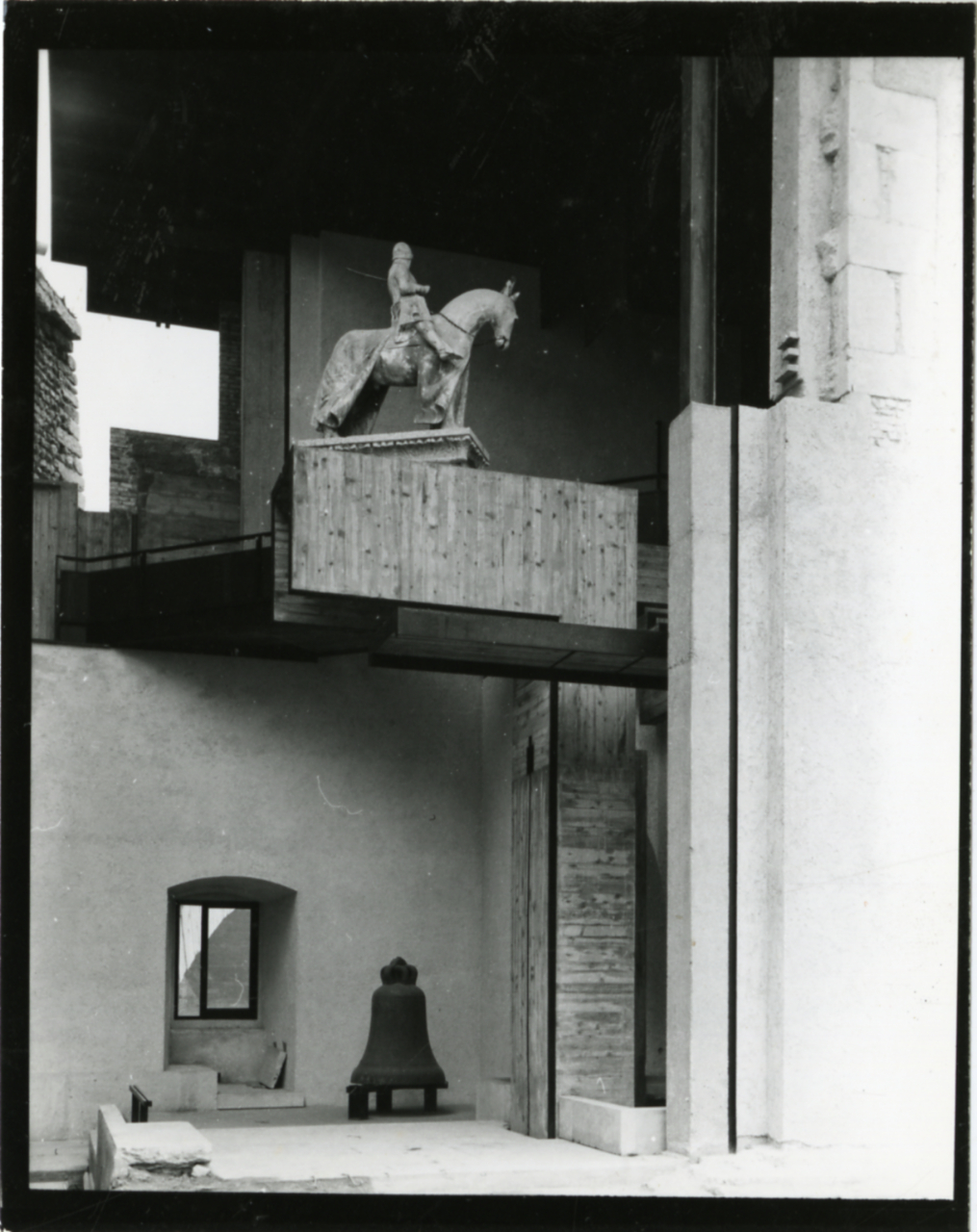
Built between 1354 and 1356 by Cangrande II della Scala, Verona's castle has been a museum since 1926. The restoration and new layout, promoted by the director Licisco Magagnato and carried out by Carlo Scarpa from 1958 to 1964, removed some of the arbitrary additions and set old stone and wood beside exposed concrete and coloured stucco. The equestrian statue of Cangrande I stands at the node of the complex, on a 7-metre concrete support.
Affiliate links — booking through Verrière helps fund our research, at no extra cost to you.
History
Cangrande II della Scala had the castle built between 1354 and 1356, after the conspiracy of his half-brother Fregnano, to command the Adige at the northern entrance to the city. It rests on older remains, among them the church of San Martino in Aquaro, whose remains can be seen in the parade ground, and a stretch of the 11th- and 12th-century city wall. To the east lies the parade ground, closed by crenellated walls and seven towers, including the 42-metre keep completed in 1376; to the west, the residential palace. A three-arched bridge joins it to the left bank of the Adige.
A barracks and then a powder store under the Republic of Venice, and a military academy in the 18th and 19th centuries, the castle lost the tops of its towers and its wall walks in the Napoleonic period, when the French built a small fort whose headquarters roughly matches today's Gallery wing. In 1923 the State handed the use of the site to the city of Verona. From 1924 to 1926 Ferdinando Forlati, then a young architect with the heritage office, put it back in order: towers raised again, crenellations reinstated, façades transformed, interiors decorated "in style" as medieval or Renaissance rooms. The museum opened on 25 April 1926 in rooms meant to evoke old houses, filled with period furniture; the equestrian statue of Cangrande I, removed from the Scaliger Tombs in 1909, was set in the palace courtyard, where it could be seen only from the front. After the war the superintendent of monuments Piero Gazzola had the bridge rebuilt (1949-1951), blown up by the Germans in 1945, along with the wing of the Sala Boggian (1948-1951).
Licisco Magagnato, head of Verona's museums from 1956, wanted the renewal of Castelvecchio to go to an architect who specialised in museums, and chose Carlo Scarpa, who had already arranged the Gallerie dell'Accademia and the Museo Correr in Venice, Palazzo Abatellis in Palermo and the Possagno gypsotheca. It all began in 1958 with the exhibition "Da Altichiero a Pisanello", set up in the palace wing. The restoration and new layout, promoted by Magagnato and carried out by Scarpa, ran from 1958 to 1964, the year the new museum opened; further campaigns followed until the mid-1970s. After Scarpa's death in 1978, Arrigo Rudi, his chief collaborator at Castelvecchio, completed the Arms room (1989) and the section of Lombard finds.
Architecture
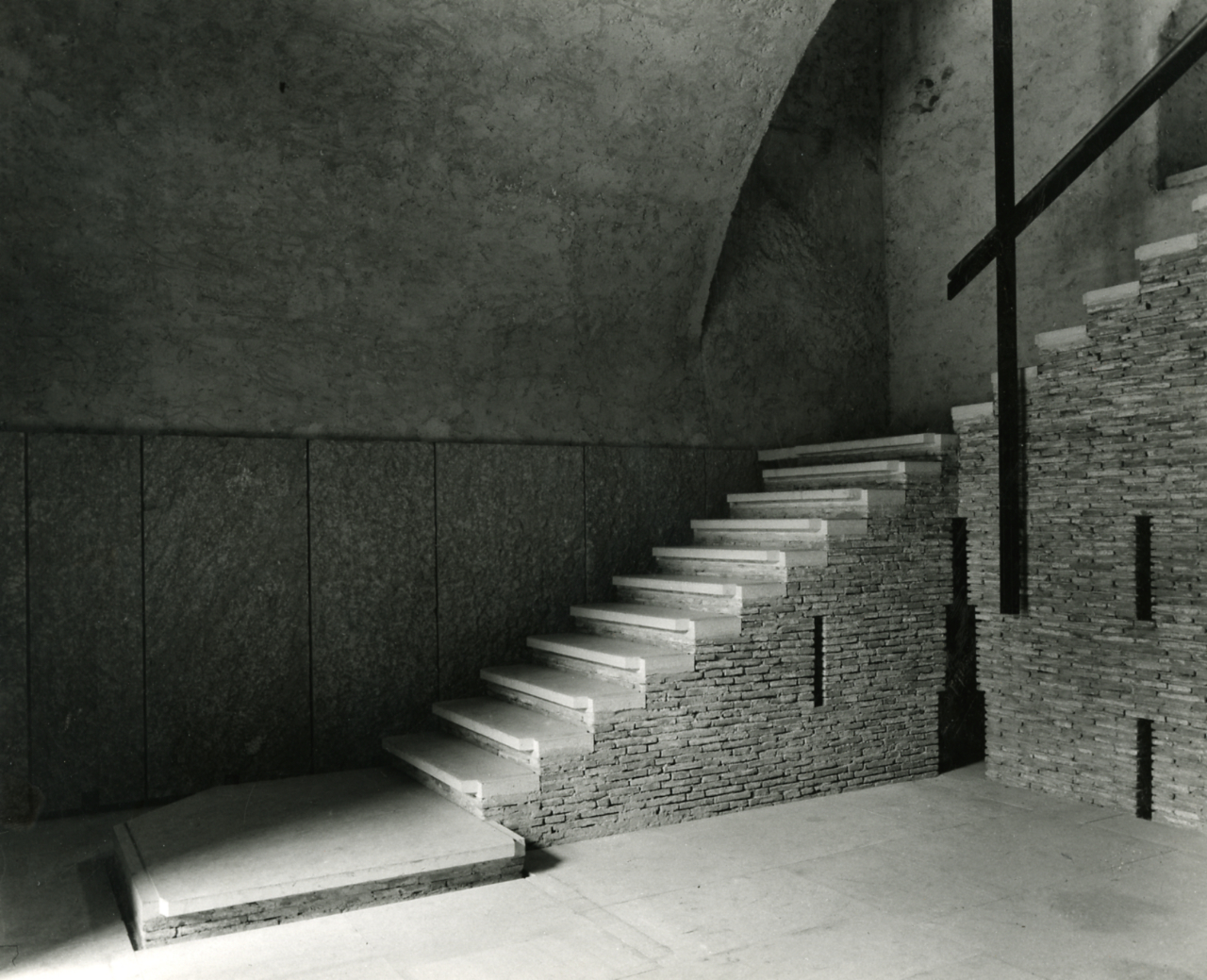
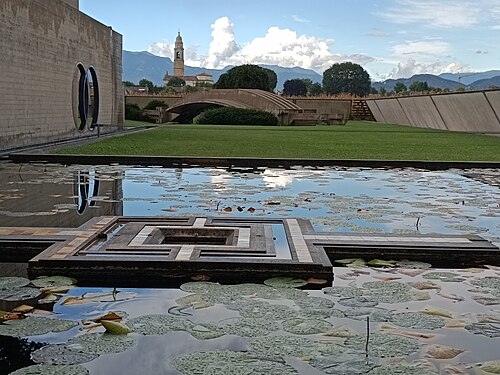
Scarpa identified the arbitrary additions and pulled some of them down to reveal the original fabric, which openings cut in the floor or sections make legible. He laid out a single continuous route, broken by outdoor passages, and set old stone and wood beside concrete left exposed or bush-hammered and coloured stucco.
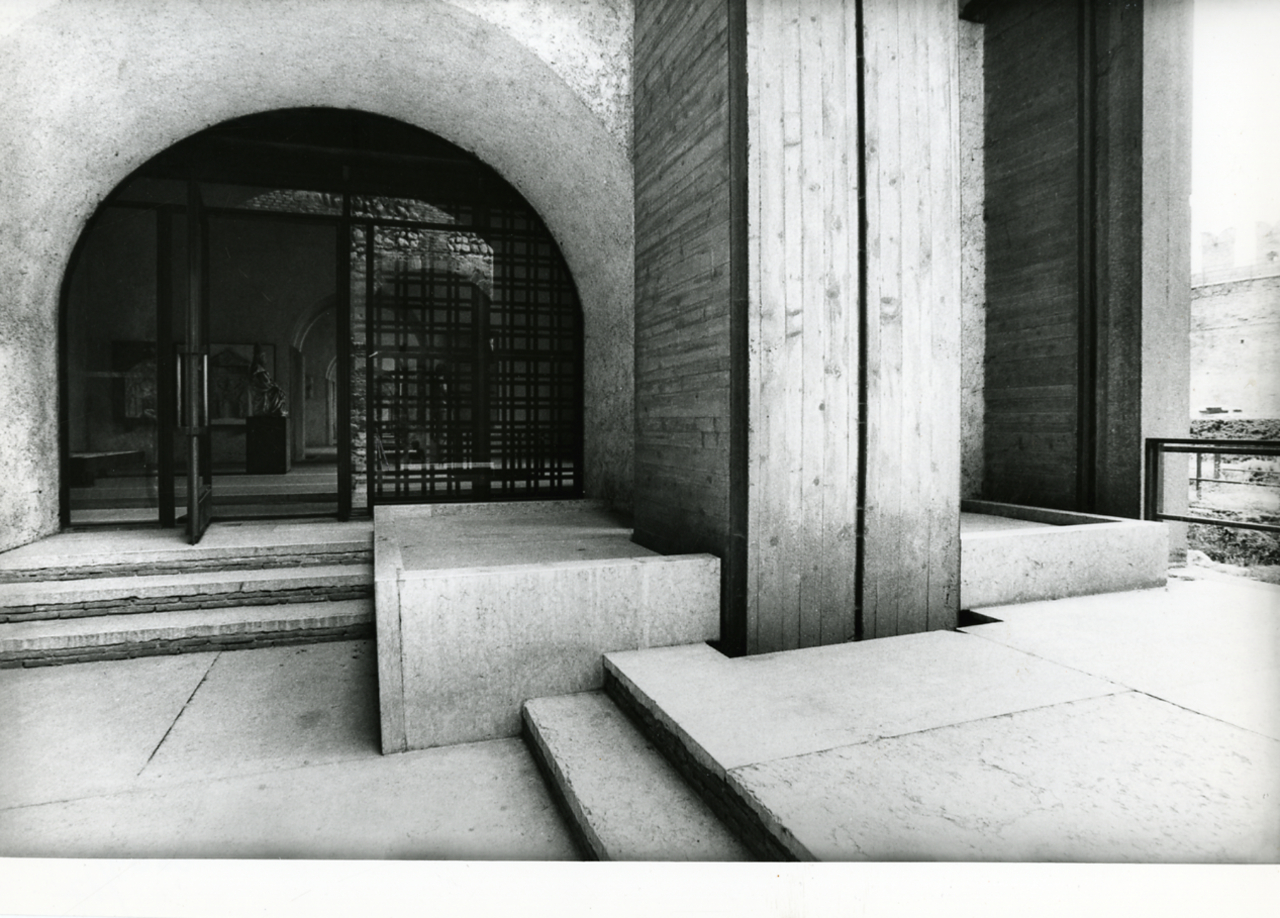
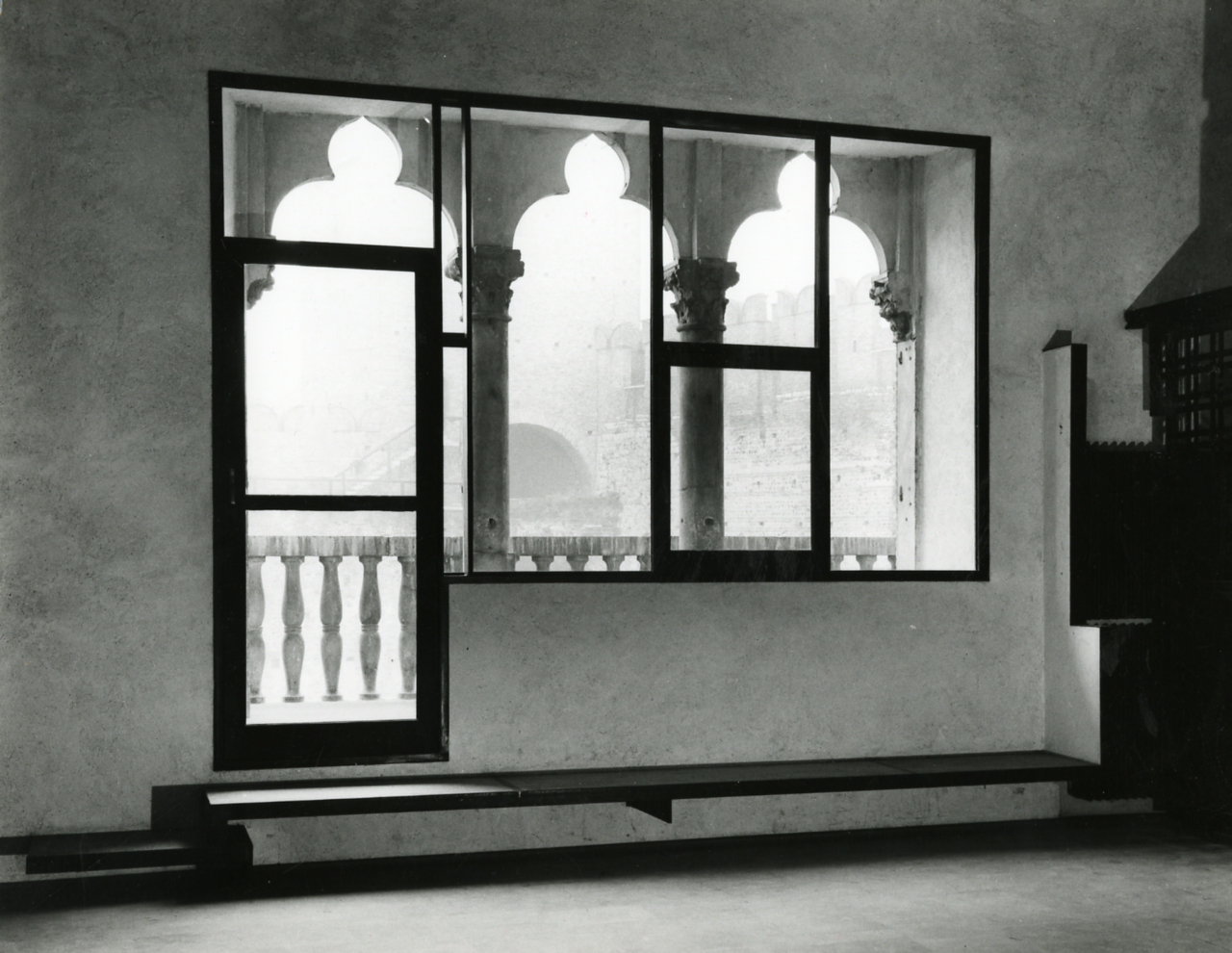
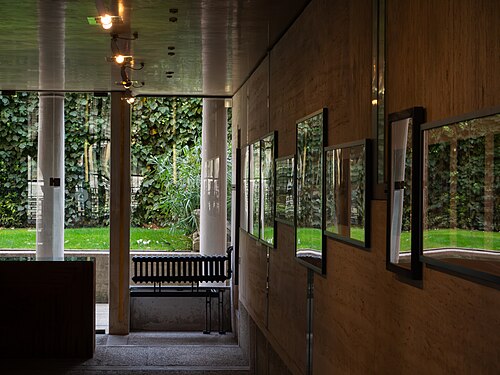
The garden, his last piece of work before the 1964 opening, leads to the entrance along a path of Prun stone between two geometric pools. Despite his strong reservations about the 1920s restoration ("At Castelvecchio everything was false," he said in a lecture), Scarpa kept the façade largely as it was: he partly filled the pointed arches of the ground floor with black lime, set in them frames of iron and burnt wood, and fitted into the second large arch the Sacello, a treasure room faced with a mosaic of pink, red and white Prun stone.
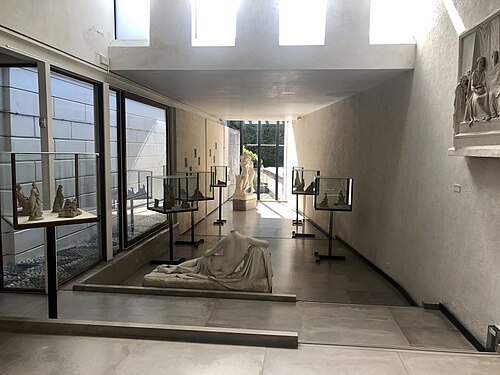
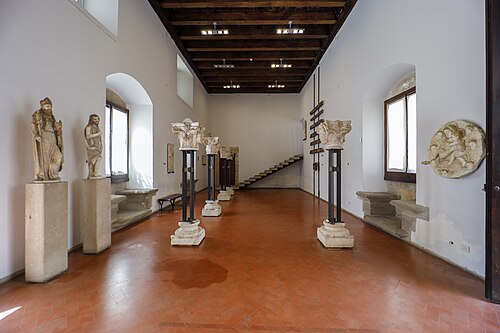
In the sculpture gallery, five rooms in a row, the statues of the Master of Sant'Anastasia rise from coloured plates that float on the concrete floors, in the light of the Gothic windows; two coloured walls, one red and the other grey-blue, pay tribute to Mondrian.
The equestrian statue of Cangrande I found its place where the museum routes meet those of the city, astride the medieval wall, in a space won from the last bay of the Napoleonic fort. Its 7-metre concrete support recalls the height of the spire above the side portal of Santa Maria Antica, conceived in the 14th century to hold it. Walkways and stairs bring the visitor closer by stages, from below and then from above, as far as a swaying platform from which it can almost be touched.
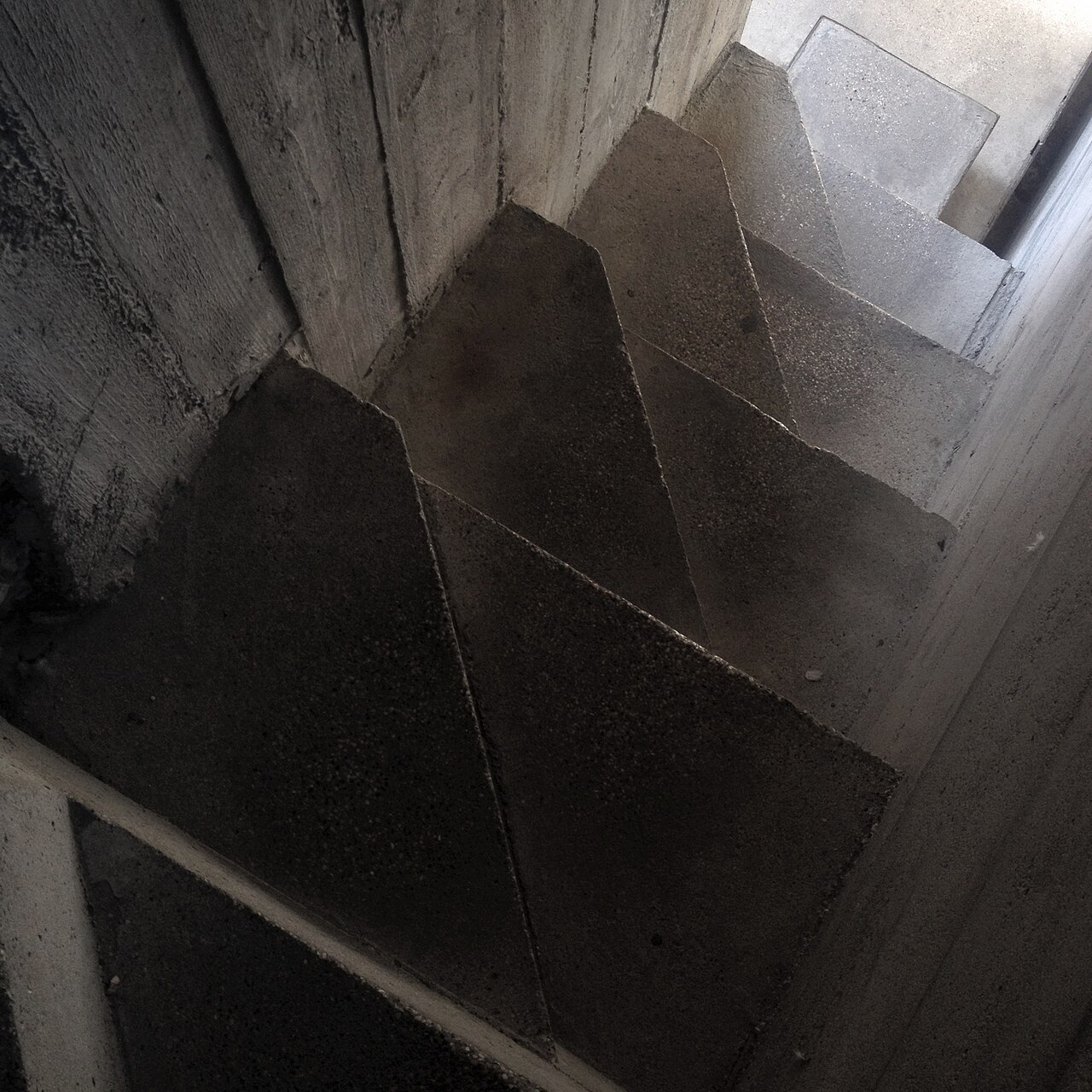
Two suspended walkways link the keep, where Scarpa built a staircase of brick and stone, to the palace. There he removed the false decoration of the 1920s to bring out the original fresco fragments, kept the wooden ceilings and gave each kind of work its own support: tufa brackets for the Gothic polyptychs, easels and weighted iron rods for the Madonnas of Pisanello and Stefano, "box" frames lined with a fabric matched to the painting.
In the picture gallery, the former 19th-century barracks, Scarpa felt less bound by what was there: he removed the 16th-century doors fitted in the previous arrangement and turned the cross walls into offset partitions with ends cut at 45 degrees, opening the view down a corridor lined with arrow slits onto the Adige. The floors are Impruneta terracotta; the false ceilings are dark grey, black or cobalt-blue stucco.
Use today
The museum shows medieval, Renaissance and early modern art up to the 18th century: paintings, sculpture, archaeological pieces and arms, with cabinets of coins and medals, drawings and prints. The route runs from the Gothic sculpture of the Master of Sant'Anastasia and the painting of the Scaliger court, with Turone and Altichiero, to Pisanello, Giovanni Bellini, Veronese, Tintoretto and the Tiepolos. The wall walks of the parade ground are part of the visit.
The museum also holds Scarpa's drawings for the project, 657 sheets that can be viewed online.
Visiting
The museum is open Tuesday to Sunday; it is closed on Mondays and, as a rule, on 25 December and 1 January. Tickets are sold online or at the museum's ticket office.
The museum is only partly accessible to visitors with reduced mobility: the lift serves only the picture gallery, and a wheelchair can be borrowed at the ticket office on request. It stands at Corso Castelvecchio 2, in Verona's historic centre.
Photos
45.44° N, 10.99° E
Greenhouses nearby
Architecture nearby
By the same architect
Sources (22)
- museodicastelvecchio.comune.verona.it/nqcontent.cfm?a_id=43066
- museodicastelvecchio.comune.verona.it/nqcontent.cfm?a_id=43074
- museodicastelvecchio.comune.verona.it/nqcontent.cfm?a_id=43067
- museodicastelvecchio.comune.verona.it/nqcontent.cfm?a_id=98495
- museodicastelvecchio.comune.verona.it/nqcontent.cfm?a_id=43073
- museodicastelvecchio.comune.verona.it/nqcontent.cfm?a_id=44455
- treccani.it/enciclopedia/carlo-scarpa_%28Dizionario-Biografico%29/
- museodicastelvecchio.comune.verona.it/nqcontent.cfm?a_id=42557
- museodicastelvecchio.comune.verona.it/nqcontent.cfm?a_id=42555
- museodicastelvecchio.comune.verona.it/nqcontent.cfm?a_id=43069
- museodicastelvecchio.comune.verona.it/nqcontent.cfm?a_id=43071
- museodicastelvecchio.comune.verona.it/nqcontent.cfm?a_id=43070
- museodicastelvecchio.comune.verona.it/nqcontent.cfm?a_id=43076
- museodicastelvecchio.comune.verona.it/nqcontent.cfm?a_id=42971
- museodicastelvecchio.comune.verona.it/nqcontent.cfm?a_id=42561
- museodicastelvecchio.comune.verona.it/nqcontent.cfm?a_id=95949
- museodicastelvecchio.comune.verona.it/nqcontent.cfm?a_id=42758
- museodicastelvecchio.comune.verona.it/nqcontent.cfm?a_id=42545
- museodicastelvecchio.comune.verona.it/nqcontent.cfm?a_id=42756
- museodicastelvecchio.comune.verona.it/nqcontent.cfm?a_id=44455&lang=en
- archiviocarloscarpa.it/carlo-scarpa-a-castelvecchio/
- archiviocarloscarpa.it/en/carlo-scarpa-at-castelvecchio/
Affiliate links — booking through Verrière helps fund our research, at no extra cost to you.