Oasi Rossi Butterfly House (Casa delle farfalle)
Santorso (Province of Vicenza), Veneto
Entry updated on October 5, 2026
- Year
- 2005
- Architect
- Unknown
- Style
- Climate-controlled tropical greenhouse with free-flying butterflies
- Dimensions
- Over 1,200 m²
- Status
- Open to the public in season (March to October)
At the foot of Monte Summano, on the former estate bought in 1865 by the industrialist Alessandro Rossi, whose park was laid out by Antonio Caregaro Negrin, a social cooperative has run the Oasi Rossi since the 1990s. Its butterfly house began in 1998 with a project called 'Voglia di volare' and was rebuilt in 2005 as a climate-controlled greenhouse of more than 1,200 m², kept between 25 and 32 °C, where butterflies from Asia, Africa and Latin America fly freely among birds, koi carp and tropical vegetation.
Affiliate links — booking through Verrière helps fund our research, at no extra cost to you.
History
1 min
The Santorso estate entered the industrial history of the Veneto in 1865, when the entrepreneur Alessandro Rossi bought it; it then comprised the villa, the park and a 'podere modello', or model farm. For some twenty years, from 1865 to 1884, the architect Antonio Caregaro Negrin, Rossi's trusted designer for many commissions in Schio and the upper Vicenza area, remodelled the house and laid out the park.
After Rossi's death the villa became an orphanage and the property was broken up, the estate passing to the charitable institutions of Schio. The park lay abandoned until 1995. A year earlier, an agreement had placed it in the hands of the Nuovi Orizzonti cooperative, founded in 1980 by a group of parents to help people with disabilities into work and community life, and the park then reopened to the public; it is now known as the Oasi Rossi.
The butterfly house began in 1998 with the 'Voglia di volare' project, which created a tropical oasis for hundreds of butterflies from around the world. In 2005 a new greenhouse replaced it; Italian Wikipedia calls it the largest area in Italy devoted to butterflies, while the official site more cautiously describes it as one of the most extensive in the country. In 2016 an educational trail was developed with the Farfalle nella Testa cooperative, which supplies the scientific material. The villa itself was bought in 2002 by the municipalities of Santorso and Schio.
Architecture and engineering
1 min
The butterfly house is a climate-controlled greenhouse of more than 1,200 m², designed so that the insects fly freely around visitors rather than behind glass cases. Purpose-built features and equipment reproduce the conditions of a tropical rainforest: the temperature ranges between 25 and 32 °C and humidity stays above 70 per cent. To power this artificial climate, the operator has invested in photovoltaic panels and new low-impact systems. Neither the designer nor details of the structure have been published.
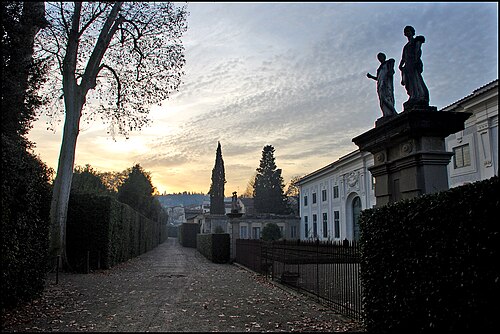
The greenhouse stands in a park that the official site puts at more than 100,000 m². The neighbouring historic garden of Villa Rossi, about 4.4 hectares, is split into two sectors, the 'Rive' and the 'Laghetto', on either side of the road to Lesina; there Caregaro Negrin brought together the devices of the nineteenth-century landscape garden: winding paths, rustic follies, imitation antique ruins, water features, small lakes, lawns and massed trees.
Plant collections
1 min
The greenhouse holds some of the most striking butterfly species in the world, from Malaysia, Uganda, the Philippines, Ecuador and Costa Rica. They arrive as chrysalises, so visitors can follow the whole life cycle: eggs, caterpillars, pupation and finally the emergence of the adult. According to Italian Wikipedia, both day-flying butterflies and moths are kept.
The butterflies share the space with a few species of plant-eating birds, other insects and koi carp, amid dense vegetation typical of a tropical climate. Next to the greenhouse, an insect exhibition shows specimens in display cases.
Visiting
1 min
The greenhouse lies within the Oasi Rossi in Santorso, on the slopes of Monte Summano in the upper Vicenza area. The park opens from March to October; since the greenhouse stays warm throughout the season, cool spring or autumn days suit a visit as well as summer. Allow time to watch the different stages of the butterflies' life cycle and the adjoining insect exhibition, then to walk through the park.
A visit continues naturally into the landscape garden of Villa Rossi, designed by Caregaro Negrin, and can be extended to Schio, the Rossi family's industrial town, where the architect also worked. Run by a social cooperative, the site has a strong educational role, with trails designed for school groups.
45.74° N, 11.39° E
Greenhouses nearby
More greenhouses — Italy
Do you have a good photo of this greenhouse? Suggest it for this page →