Brion Memorial (Brion Tomb)
San Vito d'Altivole, province of Treviso
Sources checked November 2026
- Year
- 1969-1978
- Architect
- Carlo Scarpa
- Type
- Funerary complex (walled garden, concrete, water)
- Access
- Open to the public, free entry outside guided tours (FAI website, November 2026)
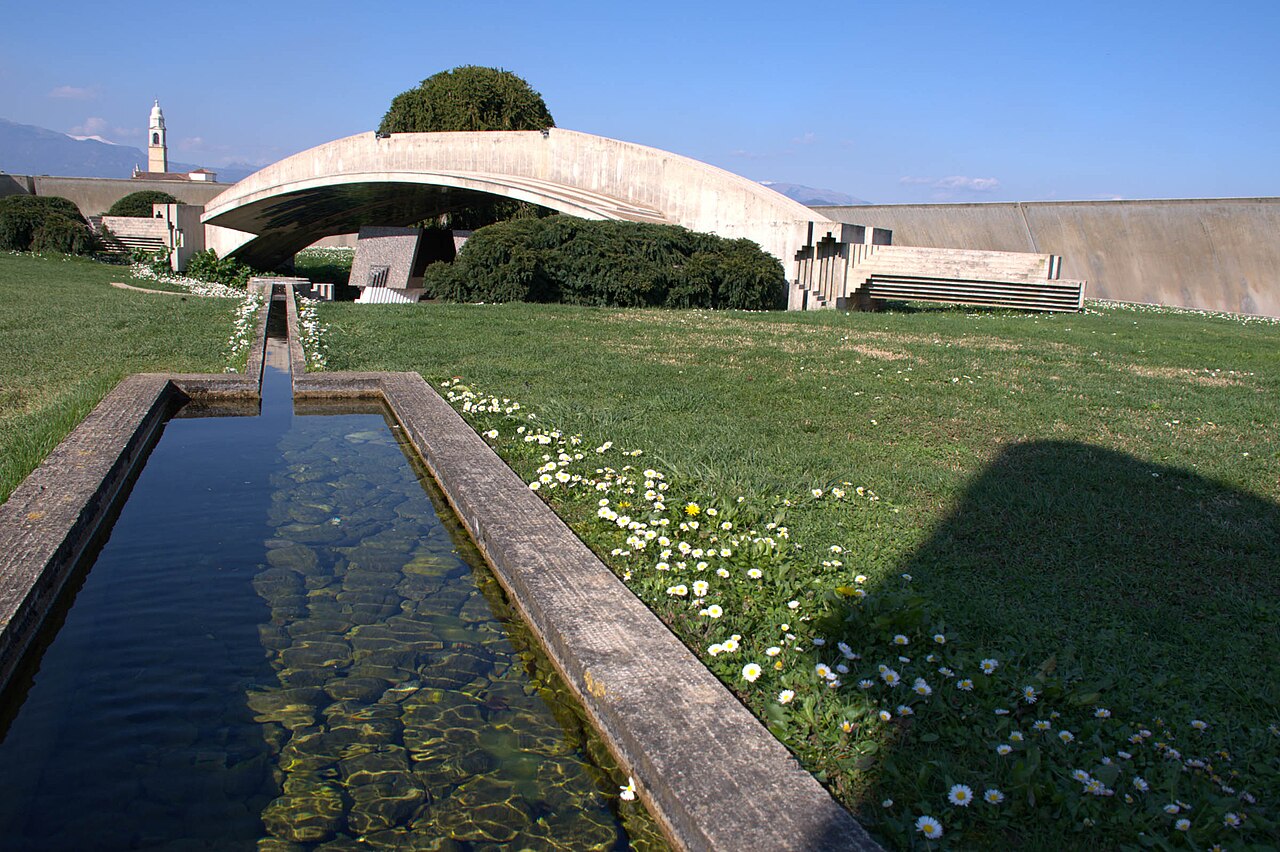
This funerary complex lies on the edge of the cemetery of San Vito d'Altivole, in the countryside of the Treviso area. Carlo Scarpa designed it for Onorina Tomasin in memory of her husband Giuseppe Brion, founder of Brionvega; commissioned in 1969 and built from 1970 to 1978, it was completed after the architect's death from his drawings. A garden enclosed by sloping walls, channels, lily basins and an arch-bridge of golden mosaic make up the site. Donated to the FAI in 2022, it can be visited today.
Affiliate links — booking through Verrière helps fund our research, at no extra cost to you.
History
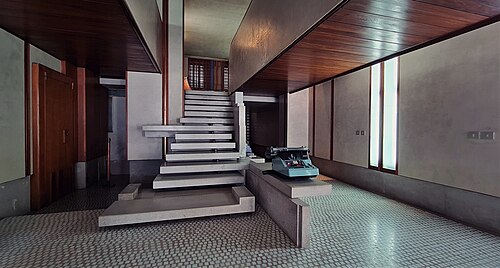
Giuseppe Brion, born in San Vito d'Altivole, had founded Brionvega, a maker of designer electronics. After his death, his widow Onorina Tomasin asked Carlo Scarpa to design a funerary complex next to the village cemetery. The plot first planned for the family chapel measured only 68 square metres. A rapport with the architect, encouraged by the enthusiasm of their son Ennio, whose admiration for Scarpa had been sparked by a visit to the Olivetti shop on Piazza San Marco in Venice, led the project to grow into the complex seen today.
Construction ran from 1970 to 1978, the year Scarpa died in Japan. The work was completed from his highly detailed drawings, now held by the MAXXI in Rome. Scarpa had wished to be buried at San Vito d'Altivole, in a strip of "no man's land" between the old cemetery and the Brion tomb; his tomb, which also holds his wife Nini Lazzari, was designed by their son Tobia, an architect like his father, with Fabio Lombardo. Scarpa said it was the only one of his works that he went to see with pleasure.
Sturdy in appearance, the complex is sensitive to the weather in its woodwork, lime plasters and mosaics, and in its reinforced-concrete elements, whose steel bars lie almost at the surface. A full conservation restoration, carried out scientifically from the archive documentation, took three years and was completed in 2021. Commissioned by Ennio Brion, it was directed by the architect Guido Pietropoli, who had worked with Scarpa on the memorial's construction. Ennio and Donatella Brion then donated the memorial to the FAI in 2022, and it became the foundation's seventieth property.
Architecture
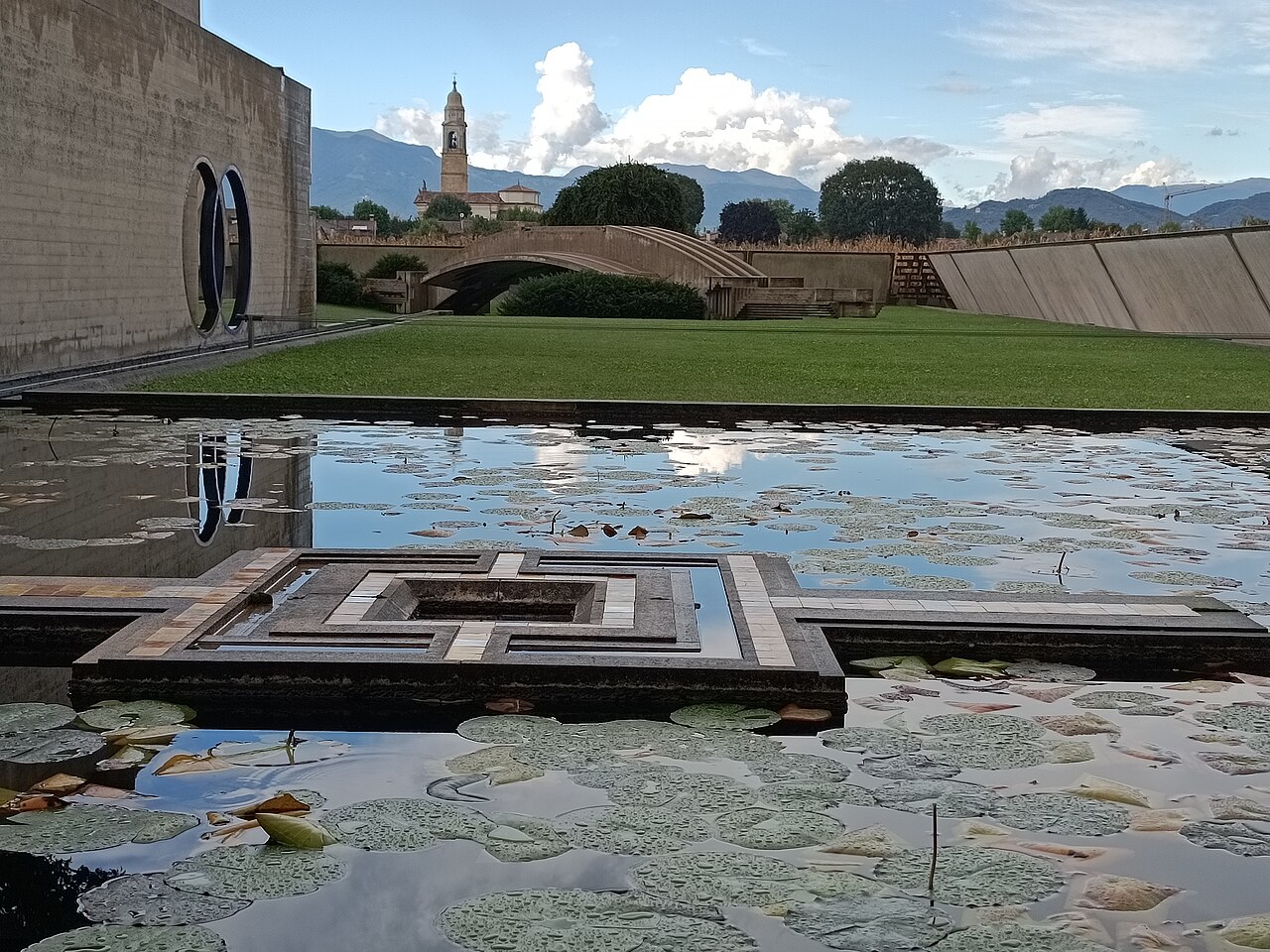
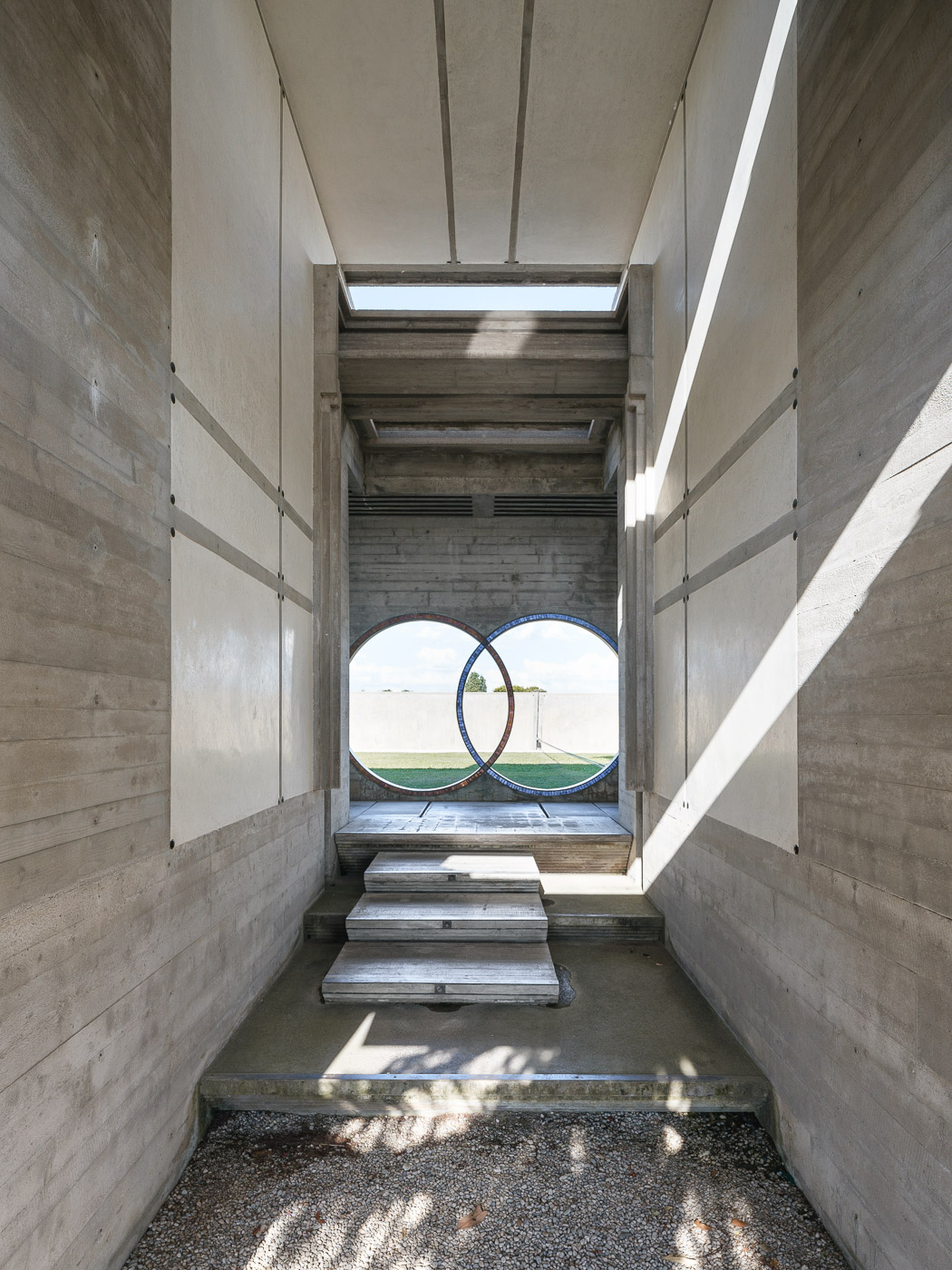
The complex is a 2,200 square metre funerary garden, raised above the surrounding fields and enclosed by sloping walls that leave the Asolo hills in view. It adjoins the small cemetery of San Vito d'Altivole, from which visitors enter through the propylaea, a monumental entrance with an opening shaped like two interlocking circles, which evoke married love, the central theme of the work.
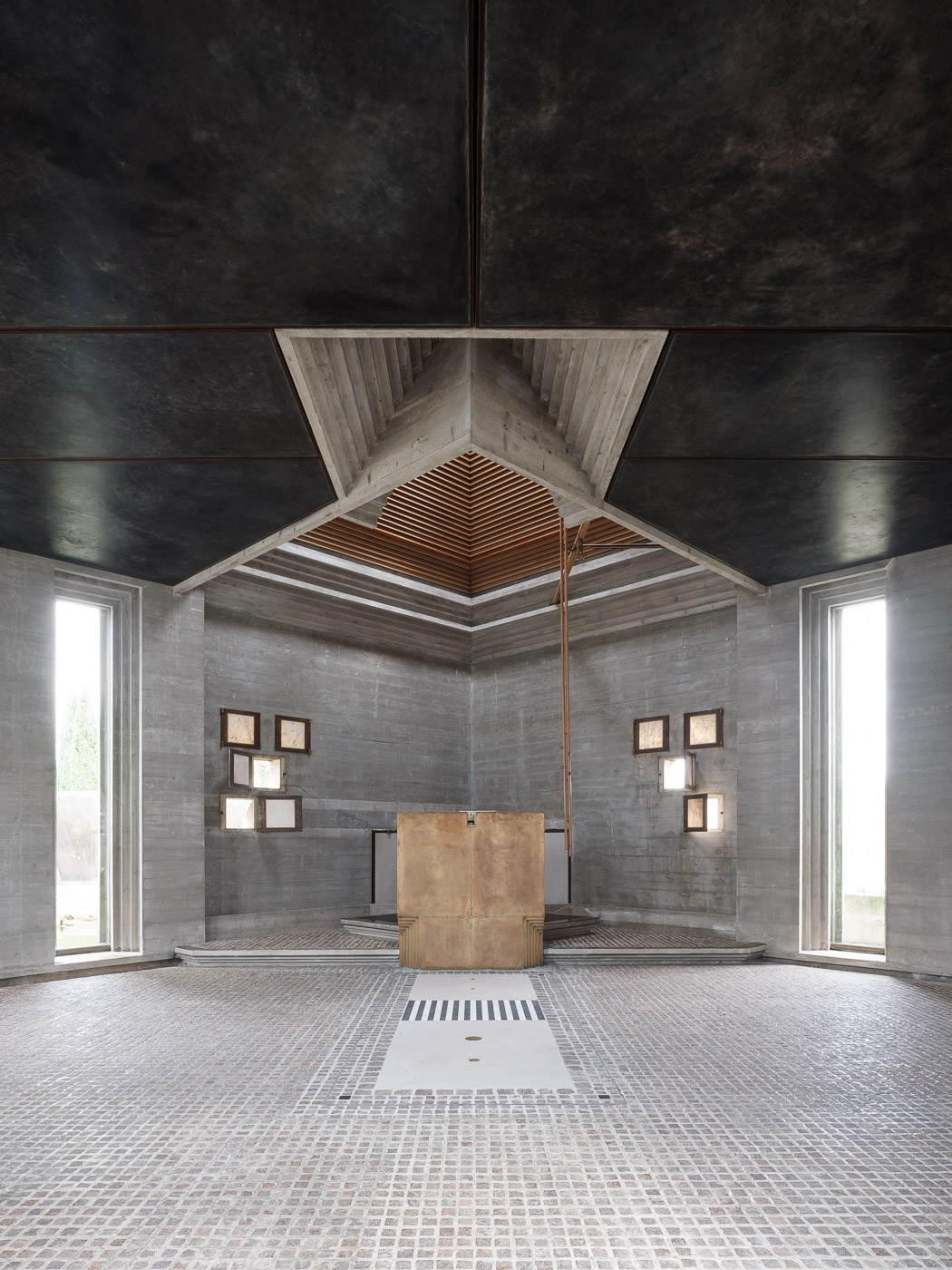
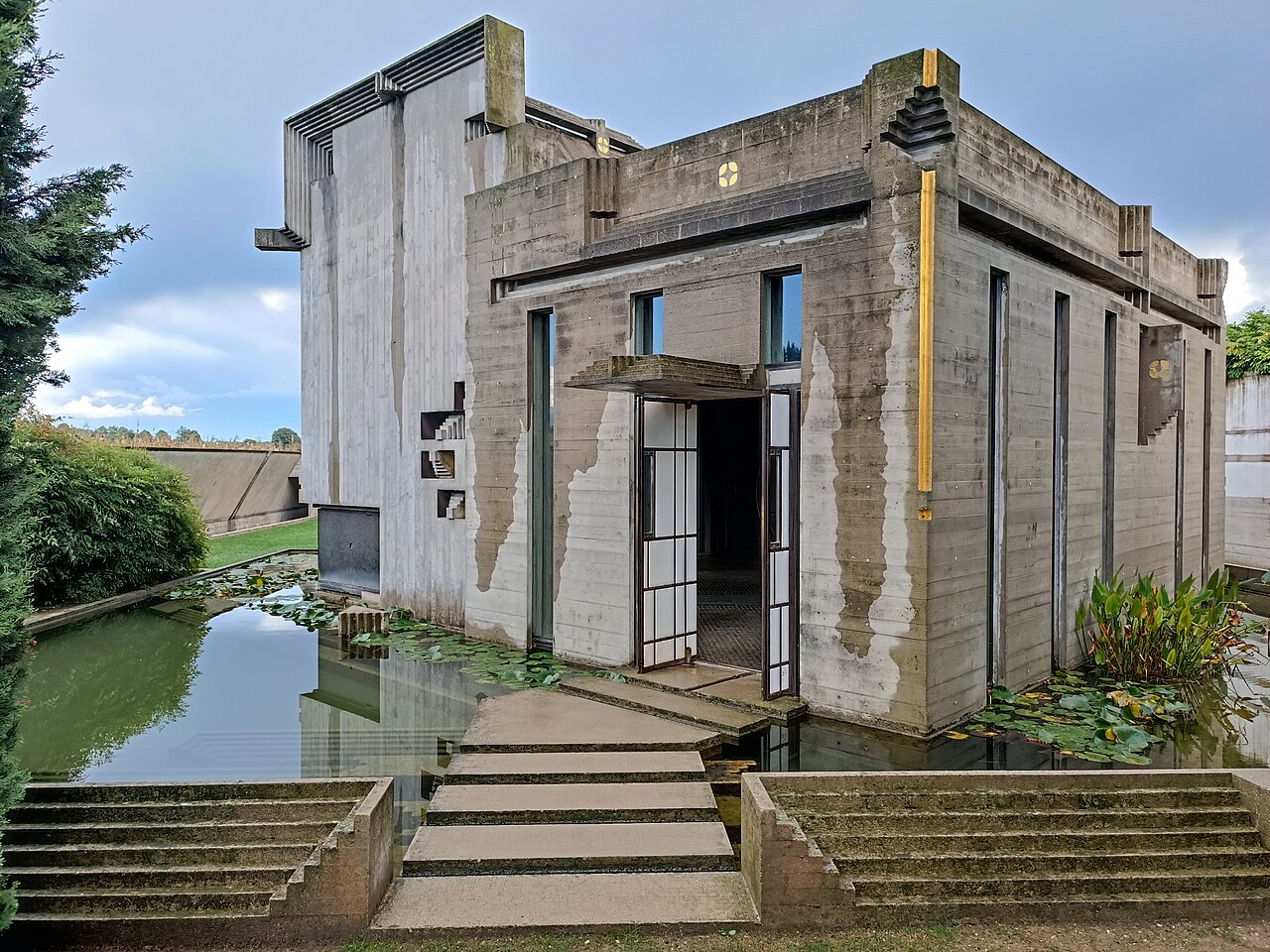
At the heart of the garden, the arcosolium is a shallow concrete arch-bridge whose inside is clad in a gleaming skin of glass tesserae laid over gold leaf. It shelters the inclined sarcophagi of Giuseppe and Onorina Brion, as if leaning toward each other. Around it, lawns cut by channels and lily basins form geometric shapes that recall Japanese gardens and Islamic paradises. On one side the meditation pavilion stands isolated on the water, placed deliberately within sight of the arcosolium; on the other are the small structure holding relatives' tombs and the chapel, surrounded by water and a cypress garden.
Concrete is the thread running through the project, and water is the other: it gushes, pools, drips and gathers in small puddles. Scarpa himself named five elements, linked by paths and by the perimeter wall, in Memoriae causa (1977), the photographic book devoted to the work: the propylaea, the meditation pavilion, the arcosolium, the small structure for relatives' tombs and the chapel. The complex gathers forms, materials and combinations of light and space that the architect had used throughout his career.
Use today
The memorial remains a family cemetery, which Scarpa conceived as a garden open to everyone and a place for meditation. The FAI looks after its upkeep and management. Guido Guidi took photographs there for ten years, in every season and at every hour of the day, and Denis Villeneuve shot a few scenes of the Dune sequel there.
Visiting
The memorial usually opens from Wednesday through Sunday; without a guided tour, entry is free on opening days. Guided tours are by reservation, as are group visits, with or without a guide.
The visit takes place outdoors, and its many steps make the route very difficult in a wheelchair.
Photos
45.75° N, 11.91° E
Greenhouses nearby
Architecture nearby
By the same architect
Sources (5)
- fondoambiente.it/luoghi/memoriale-brion
- fondoambiente.it/memoriale-brion-eng/
- fondoambiente.it/news/la-donazione-al-fai-del-memoriale-brion-capolavoro-di-carlo-scarpa
- fondoambiente.it/news/il-memoriale-brion-monumento-allamore-di-fulvio-irace
- treccani.it/enciclopedia/carlo-scarpa_%28Dizionario-Biografico%29/
Affiliate links — booking through Verrière helps fund our research, at no extra cost to you.