Herz Jesu Church, Schildgen
Bergisch Gladbach (Schildgen)
Sources checked November 2026
- Year
- 1959-1960
- Architect
- Gottfried Böhm
- Type
- Catholic parish church (protected monument)
- Access
- Parish church in use, with Mass on Sundays and weekdays (parish group website, November 2026)
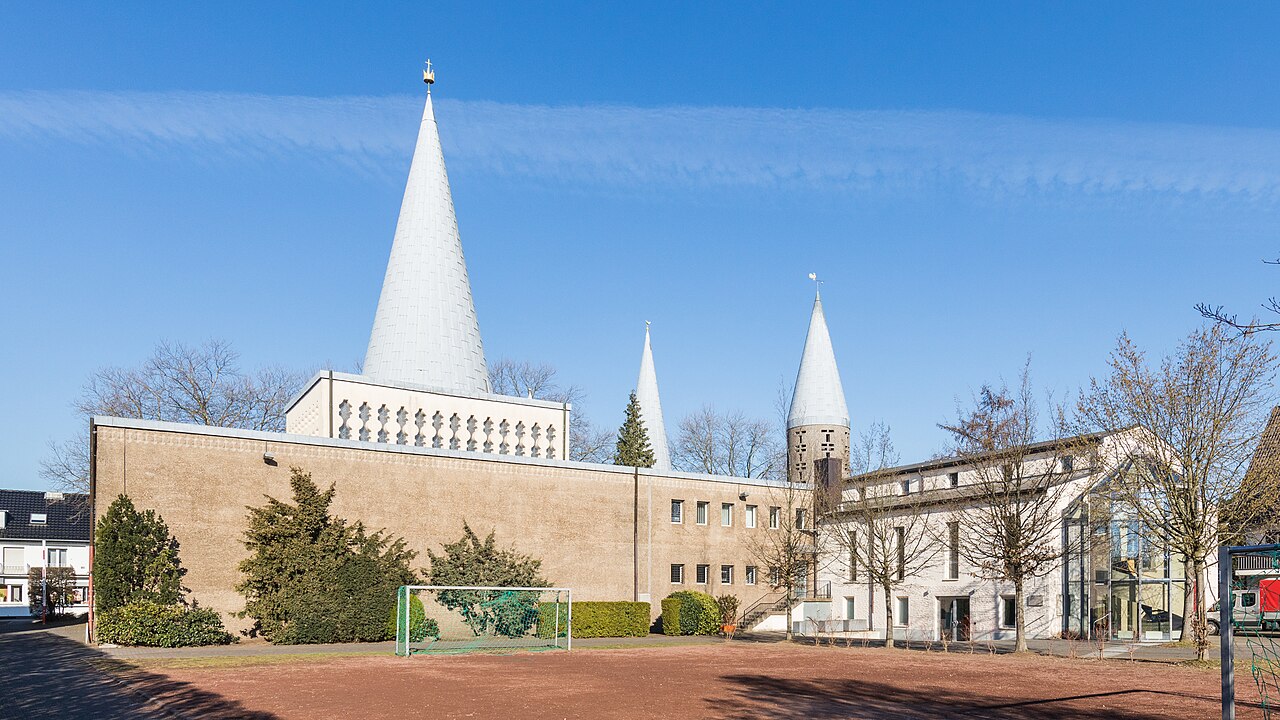
Gottfried Böhm designed this parish complex in Schildgen, Bergisch Gladbach, built in 1959-1960 beside a busy road. A five-metre concrete wall screens it from the street; behind it come a courtyard, a bright atrium and the nave, beneath cone-topped towers that mark the main places of the liturgy. Part of the old church is now the parish hall.
Affiliate links — booking through Verrière helps fund our research, at no extra cost to you.
History
Schildgen's first church was fitted out in 1928-1929 in a former factory hall of an explosives works. This basilica-type building, with a twin-towered west front, became too small, and the parish had a new church built south-west of the old one, along the Altenberger-Dom-Straße, the busy road from Cologne to Odenthal.
The design was entrusted to Gottfried Böhm, who had just taken over his father Dominikus's practice. The parish complex was built in 1959 and 1960; part of the old church was kept and is now the parish hall, while its twin-towered front was pulled down during the 1960 works.
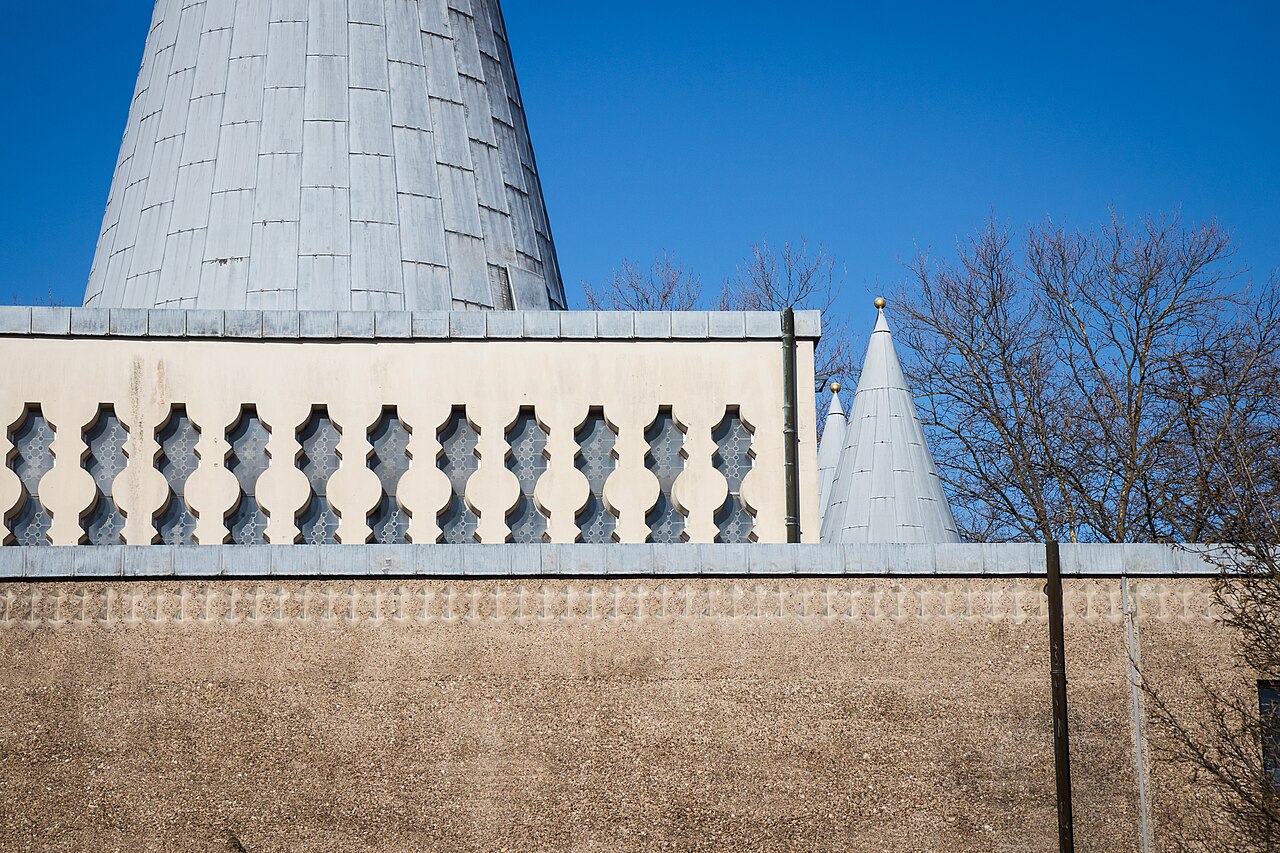
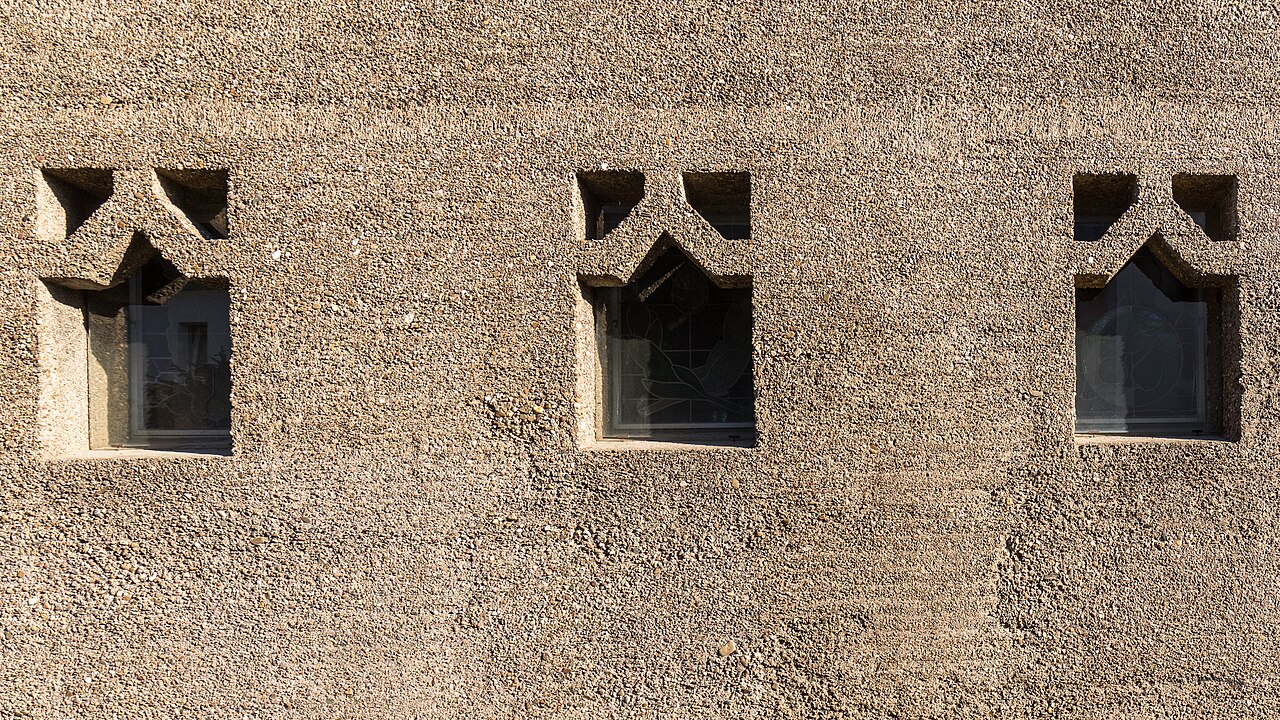
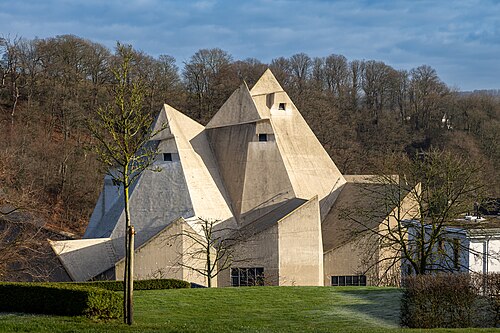
Originally the conical caps of the towers were fair-faced concrete like everything else: Böhm wanted the building to present a unified, almost monolithic image to the outside. Damage to the concrete of the caps led to extensive repairs; since then the cones have been clad in lead and stand out clearly from the rest of the building. The altar platform was reworked from 1969 onwards, after the liturgical reform of the Second Vatican Council, and no longer follows Böhm's plans; the altar table, the ambo and the altar cross are by Wilhelm Wefers. The church is a protected monument.
Architecture
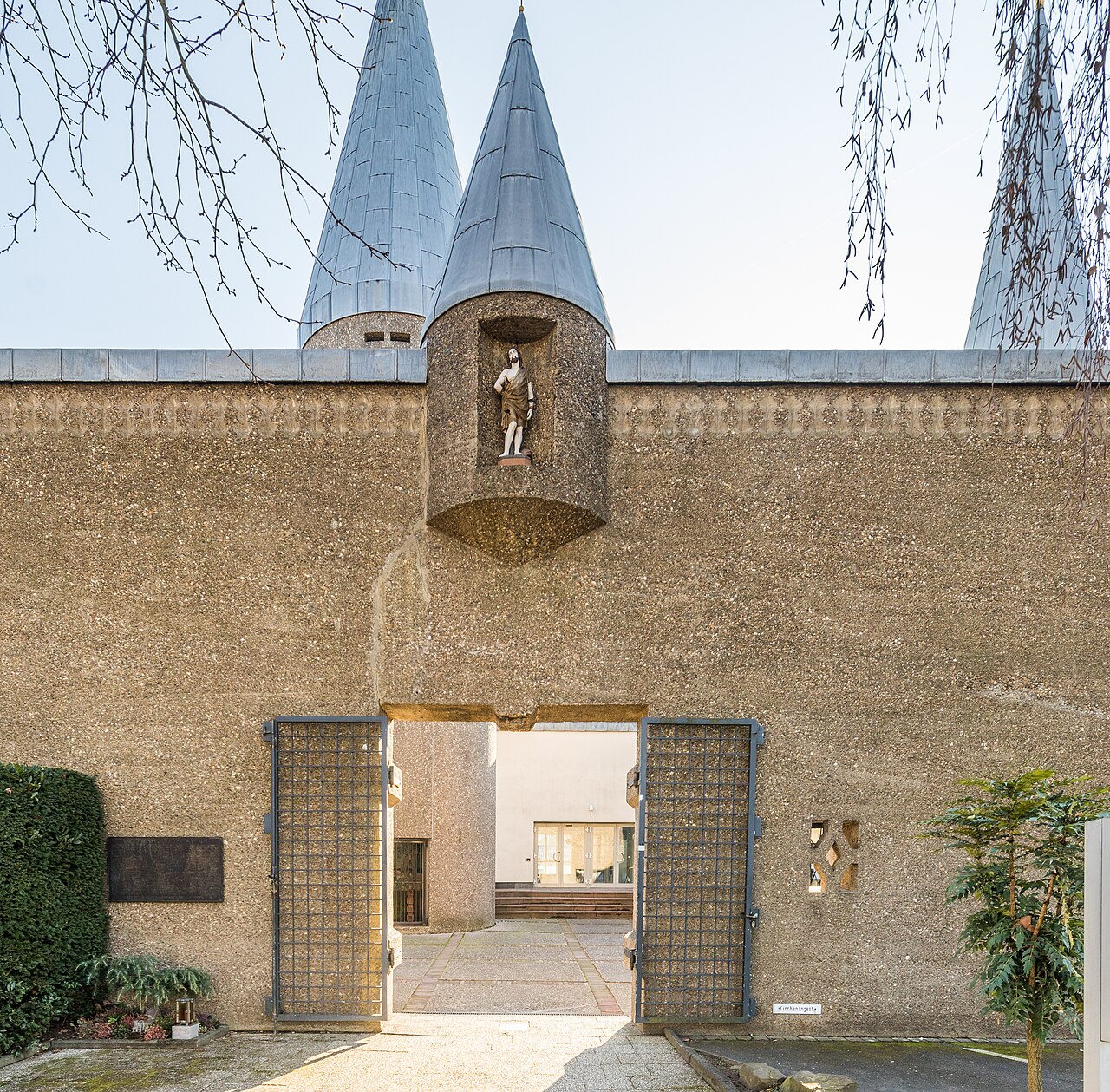
Böhm answered the site by sheltering the complex behind a five-metre concrete wall that keeps out the noise; the sequence of atria and church rooms creates an unusual calm so close to the road. A gateway cut into the wall leads in, marked by the smallest of the towers, which sits on top of the wall. To the right of the entrance, a concrete relief of Noah's Ark is by the Cologne sculptor Jochen Pechau.
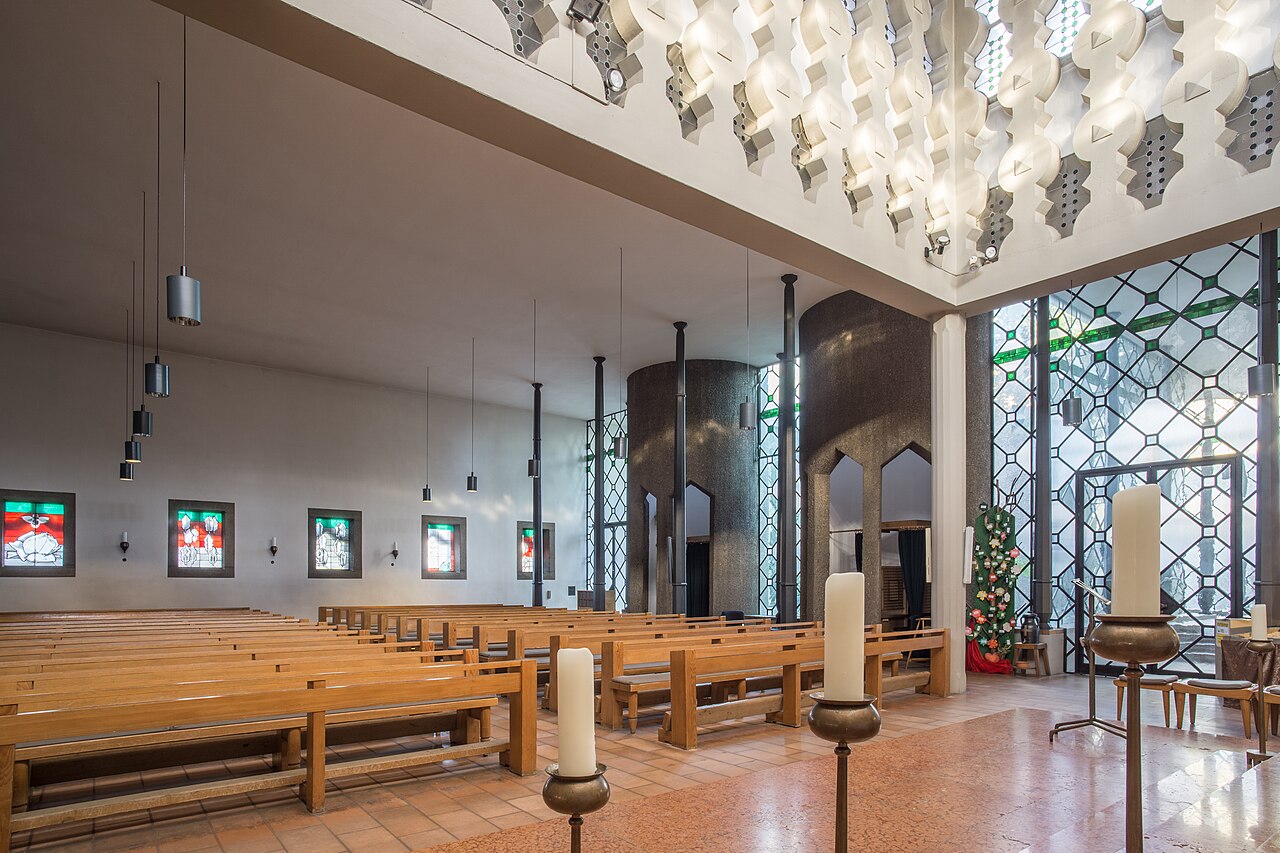
Böhm wanted visitors to pass through changing impressions of space on their way from the street to the church. The gateway leads first into an inner courtyard and then into an atrium, where two walkways run round a planted patio with a pond and a fountain to the church door. The dark nave contrasts with the light-filled atrium; the altar, beneath a large canopy, is bathed in light again through openings at the top of the canopy. Slender cast-iron columns divide the hall into four aisles. Coarse-grained fair-faced concrete and glass are the dominant materials.
Round towers with conical caps, of different heights, mark the important places from outside: the tallest rises over the altar canopy, others over the Sacrament chapel, the baptistery and the confession room, and a tall, slim tower marks the parish wing. Böhm drew on oriental architecture; the church also shares features with the one he was building at the same time in Kierspe, St. Joseph, especially the large canopy over the altar, very similar in both churches.
Böhm designed much of the furnishing, including the pews, the apostle candlesticks and the holy-water stoups. The Stations of the Cross, metalwork by the Cologne artist Theo Heiermann, are set into the glass walls that separate the patio from its walkways.
Use today
The church is one of the three churches of the Catholic parish group of Bergisch Gladbach-West, with St. Clemens in Paffrath and St. Konrad in Hand; Mass is celebrated there on Sundays and on weekdays.
Visiting
The complex is reached through the gateway in the wall on Altenberger-Dom-Straße; the church is open at Mass times.
Photos
51.02° N, 7.08° E
Greenhouses nearby
Architecture nearby
By the same architect
Sources (5)
- baukunst-nrw.de/objekte/2045-herz-jesu-kirche-schildgen
- boehmbauten.de/buildings-detail?tx_buildings_buildingsshow%5Baction%5D=show&tx_buildings_b
- kuladig.de/Objektansicht/O-56167-20121031-7
- gemeinden.erzbistum-koeln.de/pfarreiengemeinschaft-bergisch-gladbach-west/ueber_uns/kirche
- gemeinden.erzbistum-koeln.de/pfarreiengemeinschaft-bergisch-gladbach-west/glauben_entdecke
Affiliate links — booking through Verrière helps fund our research, at no extra cost to you.