Schaugewächshäuser of the Flora and Botanical Garden of Cologne
Cologne, North Rhine-Westphalia
Entry updated on September 30, 2026
- Year
- 2026
- Architect
- Königs Architekten (Cologne)
- Style
- Contemporary, three wings with parabolic steel-and-glass arches
- Dimensions
- ≈3,000 m², three wings, maximum height 16 m
- Status
- Open to the public since 12 June 2026
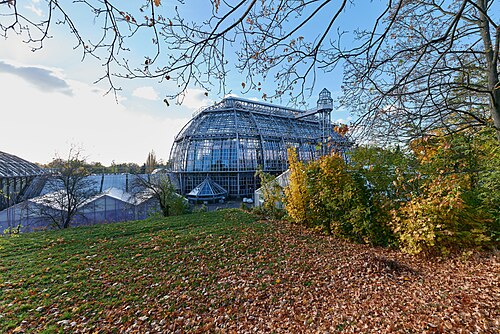
On the site of the 1950s greenhouses, closed in 2016, the Cologne Flora botanical garden opened a new complex on 12 June 2026, designed by the Cologne firm Königs Architekten. Three wings with support-free parabolic arches of steel and glass house a tropical and useful-plants house, a desert house and an orangery for exhibitions, arranged around the heritage tropical courtyard. A raised path climbs to 5.5 m into the canopy. More than 6,000 species from the tropics and deserts are shown, alongside the preserved subtropical house of 1964.
Affiliate links — booking through Verrière helps fund our research, at no extra cost to you.
History
1 min
The Flora grew out of the disappearance of Cologne's old botanical garden near the cathedral, sacrificed to the main railway station. On 5 September 1862 citizens meeting at Eduard von Oppenheim's residence resolved to create a new garden; the company Flora AG was founded in 1863 and the garden opened on 14 August 1864 to plans by Peter Joseph Lenné. Its centrepiece was Max Nohl's glass palace, both a palm house and a festive hall. A municipal botanical garden was added to the north in 1914 and merged with the Flora on 1 January 1920.
On 31 May 1943 wartime destruction swept away the whole garden. The first post-war glasshouses, arranged in a U, went up between 1950 and 1955: the small tropical house (1950), the cactus house (1953) and the large tropical house (1954-1955). The tropical courtyard followed in 1957, laid out for the Federal Garden Show, and the subtropical house in 1964, built for the centenary. Dilapidated, the 1950s houses were closed in 2016 and their rare plants moved out; excavation began in 2018, with a groundbreaking ceremony in November.
The roof structure was raised in summer 2020. On 14 August 2020 a protected Lebanon cedar in the tropical courtyard fell during the works, apparently after a storm; seeds were collected for replanting. The project was affected by the pandemic, energy-price volatility and the insolvency of two contractors. It was completed in spring 2025 and the plants moved in from 2023. According to a local newspaper, the cost estimate rose from 11.3 million euros in 2015 to 19.3 million in 2021. Mayor Torsten Burmester opened the complex on 12 June 2026.
Architecture and engineering
1 min
Königs Architekten designed three wings with parabolic arched roofs in steel and glass, built on the site of the old glasshouses with a comparable footprint. The arches allow a support-free interior and very slender steel sections; the glazing is insulated safety glass with an integrated film that lets UV light through. The maximum height of 16 metres is almost double that of the earlier houses. The three wings enclose the heritage tropical courtyard, and the connecting passage has become an orangery for temporary exhibitions.
Inside, a raised path climbs to 5.5 m through the canopy of the tropical house, while the desert house is crossed along a canyon. Three climate zones are run by automatic control: 20 to 25 °C and 80 per cent humidity for the tropical and useful-plants house, at least 12 °C and 20 to 50 per cent humidity for the desert house. Heating comes from a CO2-neutral district-heating network; ventilation flaps in the roof and sides, a high-pressure misting system and a large rainwater cistern beneath the building complete the set-up.
Plant collections
1 min
The city announces more than 6,000 species from the tropics and deserts of the Old and New Worlds. The tropical house includes a watercourse, orchids and ferns; the useful-plants section shows spices (clove, cardamom, cinnamon), tropical crops (banana, cacao, coffee, vanilla), energy plants such as oil palm and sugar cane, and indigenous forest gardens of medicinal plants.
The desert house gathers cacti and succulents from the Americas and the Old World. The former subtropical house of 1964 has been kept; since 2000 it has held the Flora's camellia collection, recognised in 2012 as an International Camellia Garden of Excellence. The garden reports more than 650 cultivars and about fifty wild species.
Visiting
1 min
The glasshouses stand in the botanical part of the site, with an entrance on the Palmenallee side, north of the Flora proper. One to two hours should be allowed for the raised path and the three houses, more if the themed gardens are added.
Winter is the camellia season. The visit combines with Lenné's historic park and with the Flora's restored Festsaal, completed in 2014; Cologne Zoo is a neighbour of the garden. The orangery linking the wings hosts rotating exhibitions, which can change the route from one visit to the next.
50.96° N, 6.97° E
Greenhouses nearby
More greenhouses — Germany
Do you have a good photo of this greenhouse? Suggest it for this page →
Sources (8)
- stadt-koeln.de/politik-und-verwaltung/presse/mitteilungen/28472/index.html
- stadt-koeln.de/artikel/67655/index.html
- stadt-koeln.de/artikel/20040/index.html
- rheinische-anzeigenblaetter.de/nippes/c-nachrichten/neue-schaugewaechshaeuser-in-der-flora
- citynews-koeln.de/die-neuen-schaugewaechshaeuser-der-koelner-flora-laden-zur-weltreise-ein
- verliebtinkoeln.com/koelner-flora-gewaechshaus-eroeffnung-termin/
- de.wikipedia.org/wiki/Flora_(K%C3%B6ln)
- en.wikipedia.org/wiki/Flora_Botanical_Garden