Bergischer Löwe civic centre and theatre (Bürgerhaus)
Bergisch Gladbach, North Rhine-Westphalia
Sources checked November 2026
- Year
- 1977-1980
- Architect
- Gottfried Böhm
- Type
- Civic centre and theatre
- Access
- Working venue for performances and gatherings (official website, November 2026)
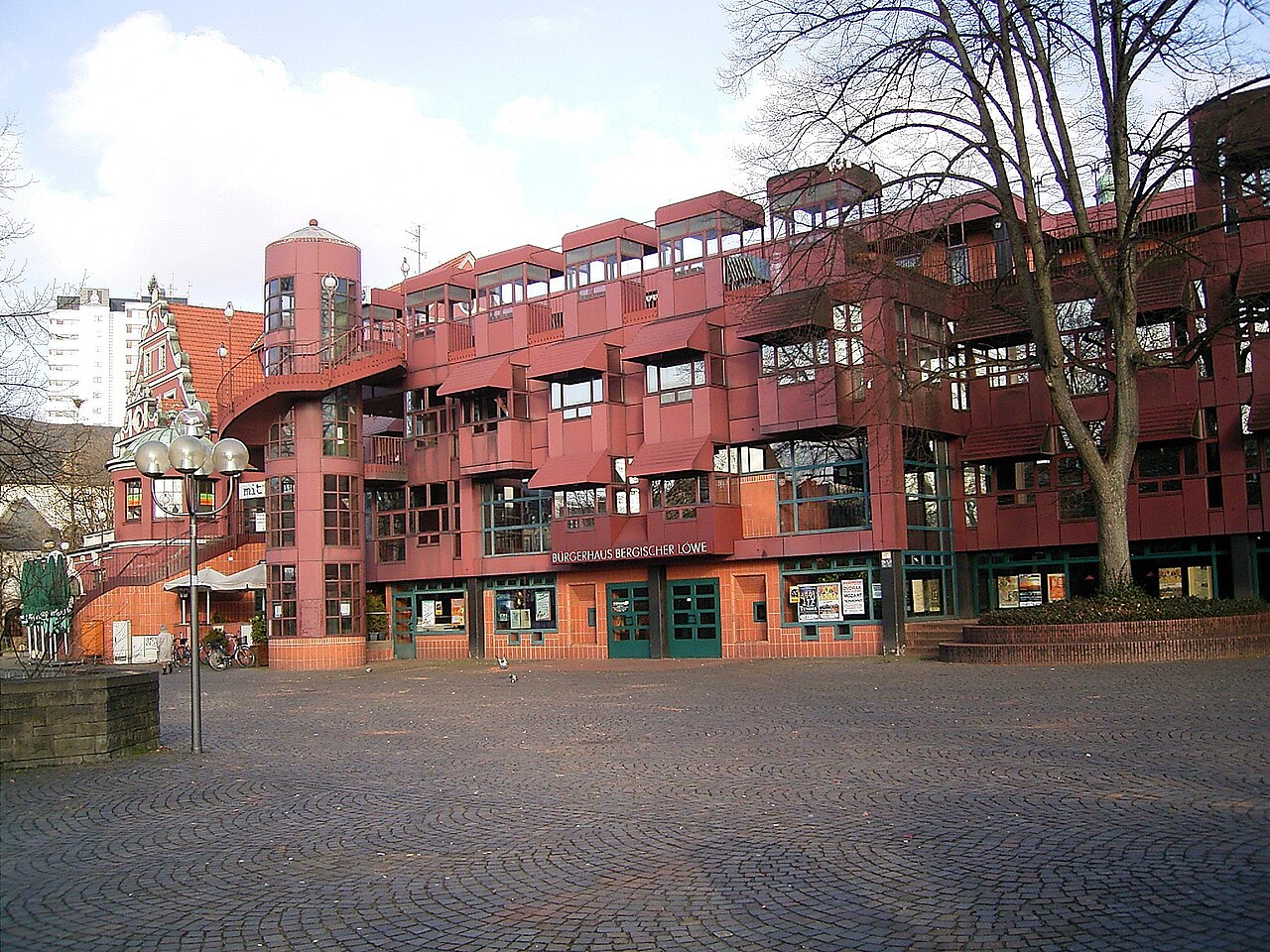
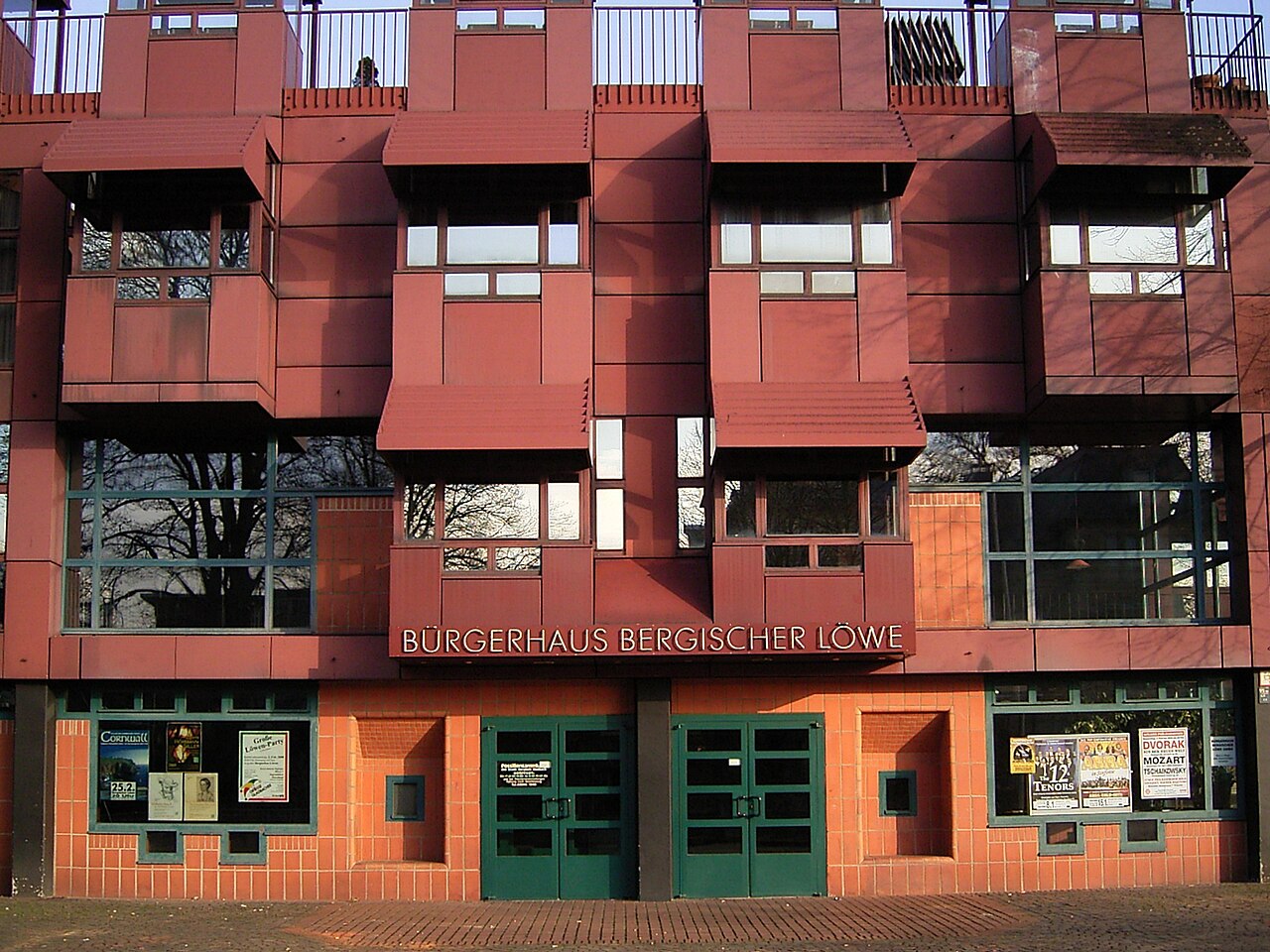
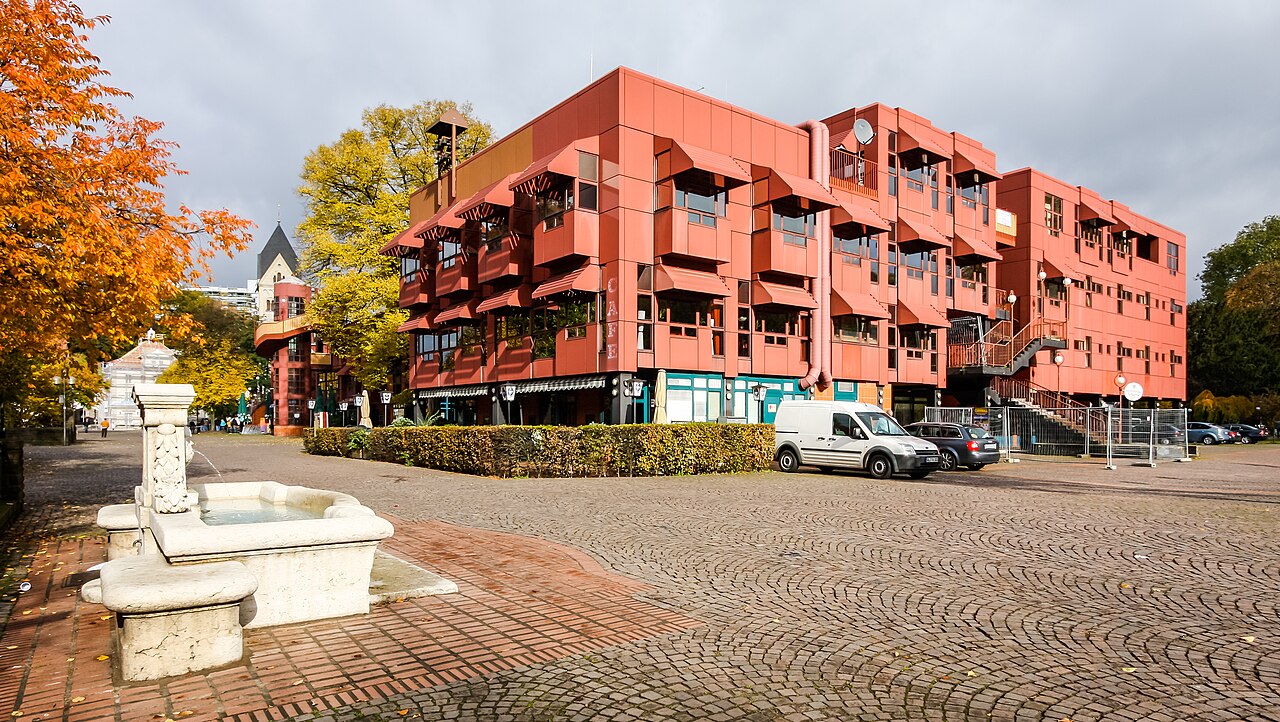
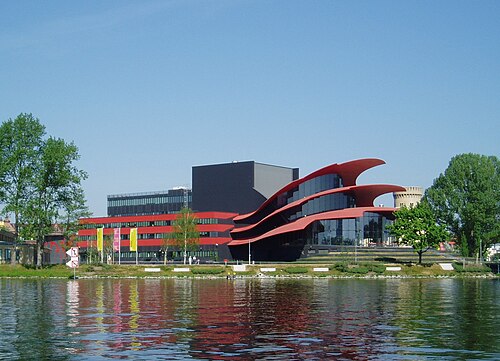
Gottfried Böhm designed the new Bürgerhaus of Bergisch Gladbach, built from 1977 to 1980 on Konrad-Adenauer-Platz. The new building, with a red-lacquered sheet-metal façade broken up by oriels and canopies, takes in a surviving part of the old Bergischer Löwe, in German Renaissance style. It holds a 650-seat theatre hall, a 1,300-square-metre foyer and several meeting rooms.
Affiliate links — booking through Verrière helps fund our research, at no extra cost to you.
History
The Bergischer Löwe goes back to the middle of the 19th century, when the Kolter inn was built on the site. The Casino society, founded by local citizens in 1903, bought it and had it turned into a prestigious meeting house under the architect Ludwig Bopp; in 1904 the Mariensaal was added, a Jugendstil theatre and concert hall made possible largely by the benefactor Maria Zanders. The town took ownership of the complex in 1939; after the war the hall was first used as a cinema, then turned into a modern stage in 1952.
In the 1970s a public plan to demolish everything and replace it with an oversized investor scheme foundered on legal and financial obstacles. The town finally decided to follow an initiative of the state of North Rhine-Westphalia and to create on the site, keeping the existing building, the new type of the Bürgerhaus or civic centre: a house of culture open to all residents. Gottfried Böhm won the competition, which was limited to a few entrants.
In 1977 the Mariensaal was demolished and the foundation stone of the new Bürgerhaus was laid, to Böhm's design. The house reopened in 1980: Böhm had worked part of the old building into the new multi-purpose venue. About a third of the historic fabric survives today, mainly the oldest part, on Hauptstraße. The Bergischer Löwe, whose buildings range from 1854 to 1980, is on the town's list of monuments, with entries dated 1983 and 2020.
Architecture
The complex brings together two parts in opposing styles. The old building, on Hauptstraße, keeps its German Renaissance forms: a two-storey round tower with a domed cap, curved gables and façades enlivened by oriels and wall dormers. It stands in clear contrast to Böhm's modern idiom.
The new building is marked by its metal façade in shades of red, made of lacquered sheet panels; many oriels, projections and canopies break it into small parts, giving a heterogeneous, almost sculptural effect. Böhm, who had built bold concrete mountains in the 1960s, changed his approach here: free sculpture gives way to a strict grid, and metal façades, tiles and paintings upstage fair-faced concrete, while the old building is integrated with the greatest respect. In its forms and colours the Bürgerhaus is clearly a product of its time.
Inside, the large theatre hall and technical installations left in view, such as the ventilation ducts, set the tone; reds dominate inside as well as out.
Use today
The large hall has a fully equipped stage, with a lowerable orchestra pit, a fly tower and a large goods lift, and 650 seats in rows. The Spiegelsaal (hall of mirrors), on the second floor, looks over Konrad-Adenauer-Platz, the Villa Zanders museum and the historic town hall. The foyer, of 1,300 square metres, is used for exhibitions, receptions, markets and trade fairs, and six group rooms of 30 to 60 square metres complete the house. The Theatercafé has two levels, with 135 seats and 60 more on the terrace, and the Penthouse, on the roof, takes up to 100 people.
The Bürgerhaus Bergischer Löwe GmbH runs the house. Its programme ranges from theatre to concerts, from readings and lectures to children's shows, from carnival to markets and fairs; since 1991 it has also hosted the town's theatre programme.
Visiting
People come to the Bürgerhaus for its shows, concerts, readings and markets. Tickets are sold at the theatre box office on Konrad-Adenauer-Platz, in the centre of Bergisch Gladbach, and an evening box office opens an hour before each event.
Photos
50.99° N, 7.13° E
Greenhouses nearby
Architecture nearby
By the same architect
Sources (15)
- bergischerloewe.de/
- bergischerloewe.de/geschichte.aspx
- bergischerloewe.de/architektur.aspx
- bergischerloewe.de/theatersaal.aspx
- bergischerloewe.de/foyer.aspx
- bergischerloewe.de/spiegelsaal-feiern.aspx
- bergischerloewe.de/theaterkasse.aspx
- bergischerloewe.de/theatercafe.aspx
- bergischerloewe.de/penthouse.aspx
- bergischerloewe.de/gruppenraeume.aspx
- baukunst-nrw.de/objekte/2046-buergerhaus-bergischer-loewe
- boehmbauten.de/buildings-detail?tx_buildings_buildingsshow%5Baction%5D=show&tx_buildings_b
- kuladig.de/Objektansicht/KLD-262045
- bergischgladbach.de/denkmalliste-stadt-bergisch-gladbach-stand-27.10.2025.pdfx.aspx
- boehm.rwth-aachen.de/wp-content/uploads/2020/10/StefanKnecht_EinTagBoehm_Abstract.pdf
Affiliate links — booking through Verrière helps fund our research, at no extra cost to you.