Archdiocesan Museum and Cathedral Treasury (Diözesanmuseum)
Paderborn, North Rhine-Westphalia
Sources checked November 2026
- Year
- 1968-1975
- Architect
- Gottfried Böhm
- Type
- Museum of religious art and cathedral treasury
- Access
- Open Tuesday to Sunday, 10 am to 6 pm, closed on Mondays (official website, November 2026)
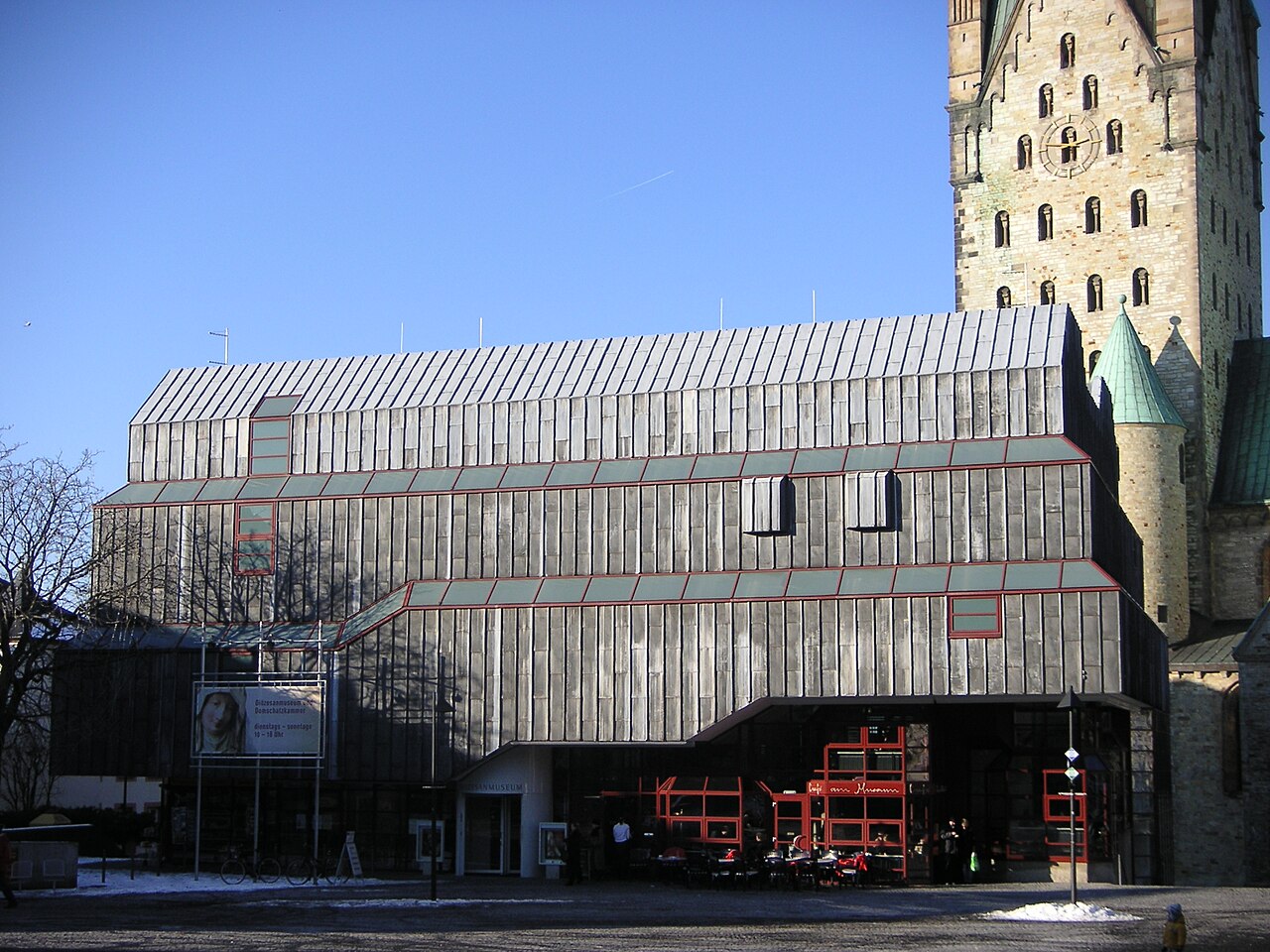
Gottfried Böhm designed this museum of religious art, opened in 1975 south-west of Paderborn Cathedral, beside the market square. Clad entirely in lead, with no distinction between roof and walls, it hangs from four supports above medieval vaults that house the cathedral treasury. It was converted in 1991-1993 to plans by Michael Brawne, and glass fronts were closed in the process.
Affiliate links — booking through Verrière helps fund our research, at no extra cost to you.
History
The museum was founded in 1853 and first housed in the former chapter house of the Busdorf church. In 1912 it moved into the newly built offices of the vicariate general, the diocesan administration, although those rooms did not lend themselves to a rigorous exhibition layout. As the collection grew, space ran short, and in 1967 the archdiocese decided to build a new museum. It chose the plot south-west of the cathedral, next to the market square, which had stood empty since 1945 and had carried buildings of three to five storeys before the war. After a limited competition, the jury unanimously chose the design by Gottfried Böhm, who would later receive the Pritzker Prize. The building was handed over for use on 25 May 1975, and the cathedral treasury then found its place in the new display.
The building was already much debated while it was going up, and it also caused problems for the collection: with no air conditioning, and sunlight pouring in through the large windows, precious objects were at risk, notably painted wooden sculptures. The archdiocese therefore had it converted to plans by the English museum architect Michael Brawne (1925-2003). The work took place from 1991 to 1993, and the museum reopened in 1993. Its new conservation standards allowed it to host international temporary exhibitions, among them "799 – Art and Culture of the Carolingian Era" in 1999, which made it known beyond the region.
Architecture
Böhm conceived the museum as a container in which the objects are shown as if in a treasure chest. Hence its massive-looking overall form, clad entirely in rolled lead, with no distinction between roof and façades: with its stepped lead façades, the building holds its own beside the cathedral like a reliquary shrine treated as sculpture. The base, by contrast, is partly open and partly glazed, and draws visitors inside. The museum gives new order to the large open space that wartime destruction had left in front of the cathedral: its position creates two squares, the square market place and an elongated square in front of the cathedral.
Medieval vaults extend beneath the building, among them those of the former residential palace of Bishop Meinwerk (1009-1036). To spare them, the building rests on just four supports, which carry a steel grid from which the floors hang, outer façades included; these exhibition levels rise gradually in twelve stages and are linked to one another by stairs. The building thus seems almost to float above the vaults, which are used as exhibition rooms.
Inside, the space contrasted with the massive façade through a transparency rare in a museum, both inwards and outwards: one large main space with no partitions or cabinets in the usual sense, bearing Böhm's signature down to the display cases and pedestals. The building embodied the museum concept of the late 1960s, which called the old-style museum into question. During the 1991-1993 conversion, glass fronts were closed, and the interior no longer has its original brightness.
Use today
The museum shows a collection of more than 12,000 objects: sculpture, painting, textiles, books and goldsmiths' work from the Middle Ages and the Baroque, down to plain testimonies of popular devotion. Its emphasis lies on sculpture from the Middle Ages to the twentieth century, with particular weight on images of the Virgin.
In the medieval vaulted cellar the treasury of Paderborn Cathedral is kept, with the shrine of St Liborius.
Visiting
The museum is open Tuesday to Sunday, 10 am to 6 pm, and closed on Mondays. It is at Markt 17, on the market square.
The levels are linked by stairs and only some of them can be reached by lift: the museum is not accessible to people with reduced mobility.
51.72° N, 8.76° E
Greenhouses nearby
Architecture nearby
By the same architect
Sources (8)
- dioezesanmuseum-paderborn.de/architektur/
- dioezesanmuseum-paderborn.de/besucher-informationen/
- dioezesanmuseum-paderborn.de/sammlung/
- dioezesanmuseum-paderborn.de/
- baukunst-nrw.de/objekte/270-erzbischoefliches-dioezesanmuseum-paderborn
- boehmbauten.de/buildings-detail?tx_buildings_buildingsshow%5Baction%5D=show&tx_buildings_b
- openstreetmap.org/way/68346601
- wikidata.org/wiki/Q1363869
Affiliate links — booking through Verrière helps fund our research, at no extra cost to you.