John F. Kennedy Presidential Library and Museum
Columbia Point, Boston (Massachusetts)
Sources checked October 2026
- Year
- 1979
- Architect
- I. M. Pei
- Type
- Presidential library and museum
- Access
- Open to the public every day, 10:00 to 17:00; tickets on site or online (official website, October 2026)
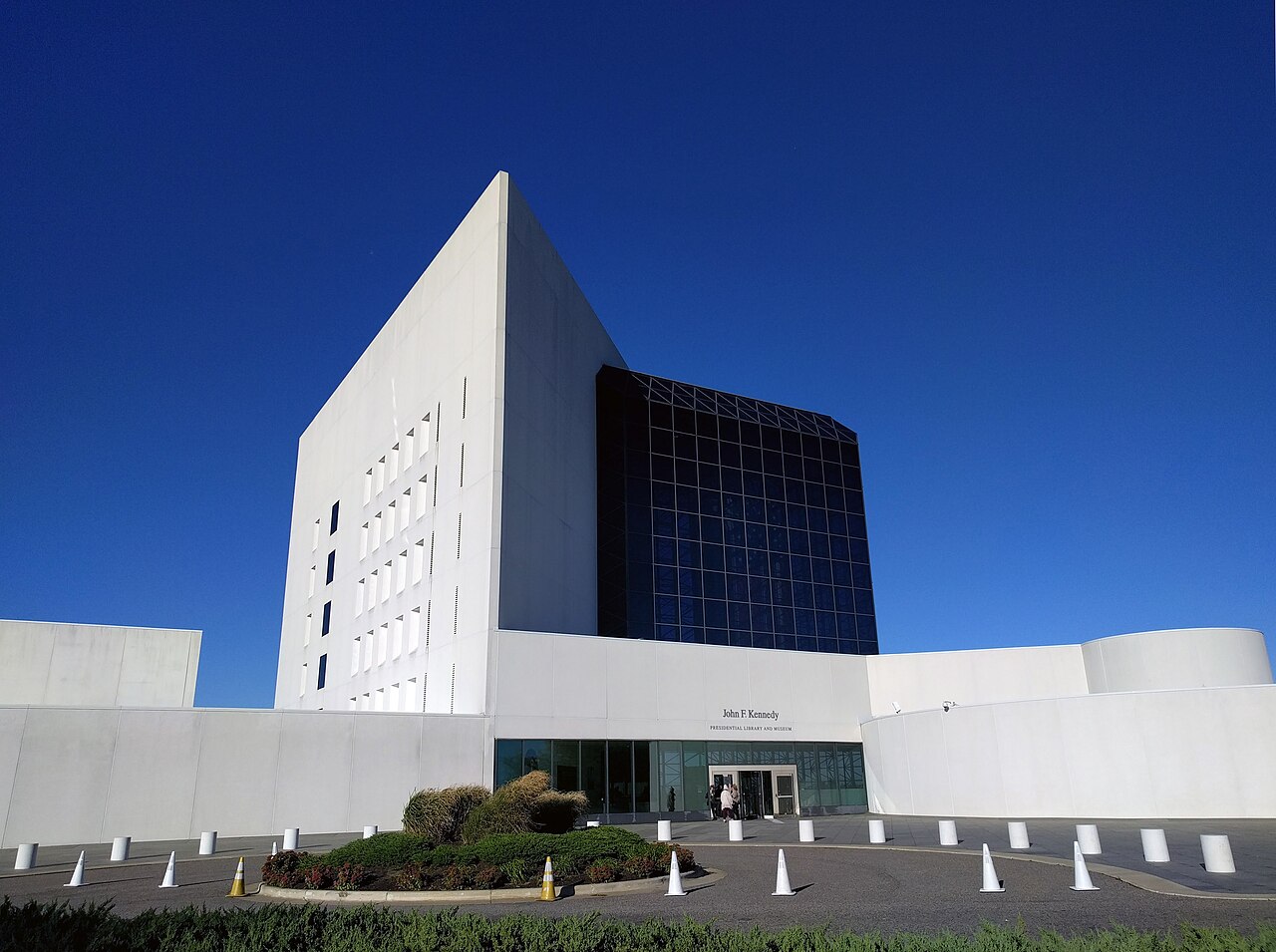
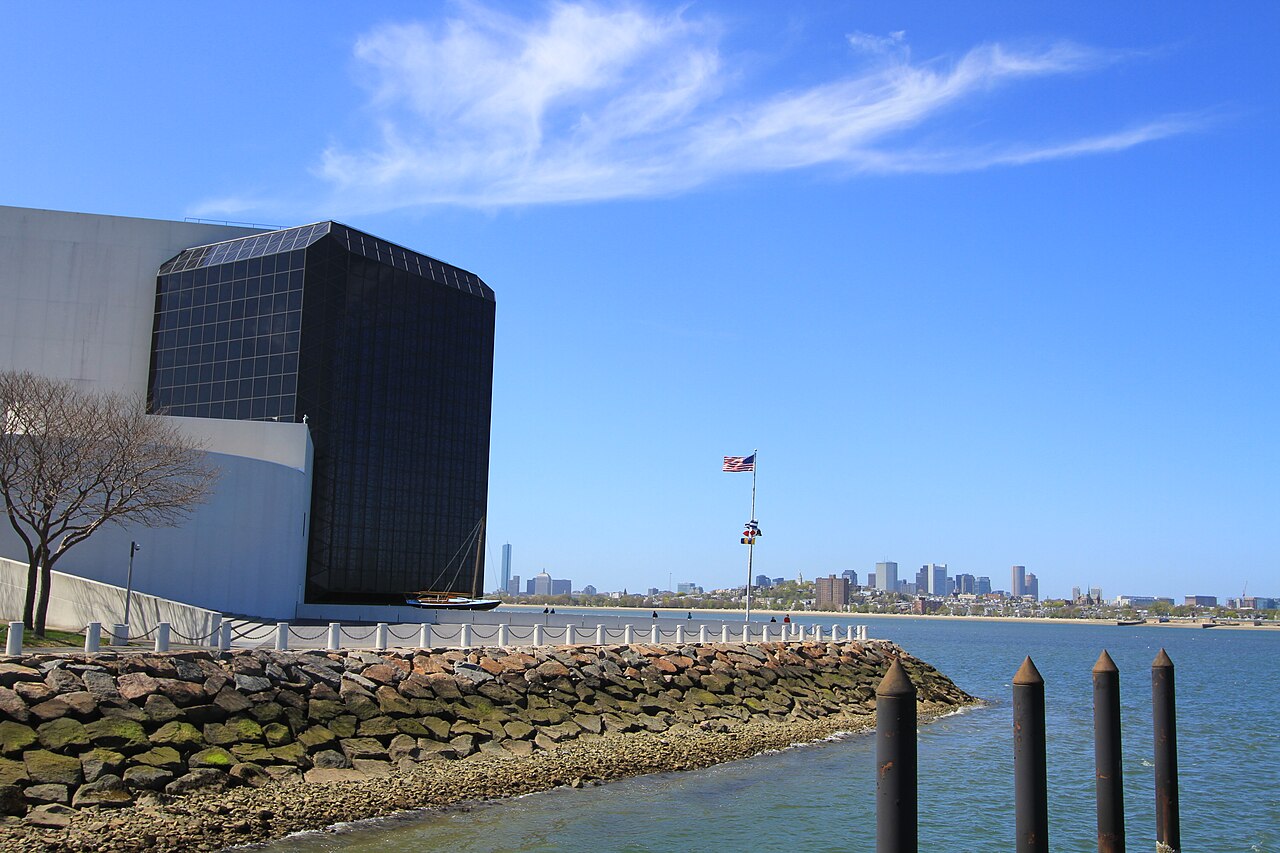
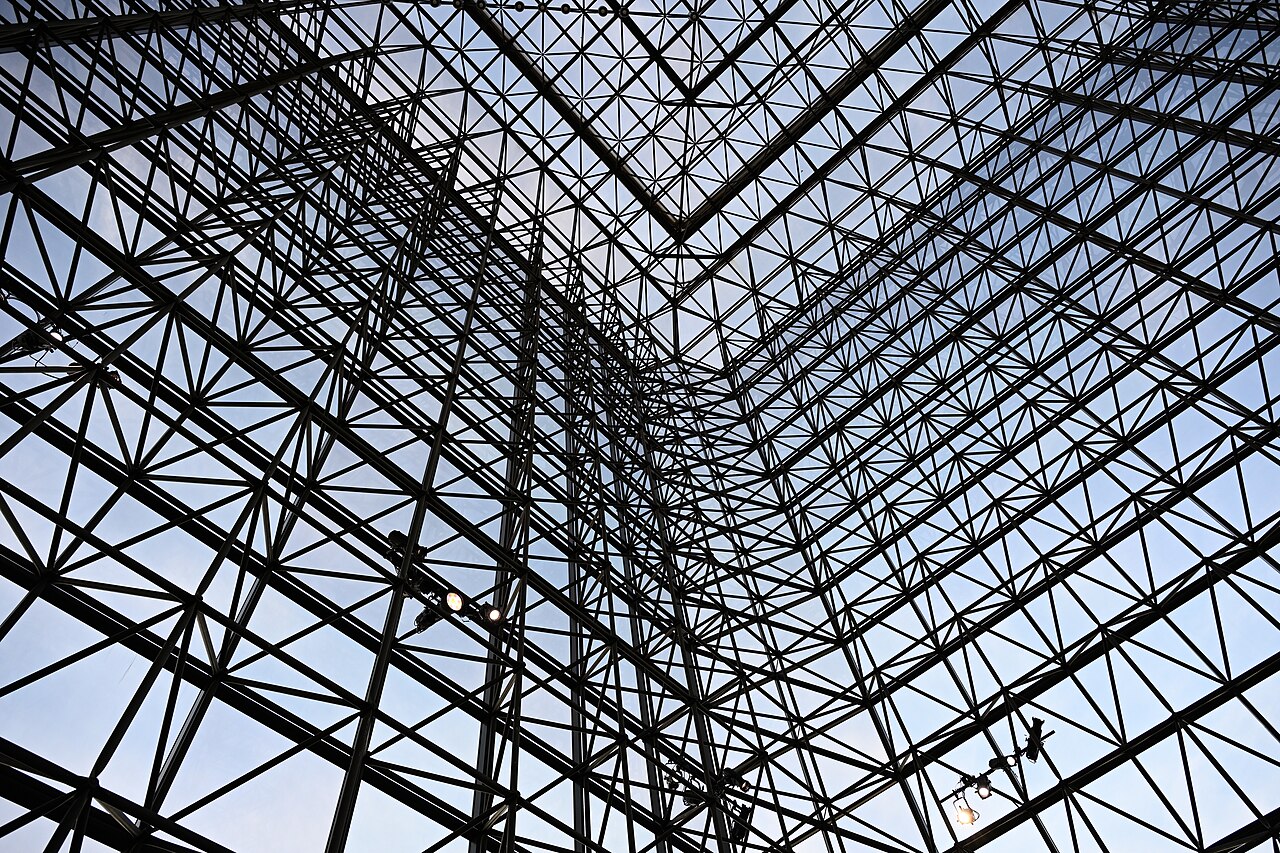
I. M. Pei & Partners designed the Kennedy presidential library and museum, which stands at Columbia Point, in Boston's Dorchester neighbourhood, overlooking the entrance to the harbour. It combines a nine-storey tower of white precast concrete with a glass-and-steel pavilion about 35 m (115 feet) high. After the exhibition galleries, the route opens into this empty pavilion, looking out to the sky and the sea. It was dedicated on 20 October 1979.
Affiliate links — booking through Verrière helps fund our research, at no extra cost to you.
History
In December 1964 the corporation set up to create the library commissioned I. M. Pei to design a building for a site next to Harvard University, in Cambridge. Jacqueline Kennedy played a major role in the choice of this then relatively young architect, whom she selected from a list of candidates that included some of America's best-known architects. Pei's initial design included a truncated glass pyramid symbolising the president's abruptly cut-off life; the idea re-emerged 25 years later in his expansion of the Louvre in Paris.
Delays in freeing the site and fears of urban congestion led in 1976 to the choice of Columbia Point, in Dorchester, on a site donated by the University of Massachusetts Boston and approved by the state legislature. Jacqueline Kennedy Onassis was delighted: the site was close to the childhood home of John Kennedy's mother and offered the beauty of the adjacent harbour, with the ocean the president loved. Pei and his associate Ted Musho started the design again from scratch.
The official groundbreaking took place on 12 June 1977; construction began in August with the driving of over 400 concrete piles, some 150 feet (about 46 m) down to rock. The building stands on landfill that overlooks Boston, Dorchester Bay and the ocean; the site was raised by 15 feet, about 4.6 m. Construction was paid for entirely by private contributions, to which thirty million people gave.
The library was dedicated on 20 October 1979 in the presence of President Jimmy Carter, who accepted it on behalf of the American people; on that day the corporation that had built it transferred the completed building to the United States National Archives. In 1991 the Stephen E. Smith Center, also designed by Pei, was added to the complex. A storage block for archives and collections followed in 2012.
Architecture
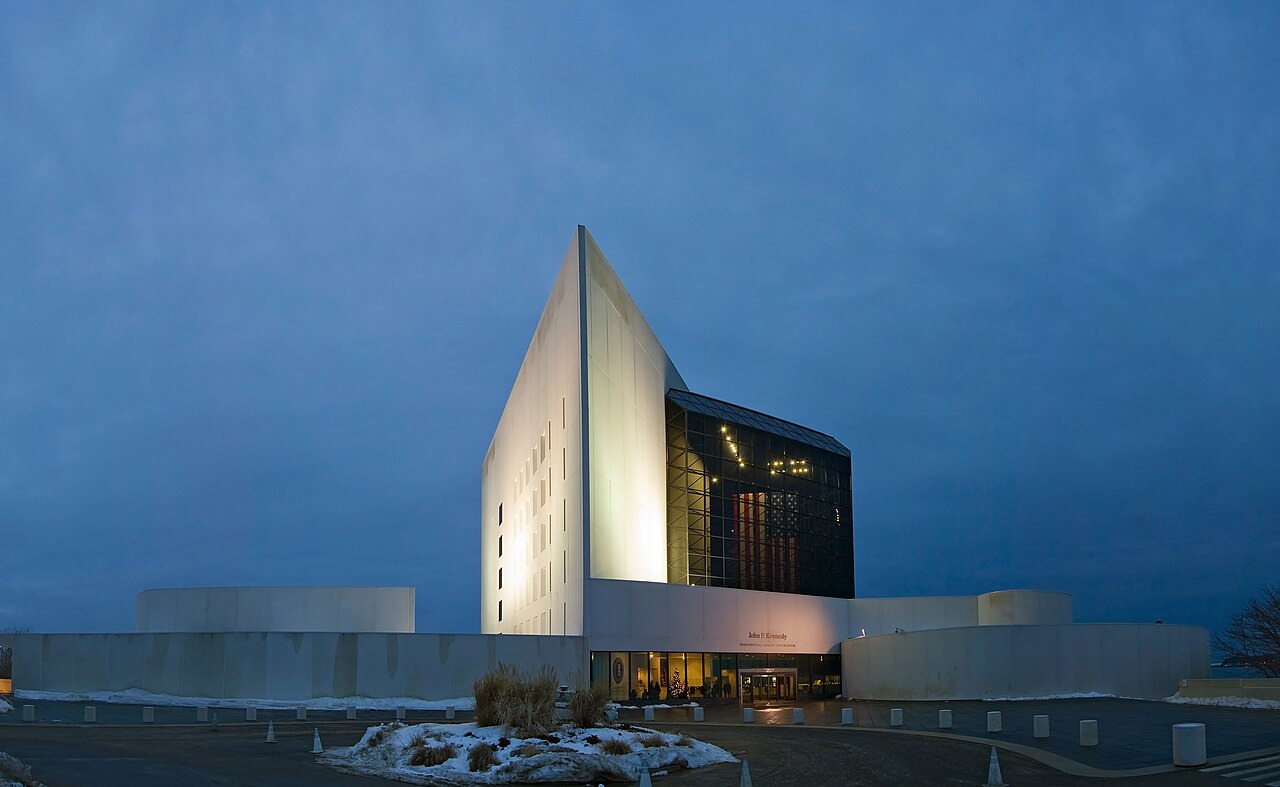
The complex rests on three elements: a triangular nine-storey tower, a two-storey base containing the exhibition and two 230-seat theatres, and a memorial pavilion about 35 m (115 feet) high that gives the whole its coherence and focus. The tower, of stark white precast concrete, is 125 feet (about 38 m) high; its upper floors house offices, research spaces and document storage. The lower floors hold the two theatres and an exhibition area of 18,000 square feet, about 1,700 m².
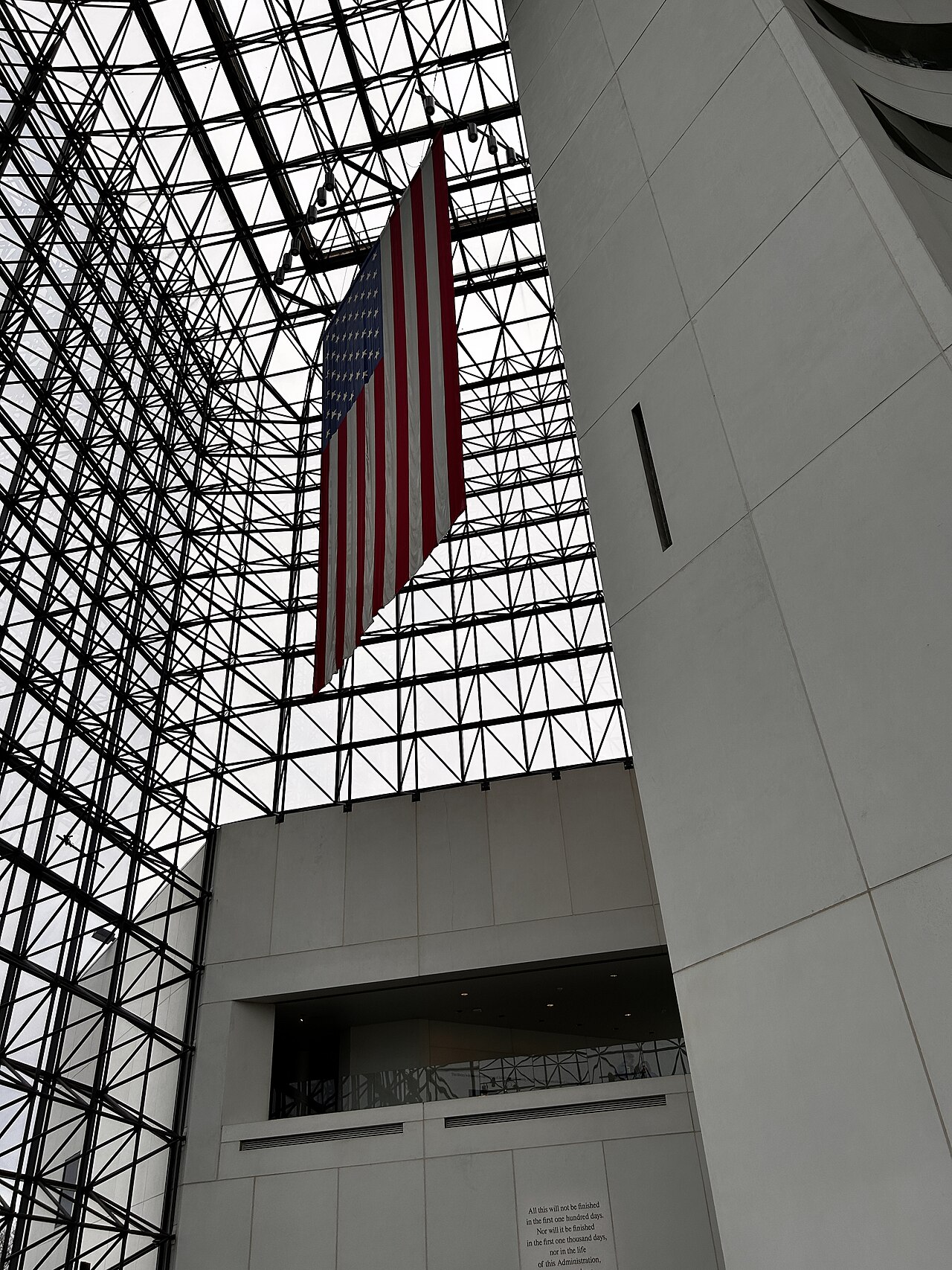
On a limited site and budget, Pei adopted a split-level design: the museum spaces occupy a layer below ground, while the most emotive elements are set apart above. After the film on the president's early life, visitors descend into linked exhibition areas covering the 1960 campaign, his administration and his legacy. From that darkened setting they emerge into the sun-filled, silent void of the space-framed glass pavilion. Except for an enormous American flag suspended above, the space is empty, so that visitors can contemplate a great panorama of sky, land and open sea.
The glass-and-steel pavilion measures 80 feet (about 24 m) on each side and 115 feet high. The space frames for its roof and walls were first assembled on the ground, then lifted into place one at a time by crane; an entire space-frame wall weighs no more than one of the larger precast panels of the tower. Those panels, which clad the concrete frame, were cast in North Wilbraham, Massachusetts, trucked to the site and fitted into place like a three-dimensional jigsaw puzzle.
For the dedication programme Pei wrote: "Its openness is the essence." And he went on: "In the silence of that high, light-drenched space, the visitors will be alone with their thoughts."
Use today
The museum portrays the life, leadership and legacy of President Kennedy, conveys his enthusiasm for politics and public service, and illustrates the nature of the office of the President. The permanent exhibits include Young Jack, the 1960 presidential election, the inauguration, Kennedy and the press, the Peace Corps, the US space programme, Robert Kennedy's Attorney General's office, the Oval Office, First Lady Jacqueline Kennedy and the state visit to Europe. The original exhibits were by Chermayeff & Geismar Associates; the museum was rededicated in 1993 after the exhibits were redesigned by Kennedy & Associates.
It is also an archive: students and scholars can consult the collections on mid-twentieth-century politics and on the life and administration of John F. Kennedy, in the research room by appointment. The library also holds the Ernest Hemingway Collection. A federal facility, it is administered by the United States National Archives and Records Administration (NARA).
Visiting
The museum is open every day from 10:00 to 17:00. Tickets can be bought on site until 16:15 or in advance online; it is best to arrive before 15:30 to have time for the visit. It is closed on 1 January, Thanksgiving Day and 25 December, and closes at 14:00 on the day before Thanksgiving, on 24 December and on 31 December. Admission is free for visitors aged 17 and under.
All visitors pass through a security check with a metal detector. Backpacks and large bags must be left in the vehicle; one purse or nappy bag is allowed per person, no larger than 43 × 66 cm (17 × 26 inches). Photography is encouraged in the museum, unless otherwise noted on the exhibit wall text, but flash, tripods, selfie sticks and drones are not allowed. The museum is wheelchair accessible, and manual wheelchairs can be borrowed at the admission desk.
Parking is free, but space is limited. Without a car, take the Red Line to the JFK/UMass stop, then the free shuttle bus of the University of Massachusetts Boston.
Photos
42.32° N, 71.03° W
Greenhouses nearby
Architecture nearby
Sources (13)
- jfklibrary.org/visit-museum/visit/plan-your-trip/hours-and-admission
- jfklibrary.org/about-us/about-the-jfk-library/history/im-pei-architect
- jfklibrary.org/about-us/about-the-jfk-library/kennedy-library-fast-facts
- jfklibrary.org/visit-museum/visit/plan-your-trip/getting-here
- jfklibrary.org/visit-museum/exhibits/permanent-exhibits
- jfklibrary.org/visit-museum/visit/plan-your-trip/visiting-faq
- jfklibrary.org/visit-museum/visit/plan-your-trip/accessibility
- jfklibrary.org/about-us/about-the-jfk-library
- jfklibrary.org/hemingway/about-hemingway-at-the-jfk
- jfklibrary.org/about-us/about-the-jfk-library/history/history-overview
- en.wikipedia.org/wiki/John_F._Kennedy_Presidential_Library_and_Museum
- wikidata.org/wiki/Q2007919
- openstreetmap.org/way/217512570
Affiliate links — booking through Verrière helps fund our research, at no extra cost to you.