Orangerie and Limonaia (New England Botanic Garden at Tower Hill)
Boylston, Massachusetts

Entry updated on October 5, 2026
- Year
- 1999
- Architect
- Homsey Studio (Tevebaugh Architecture) for the Orangerie
- Style
- Contemporary orangery, glass roof carried on steel catenary arches
- Dimensions
- 14,000 sq ft addition (≈1,300 m²); 30 ft (≈9 m) at the apex
- Status
- Open to the public
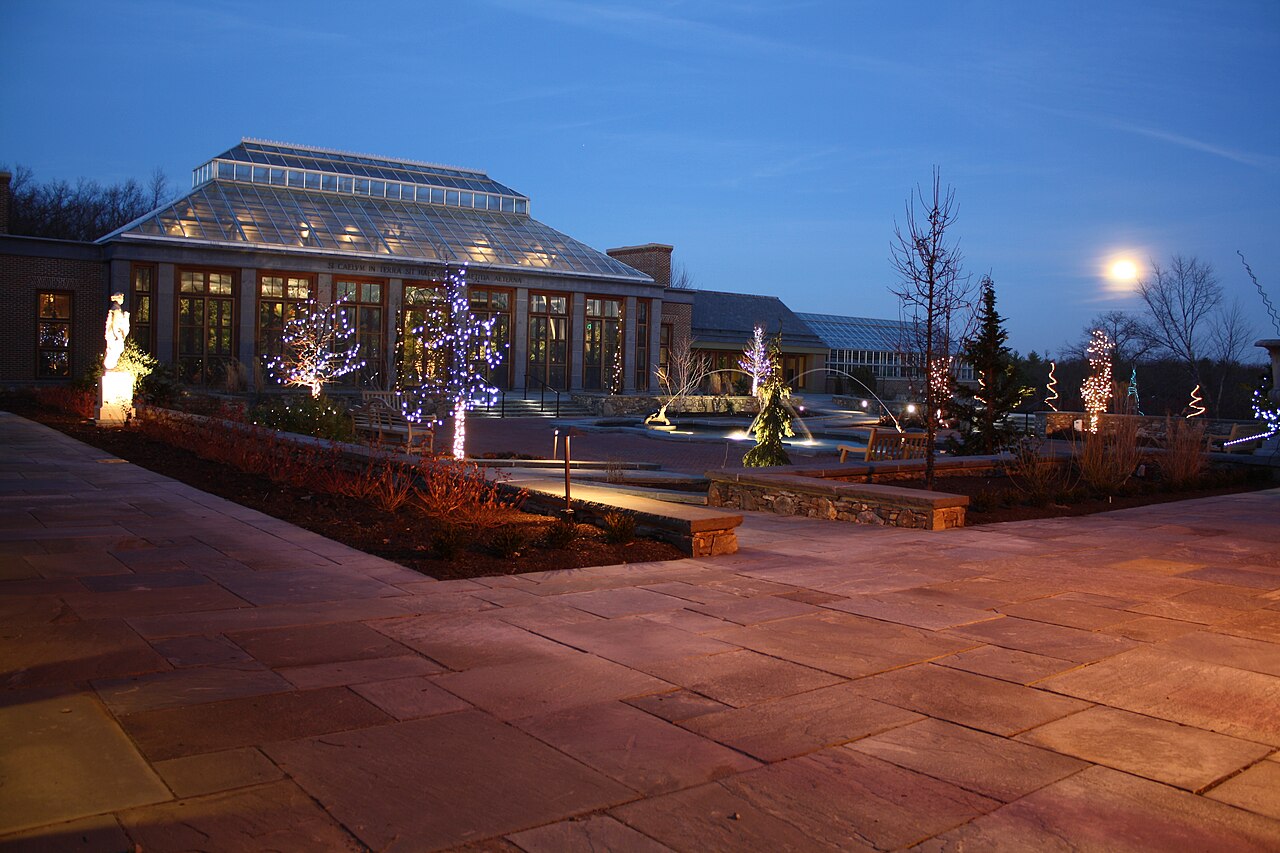
Dedicated in 1999 at the botanic garden that the Worcester County Horticultural Society created in Boylston, the Orangerie was designed by the Homsey Studio of Tevebaugh Architecture as a hybrid of the 18th-century orangery and the modern conservatory: steel catenary arches carry a glass roof that rises to 30 feet, about 9 m, at its apex. It houses tropical and subtropical plants. Since 2010 a second, cooler conservatory, the polycarbonate-roofed Limonaia, has sheltered camellias, date palms, cycads and lemon trees.
Affiliate links — booking through Verrière helps fund our research, at no extra cost to you.
History
1 min
The story of these conservatories begins long before the garden that holds them. The Worcester County Horticultural Society was incorporated on 3 March 1842; it built its first Horticultural Hall on Front Street in Worcester in 1851 and opened a second hall on Elm Street in 1925. In 1985 the society decided to buy Tower Hill Farm, a 132-acre property in Boylston acquired from the Carter family, in order to create a botanic garden, which opened to the public in 1986.
Buildings followed in stages. Work on the Entry Garden and the Stoddard Education and Visitors Center began in 1992, and the visitor centre opened in January 1994. Ground was broken in 1997 for the Orangerie, described by the garden as a 14,000-square-foot addition. After four years of planning and construction it was dedicated in 1999, the same year in which the project earned its architects an AIA Delaware Honor Award for Design Excellence.
In 2010 the Winter Garden and the Limonaia opened, the latter a second, cooler conservatory for plants that cannot survive the New England winter outdoors. In 2022 the institution announced that Tower Hill Botanic Garden would henceforth be called New England Botanic Garden at Tower Hill. The grounds now cover nearly 200 acres.
Architecture and engineering
1 min
The Homsey Studio of Tevebaugh Architecture set out to blend two types: the spirit of an 18th-century orangery and the performance of a modern conservatory. The glass roof is borne by steel catenary arches, light in appearance and structurally efficient, and the interior rises to 30 feet, a little over 9 m, at its apex. On the north side a fern gallery with arched openings wraps around the main volume and offers other views into it; the building also adjoins the Winter Garden.
The design relies on passive solar principles that exploit the building's orientation, backed by drainage and ventilation systems. The architects give a winter temperature of 55 °F (13 °C), while the garden describes a range of 60 to 70 °F (16 to 21 °C). Staff hose down the stone floors so that evaporation keeps the air humid. The project also included a potting shed, a mechanical room, a growing house and a pit greenhouse reached from the Orangerie through an underground tunnel. The facade bears the inscription "If there be heaven on earth, this is it, joy everlasting".
The Limonaia of 2010 follows the nave-like plan of a traditional lemon house beneath a polycarbonate roof that admits bright but indirect light; its motto is "Festina lente".
Plant collections
1 min
Together the two conservatories display between 300 and 500 plants from every continent except Antarctica, including species on the IUCN Red List; a horticultural magazine counts about 400 in the Orangerie alone, orchids among them. Visitors can find the red powder puff tree (Calliandra haematocephala), the lacy tree philodendron (Thaumatophyllum bipinnatifidum), the giant Dutchman's pipe (Aristolochia gigantea), the Wollemi pine (Wollemia nobilis), the giant white bird of paradise (Strelitzia nicolai) and the Zulu giant (Stapelia gigantea).
The cooler Limonaia, kept at 55 to 65 °F according to the garden, gathers camellias (Camellia japonica) from the Isabella Stewart Gardner collection, date palms, cycads, lemon trees and subtropical plants that prefer drier air. Each spring many of these plants move outdoors; when they return with the cold weather, the horticulture staff redesign the whole arrangement.
Visiting
1 min
The two conservatories form the built heart of the garden at 11 French Drive in Boylston, just outside Worcester. The Limonaia opens directly off the lobby, between the courtyard called The Court: A Garden Within Reach and the Winter Garden, and the Orangerie continues the sequence.
Their warmth makes them the obvious winter destination, as the garden is open all year apart from a few holidays and runs a continuous programme of events and workshops. In the warmer months the walk carries on through the Lawn Garden, the Secret Garden, The Ramble designed for children and the Frank L. Harrington Sr. apple orchard with its 119 heritage varieties.
42.36° N, 71.73° W
Greenhouses nearby
More greenhouses — United States
Do you have a good photo of this greenhouse? Suggest it for this page →