Louvre Pyramid
Paris
Sources checked October 2026
- Year
- 1989
- Architect
- I. M. Pei
- Type
- Glass pyramid, entrance to the Louvre museum
- Access
- Main entrance of the museum, closed on Tuesdays; booking a time slot recommended; Cour Napoléon open 7:30 am to 9 pm (official website, October 2026)
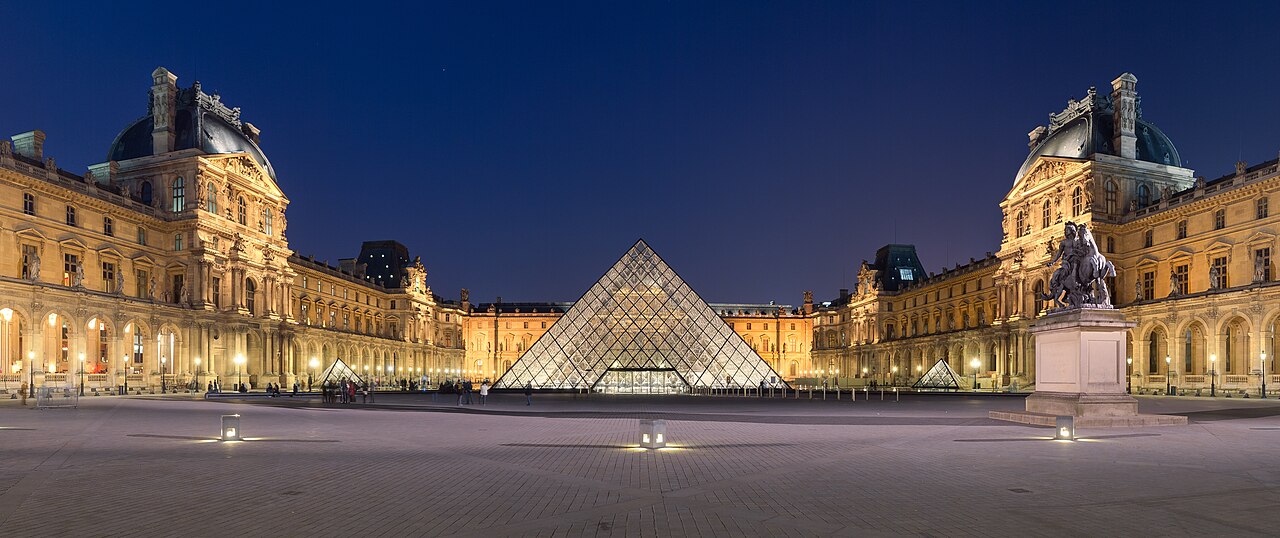
Designed by I. M. Pei as part of the Grand Louvre project, the glass and metal pyramid, 21 m high, stands at the centre of the Cour Napoléon and houses the museum's main entrance. It opens onto an underground reception area leading directly to the three wings, and three small pyramids light the entrances leading to each. Inaugurated on 29 March 1989, it has become the symbol of the museum.
Affiliate links — booking through Verrière helps fund our research, at no extra cost to you.
History
In the 1980s the Cour Napoléon held a car park and two small parks that Hector Lefuel, architect to Napoleon III, had created in the 19th century; the Richelieu wing was then occupied by the Ministry of Finance. Visitor numbers were rising and the museum was increasingly ill adapted to receive them. Announced in September 1981 by President François Mitterrand, the Grand Louvre project was to give the museum the whole palace, modernise it and expand it: the exhibition area grew from 31,000 m² to more than 60,000 m².
In July 1983 I. M. Pei was appointed architect of the project; he had already designed the extensions of the National Gallery of Art in Washington and of the Museum of Fine Arts in Boston. He conceived a central underground reception area giving direct access to the museum's three wings, with an entrance that took the unexpected form of a pyramid. He was also entrusted with the new exhibition spaces of the Richelieu wing, the underground storerooms and the underground spaces for visitors: auditorium, ticket office, cafés, restaurants, bookshops, and a shopping gallery linked to the nearest metro station.
The project stirred up a great deal of debate, and the pyramid drew all the criticism; its opponents denounced a "pharaonic building site". Archaeological excavations in the Cour Napoléon and the Cour Carrée uncovered the medieval moats of Philippe Auguste's Louvre. After four years of work the pyramid was inaugurated by François Mitterrand on 29 March 1989.
Designed originally to receive 4.5 million visitors a year, the pyramid had to cope, twenty-five years later, with museum attendance close to 10 million. The "Pyramid" project, begun in June 2014 with the architecture firm Search, reorganised the reception area beneath it: ticket office, cloakrooms and toilets were moved to the outer edge, and the Hall Napoléon went back to its role as a place to prepare the visit, with no intervention on the architecture of the building.
Architecture
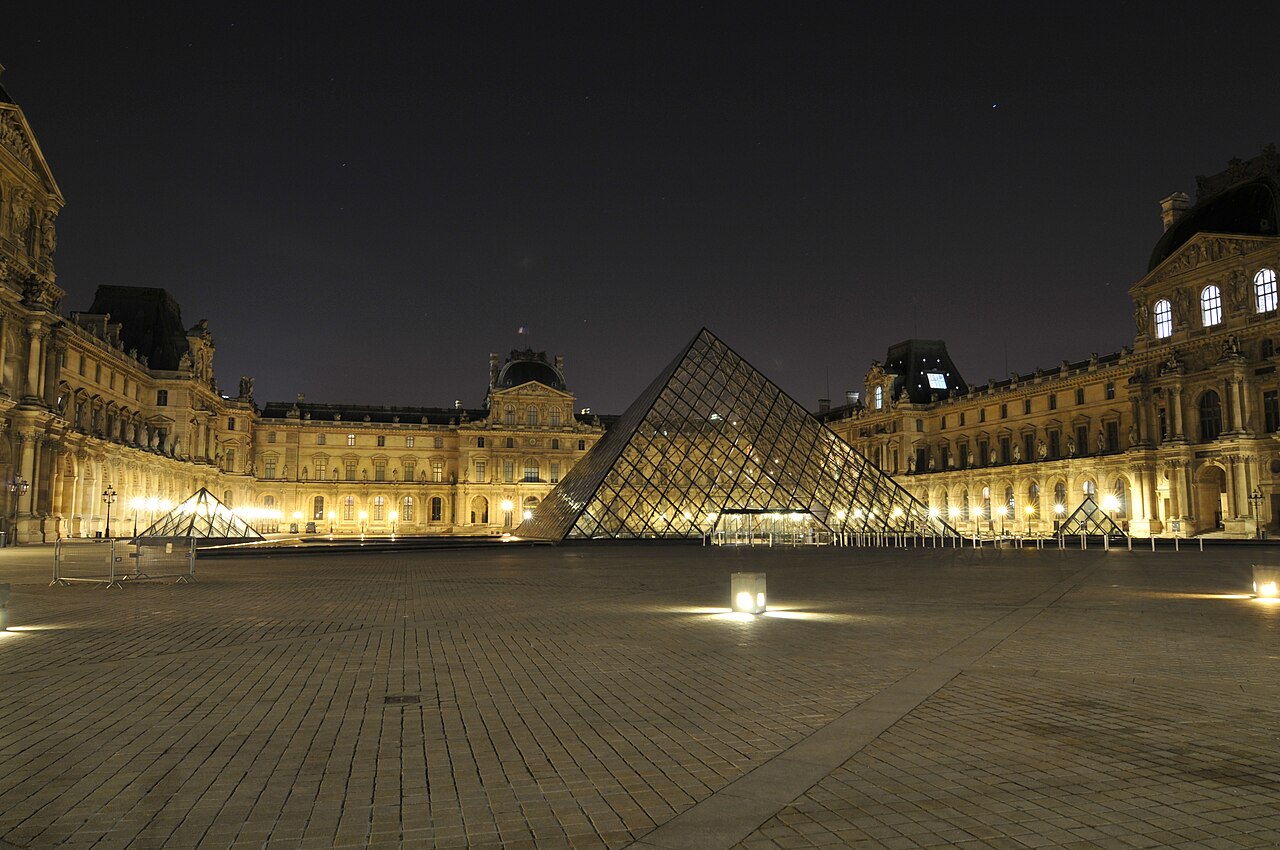
The glass and metal pyramid stands at the centre of the Cour Napoléon: 21 m high and 35 m wide at the base, with a 95-tonne steel structure and a 105-tonne glazed aluminium frame. Its metal frame was built with the help of companies specialised in ships' rigging. Pei wanted the most transparent, light and airy structure possible, while respecting the main axes of the palace. Pei said his approach had been a landscape designer's rather than an architect's, that Le Nôtre was his main source of inspiration, and that the design of the Pyramid's modules is itself French. It is built on the square and the triangle, which multiply across the courtyard, in the design of the pools around the pyramid and even in the paving.
Pei wanted glazing of absolute transparency, so that the historic façades of the palace can be seen as well from inside the pyramid as from outside. Developing an extra-clear glass took two years of research: the 2,000 m² of glazing, 21 mm thick, were made by the Saint-Gobain factory.
Because the Seine curves, the Louvre and the Tuileries garden are out of line: the Arc du Carrousel and the pyramid are not aligned. Pei had the idea of siting the statue of Louis XIV in front of the pyramid, in the alignment, as the starting point of the perspective that runs through the Tuileries, the Place de la Concorde and the Champs-Élysées as far as the Grande Arche de la Défense.
The great pyramid has three small sisters in the Cour Napoléon, which light the three entrances leading to the museum's three wings. An inverted pyramid, in front of the museum entrance in the Carrousel galleries, brings the number of pyramids on the estate to five; its surface glazing is hidden in the planting of the roundabout that lies between the Carrousel garden and the Cour Napoléon.
Use today
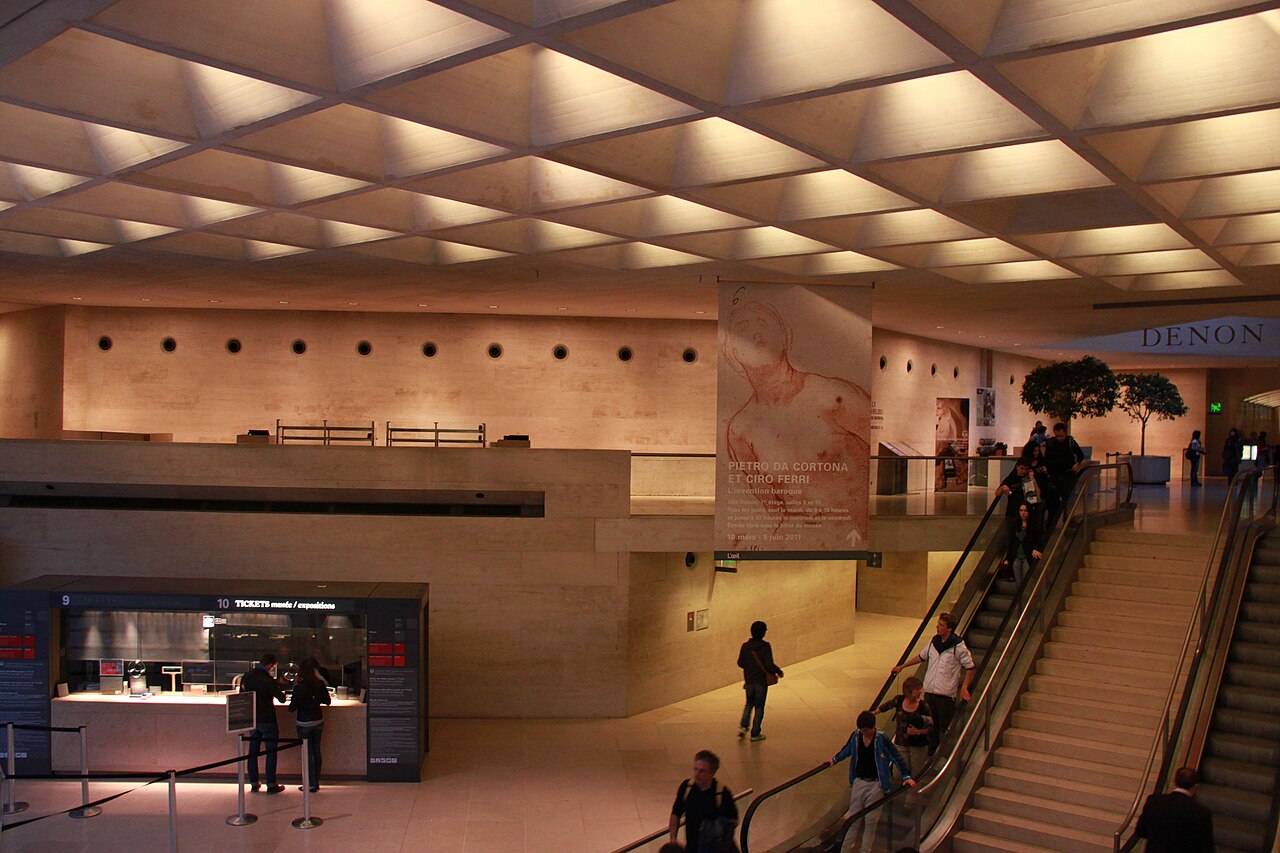
The pyramid houses the main entrance of the Louvre museum. Beneath it, the Hall Napoléon welcomes visitors, with information desks built into large pillars; the ticket office and cloakrooms occupy its edges, and shops line the Allée du Grand Louvre. From there, the central underground reception area conceived by Pei gives access to the museum's three wings.
Visiting
The pyramid is the main entrance of the Louvre museum for all individual visitors, with three queues: holders of a ticket or the Paris Museum Pass, visitors without a booking, and disabled visitors with priority access. Booking a time slot online is recommended, including for visitors entitled to free admission; the ticket is valid only for the date and time indicated, and every exit is final.
The museum is open from 9 am to 6 pm on Monday, Thursday, Saturday and Sunday, from 9 am to 9 pm on Wednesday and Friday, and closed on Tuesday. It is also closed on 1 January, 1 May and 25 December; on other public holidays it opens, unless they fall on a Tuesday. Last admission is one hour before closing. The Cour Napoléon, from which the pyramid and its pools can be seen, is open from 7:30 am to 9 pm.
The tube, the pyramid's lift, is reserved for people with reduced mobility, wheelchairs and pushchairs.
Photos
48.86° N, 2.34° E
Greenhouses nearby
Sources (9)
- louvre.fr/decouvrir/le-palais/une-pyramide-pour-symbole
- louvre.fr/en/explore/the-palace/a-pyramid-for-a-symbol
- louvre.fr/visiter/horaires-tarifs
- louvre.fr/visiter/plan-acces-transports
- presse.louvre.fr/projetpyramide/?lang=fr
- presse.louvre.fr/la-pyramide-du-louvre-a-30-ansbr-nbsp/?lang=fr
- fr.wikipedia.org/wiki/Pyramide_du_Louvre
- wikidata.org/wiki/Q13397
- openstreetmap.org/way/375076234
Affiliate links — booking through Verrière helps fund our research, at no extra cost to you.