Le Corbusier's Cabanon
Roquebrune-Cap-Martin, Alpes-Maritimes
Sources checked October 2026
- Year
- 1951
- Architect
- Le Corbusier
- Type
- Timber cabin, minimal living cell
- Access
- Guided visit, online booking compulsory, together with Villa E-1027 and the Le Corbusier site, from 1 April to 31 October; annual winter closure (Cap Moderne, October 2026)
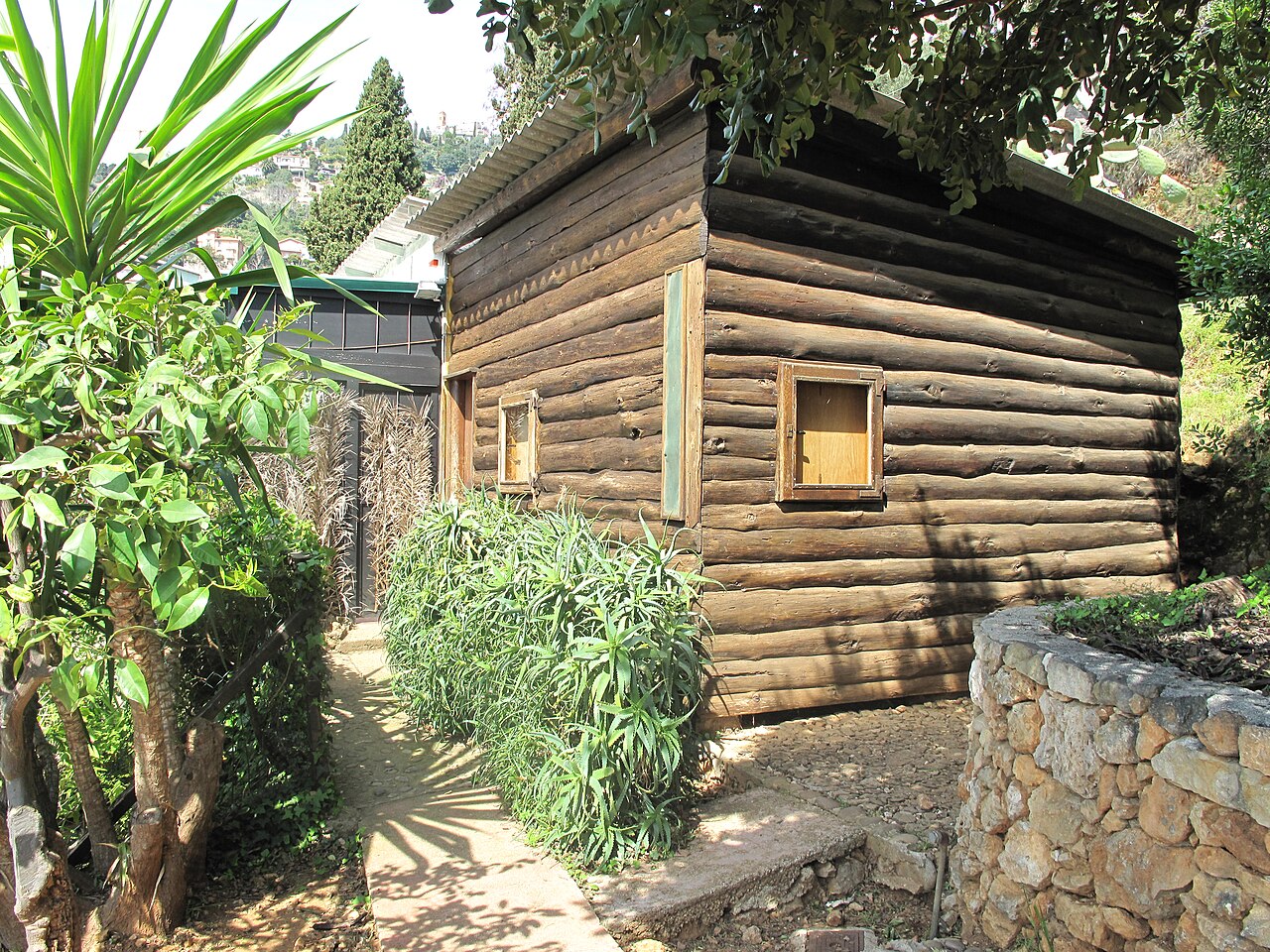
In 1951 Thomas Rebutato, owner of the bar-restaurant L'Étoile de mer, allowed Le Corbusier to build this timber cabin, prefabricated in Corsica and assembled on site. Designed on the measurements of the Modulor, it fits a rest corner, a work corner, a toilet and a washbasin into a cell of 3.66 × 3.66 m and extends the architect's research into living space reduced to its minimum. Le Corbusier stayed there every summer until his death in 1965; the site has been on the UNESCO World Heritage List since 2016 and can be visited on a guided tour with Cap Moderne.
Affiliate links — booking through Verrière helps fund our research, at no extra cost to you.
History
During a stay at Villa E-1027, designed by Eileen Gray and Jean Badovici, Le Corbusier gets to know Thomas Rebutato, a former plumber from Nice who has just built a bar-restaurant nearby, L'Étoile de mer. He takes his meals there and becomes very close to the owner.
In 1951, Thomas Rebutato allows him to build a cabin attached to the restaurant. Le Corbusier entrusts the work to Charles Barberis, a Corsican carpenter who prefabricates the timber elements in Ajaccio and assembles them on site. The Cabanon is the culmination of his work on a rational, functional living space reduced to its minimum, designed on the measurements of the Modulor. "For my own use, I have a château on the Côte d'Azur that measures 3.66 × 3.66 m; it was for my wife; it was wonderful, it was extravagant inside in comfort and kindness," he told Georges Charensol on the radio in 1962.
In 1954, Le Corbusier has a building-site hut made of prefabricated elements installed a few metres from the Cabanon, to have a workspace; his assistant Fernand Gardien insulates its walls with glass fibre and fits a plywood lining inside. In 1957 he builds the five Unités de camping for Thomas Rebutato.
He spends every summer at the Cabanon with his wife Yvonne until her death in 1957, then alone until his own death in 1965, during a swim at the foot of the Cabanon. Since 2016 the Cabanon site, with the workshop hut, the Unités de camping and L'Étoile de mer, has been inscribed on the UNESCO World Heritage List together with sixteen other works by Le Corbusier.
Architecture
Designed in the spirit of traditional huts, the Cabanon is built of wood, clad in pine slab-wood siding and topped with a single-pitch Eternit roof. Everything fits within a square cell of 3.66 × 3.66 m and 2.26 m in height, measurements borrowed from the Modulor. Within it, Le Corbusier arranges a rest corner, a work corner, a toilet and a washbasin.
Two windows, 70 cm square and fitted with folding shutters, frame the Mediterranean on one side and a hundred-year-old carob tree on the other. The furnishings are a wooden bed with a headrest and storage, a wardrobe, a table with added shelving, stools and a coat rack. Corsica is where all the wooden panels and the furniture were prefabricated, before being put together at the site.
The red curtain of the toilet, the yellow parquet, the green, red and white ceiling panels and the pegs of the coat rack bring touches of colour to the minimalist interior. A mural by Le Corbusier titled Bulls (Taureaux) adorns the wall of the entrance passage, while the inside face of the two folding shutters shows female figures inspired by Yvonne. A door leads straight into the guinguette, where the couple ate their meals; outside, an open-air shower and a concrete table complete the amenities.
In his correspondence with Charles Barberis, Le Corbusier spoke of producing this prototype in series.
Use today
The Cabanon is part of the Cap Moderne complex, which also includes Villa E-1027 and its garden; the Centre des monuments nationaux manages the complex, which is open to visitors.
Now recognised as a manifesto of modern architecture, it has been the subject of a replica made by Cassina, regularly shown to the public in exhibitions.
Visiting
The Cap Moderne site opens from 1 April to 31 October; it then closes for the winter and reopens in April.
The Cabanon can only be visited with a guide, as part of the Cap Moderne guided tour, which covers Villa E-1027 and the Le Corbusier site: independent visits are not offered and online booking is compulsory. The tour lasts 2 hours, in French or English; it leaves from the reception, the Cap Moderne Hangar, where visitors meet 15 minutes before departure.
Photography is forbidden inside the Cabanon; only strictly personal photos are allowed during the pauses the guides allow. The site is not suitable for visitors with reduced mobility, children under 7 are not recommended, and pushchairs and animals are not allowed.
The reception is on the forecourt of the Cap-Martin Roquebrune railway station, served by TER trains on the Nice–Ventimiglia line.
43.76° N, 7.46° E
Greenhouses nearby
Architecture nearby
By the same architect
Sources (11)
- capmoderne.monuments-nationaux.fr/
- capmoderne.monuments-nationaux.fr/visiter/informations-pratiques
- capmoderne.monuments-nationaux.fr/visiter/visites-et-activites
- capmoderne.monuments-nationaux.fr/decouvrir/histoire-de-cap-moderne-eileen-gray-et-le-corb
- fondationlecorbusier.fr/oeuvre-architecture/realisations-cabanon-de-le-corbusier-roquebrun
- sites-le-corbusier.org/oeuvres/cabanon-de-le-corbusier-roquebrune-cap-martin/
- fr.wikipedia.org/wiki/Roquebrune-Cap-Martin
- openstreetmap.org/way/138596959
- wikidata.org/wiki/Q1809766
- sites-le-corbusier.org/en/oeuvres/cabanon-de-le-corbusier-roquebrune-cap-martin/
- fondationlecorbusier.fr/en/work-architecture/achievements-le-cabanon-roquebrune-cap-martin
Affiliate links — booking through Verrière helps fund our research, at no extra cost to you.