Grave of Le Corbusier and Yvonne Gallis
Roquebrune-Cap-Martin
Sources checked November 2026
- Year
- 1958-1965
- Architect
- Le Corbusier
- Type
- Tomb (municipal cemetery)
- Access
- In the municipal cemetery, free access
Following the 1957 death of his wife Yvonne, Le Corbusier designed a grave for the two of them in the cemetery of Roquebrune-Cap-Martin, the commune where he had built the Cabanon. A cement-stone slab brings together a cylindrical vase, a shell imprint, Yvonne's bronze cross and two enamel plaques, facing the sea. He has lain there since 1965.
Affiliate links — booking through Verrière helps fund our research, at no extra cost to you.
History
Yvonne, Le Corbusier's wife, died on 5 October 1957. The architect then took up the project of a grave that would hold them both. He settled on the cemetery of Roquebrune-Cap-Martin, the commune of his summer stays, where he had built his "château", the Cabanon, and the place that best expressed his love of the Mediterranean.
On 25 March 1958 the mayor of Roquebrune granted him a thirty-year concession for plots 3 and 4 of section J, 4 m² in all. To build the grave he called on his friend the carpenter Charles Barberis, who made the formwork, and on the mason Salvator Bertocchi, in charge of the cement-stone slab; Robert Rebutato bought the materials and the enameller Jean Martin made two white enamel plaques. Yvonne's epitaph is painted on the lower plaque, which Le Corbusier heightened with blue to evoke the sea. After the architect's death, on 27 August 1965, the upper plaque was replaced with one adorned with yellow and red, the colours of a sunlit, glowing sky.
The grave is not protected as a historic monument. In 2000 it received the Patrimoine du XXe siècle label, now Architecture contemporaine remarquable, and it lies in the buffer zone of the Cabanon, part of the World Heritage series of Le Corbusier's architectural work.
Architecture
In a letter to the mayor dated 16 May 1958, Le Corbusier described his design: a funerary slab carrying a prismatic block 53 cm high and 43 cm wide, whose top slopes down to 10 cm at the far end, over a length of 70 cm. The block serves as the closure through which the ashes are put in.
The grave forms a large square divided into geometric shapes. Against the block Le Corbusier built a cylindrical vase in masonry, which recalls the Purist compositions of the 1920s and makes the geometry of the whole more complex. The slab is not solid, leaving room for Mediterranean plants. On Yvonne's side, to the right, he pressed the shape of a shell into the slab and set in it the bronze cross she never parted with; on the left he kept his own place, marked by a brightly coloured enamel epitaph.
Use today
Le Corbusier rests here beside Yvonne. As he had firmly asked when she died, the grave is meant to be appreciated "without flowers or wreaths".
Visiting
The grave is in the municipal cemetery of Roquebrune-Cap-Martin, freely accessible every day. It faces the Mediterranean, at the very spot where Le Corbusier died of a heart attack.
43.77° N, 7.46° E
Greenhouses nearby
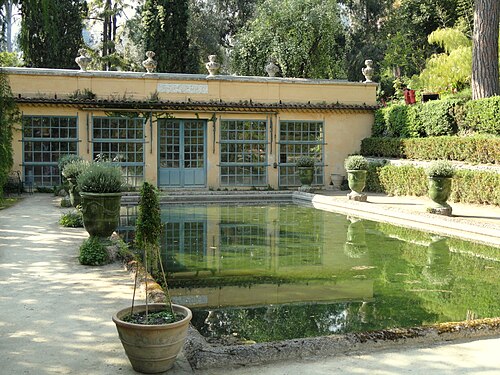
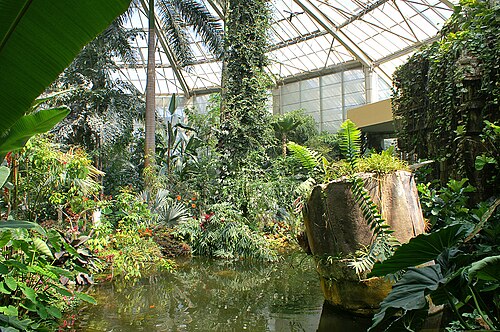
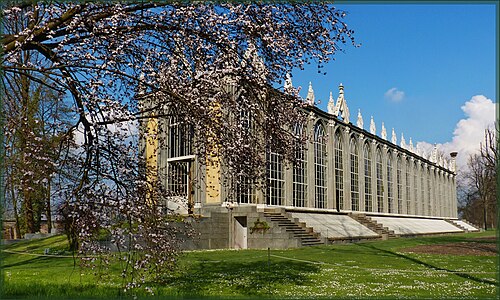
Architecture nearby
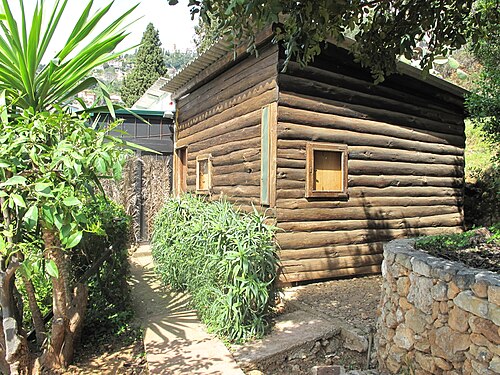
By the same architect
Sources (6)
- fondationlecorbusier.fr/oeuvre-architecture/realisations-tombe-de-le-corbusier-roquebrune-
- fondationlecorbusier.fr/en/work-architecture/achievements-le-corbusiers-grave-roquebrune-c
- pop.culture.gouv.fr/notice/merimee/ACR0001294
- cotedazurfrance.fr/offres/tombe-de-le-corbusier-roquebrune-cap-martin-fr-3001163/
- culture.gouv.fr/regions/drac-provence-alpes-cote-d-azur/politique-et-actions-culturelles/a
- cotedazurfrance.com/offers/tombe-de-le-corbusier-roquebrune-cap-martin-en-3001163/
Affiliate links — booking through Verrière helps fund our research, at no extra cost to you.