Yale Center for British Art
New Haven, Connecticut
Sources checked November 2026
- Year
- 1969-1977
- Architect
- Louis Kahn
- Type
- Art museum and study center
- Access
- Open to the public, free admission (official website, November 2026)
Established through Paul Mellon's gift to Yale University, the Yale Center for British Art is Louis Kahn's last building, put up across the street from the Yale University Art Gallery. Kahn died in 1974; the firm Pellecchia & Meyers completed the project and the museum opened on April 19, 1977. Outside, a concrete frame holds panels of matte steel and reflective glass; inside, the plan is organized around two courtyards.
Affiliate links — booking through Verrière helps fund our research, at no extra cost to you.
History
Paul Mellon, Yale class of 1929, gave the university the building, works of art and an endowment in 1966, which established the Yale Center for British Art; he insisted that the center not carry his name. Louis Kahn designed it between 1969 and 1974, across the street from the Yale University Art Gallery, his first major commission, opened in 1953. Kahn died in 1974: the firm Pellecchia & Meyers, as successor architect, completed the project, with Pfisterer, Tor & Associates as structural engineers. The center opened to the public on April 19, 1977.
Maintenance and renovations have since aimed to respect Kahn's plans. In 1996 most of the windows were replaced with triple-glazed units fitted with adhesive UV filters. In 1998 the roof system was reengineered, with a new drainage system, and all 224 roof domes were reassembled during the "Year of the Roof." In 2005 the American Institute of Architects gave the center its Twenty-five Year Award, which four other Kahn buildings had already received: the Yale University Art Gallery, the Salk Institute, the Phillips Exeter Academy Library and the Kimbell Art Museum.
A conservation plan published in 2011 by Peter Inskip and Stephen Gee with Constance Clement guided three phases of work. The last, in 2015-16 under Knight Architecture, replaced the movable partitions of the Long Gallery with new ones based on a drawing Kahn had completed before his death; the building reopened in May 2016. The museum then closed from February 2023 to March 2025: the 224 original Plexiglas domes were replaced by domes glazed in polycarbonate, and the original halogen lighting by LEDs.
Architecture
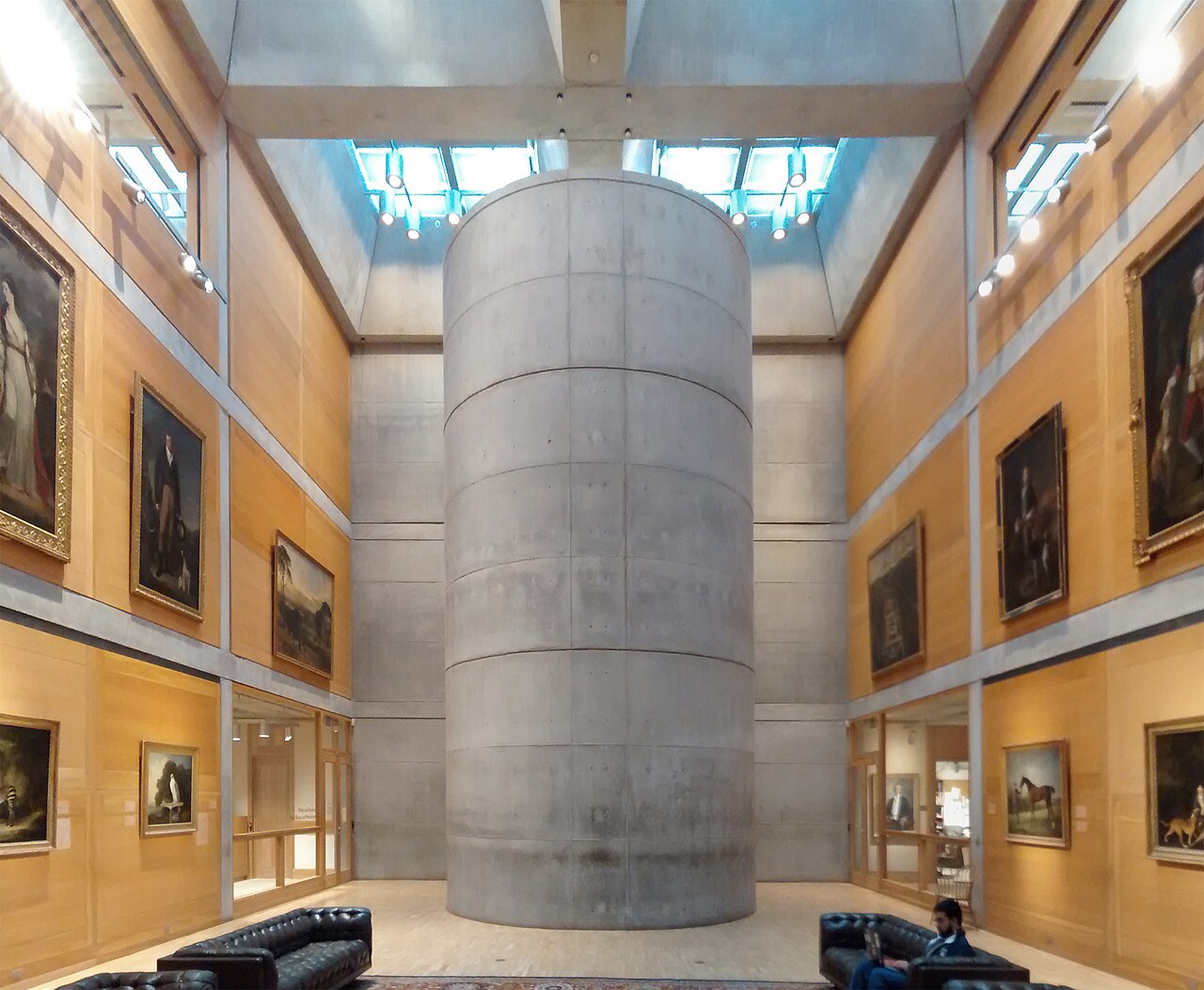
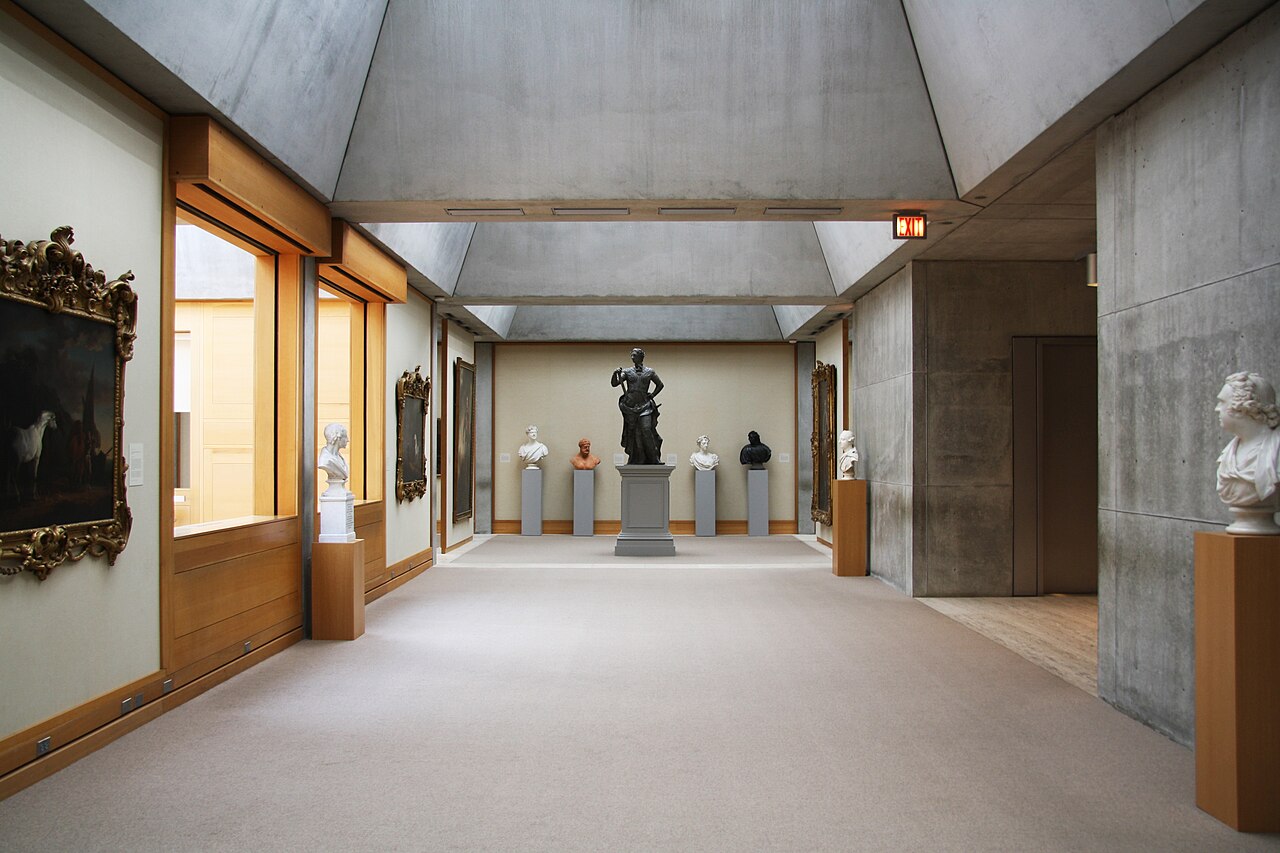
The exterior structural frame is concrete, infilled with panels of matte steel and reflective glass. Inside, the geometric plan is organized around two courtyards, and a sober palette of natural materials prevails, among them travertine, white oak, concrete and Belgian linen. In the galleries, Belgian linen covers the display walls, and wool carpet sits alongside white oak trim and travertine floor tiles.
Kahn wanted intimate galleries where works are seen in diffused natural light: he meant to let in as much daylight as possible and to use artificial lighting only on dark days and in the evening. The roof, which he called the building's "fifth elevation," carries 224 skylight domes, originally of Plexiglas.
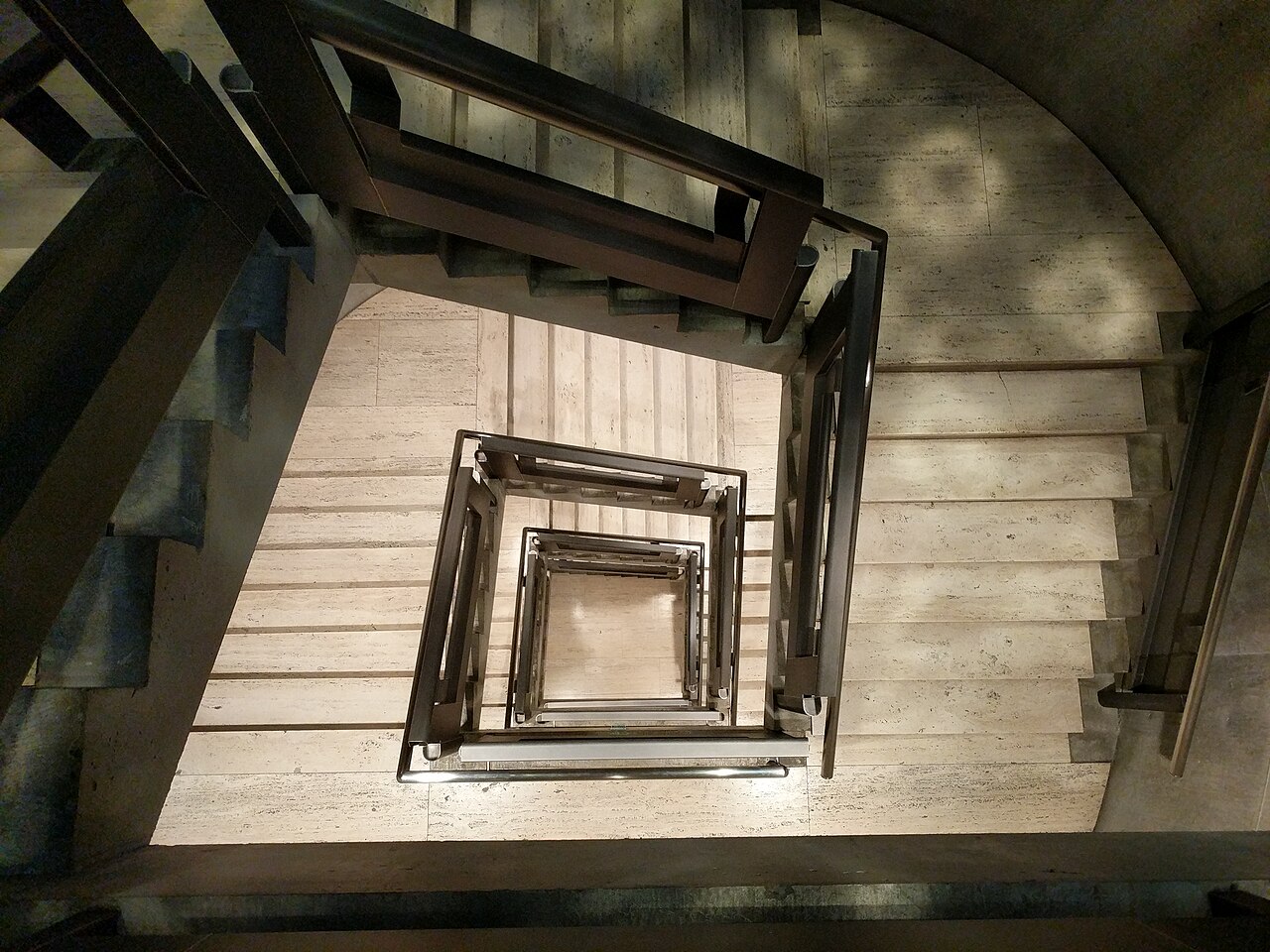
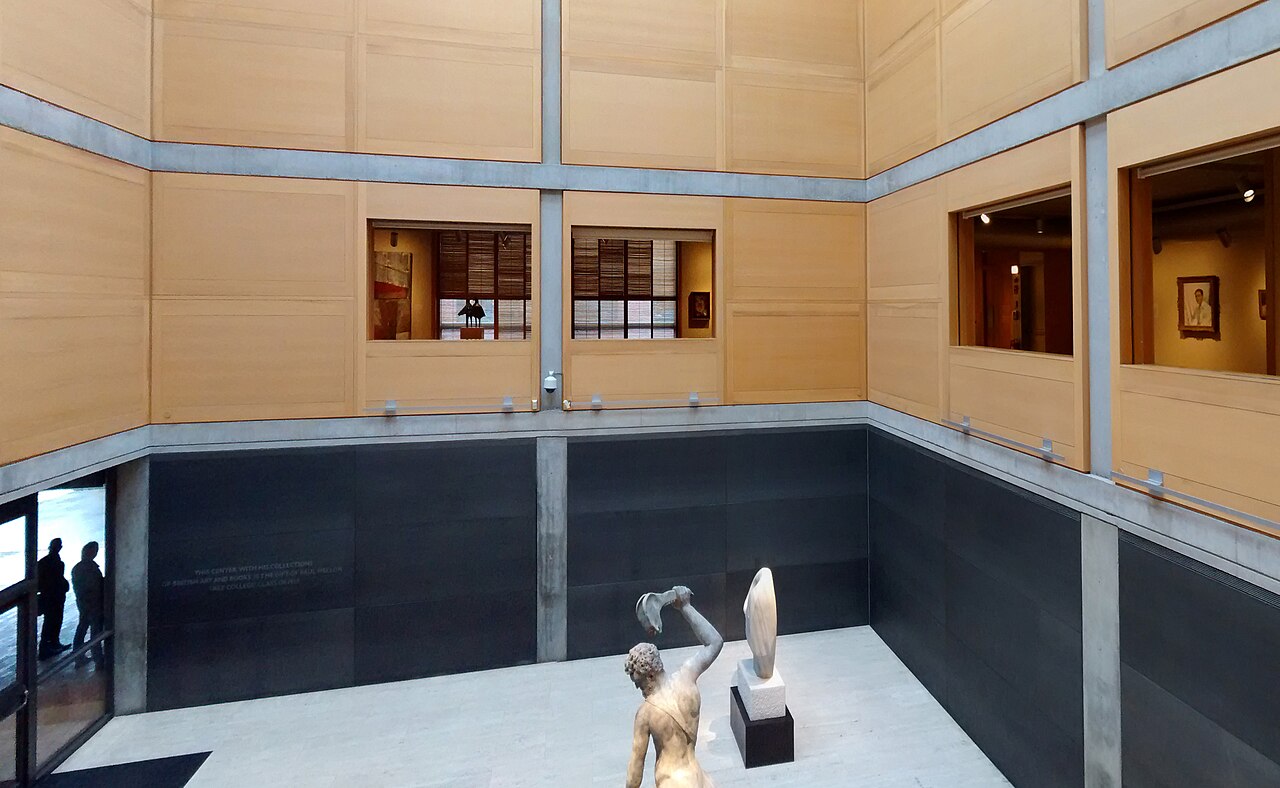
The three-story Library Court lies at the heart of the center: it holds the cylindrical concrete stair tower and links the galleries, the Reference Library and Archives, and the Study Room. The four-story Entrance Court is lined with white oak panels. Shops, part of the design from the start, occupy the ground floor.
Use today
The museum shows its collection of British art, from the fifteenth century to the present. Gallery and study center share the building, with a reference library, archives, and a study room where works on paper, rare books and manuscripts can be examined.
Visiting
Admission is free. The museum opens Tuesday to Saturday from 10 am to 5 pm (7 pm on Wednesdays) and on Sunday from 11 am to 5 pm. It shuts on Mondays, Yale Commencement apart, and for Juneteenth, the Fourth of July, Thanksgiving, Christmas Eve, Christmas Day and New Year's Day.
Visitors go in at 1080 Chapel Street, through the entrance at the southwest corner where Chapel Street meets High Street; the museum lies between High and York Streets. Photography is allowed for non-commercial use and without flash, unless otherwise indicated.
Photos
41.31° N, 72.93° W
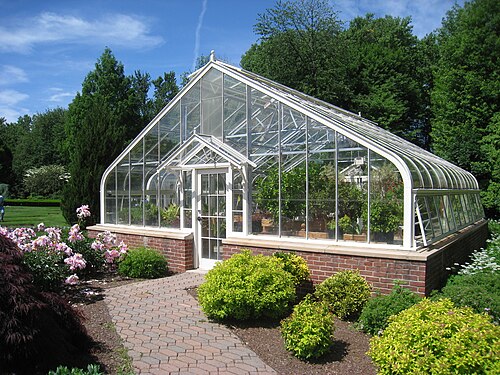
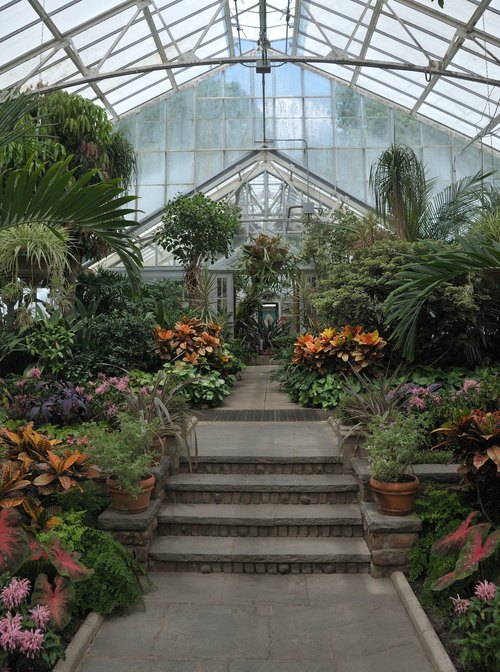
Greenhouses nearby
Architecture nearby
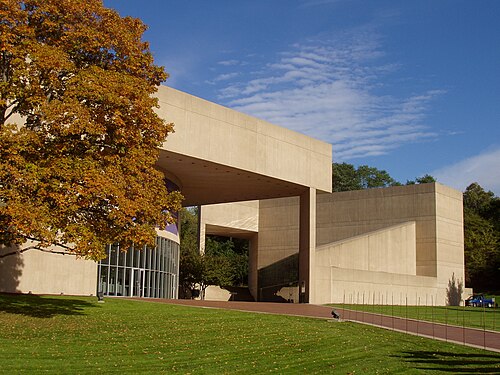
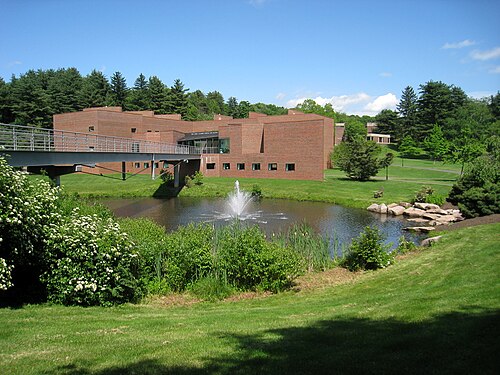
By the same architect
Sources (10)
- britishart.yale.edu/architecture
- britishart.yale.edu/hours-and-visitor-information
- britishart.yale.edu/stories/conserving-yale-center-british-art-history
- britishart.yale.edu/about-yale-center-british-art
- britishart.yale.edu/stories/paul-mellon-founder
- britishart.yale.edu/sites/default/files/inline/Building%20Conservation%20Project%20Fact%20
- philadelphiabuildings.org/pab/app/pj_display_alldates.cfm/17064
- britishart.yale.edu/stories/aia-twenty-five-year-award
- ctpublic.org/news/2025-03-21/yale-center-for-british-art-prepares-to-reopen-after-two-year
- philadelphiabuildings.org/pab/app/pj_display.cfm/17064
Affiliate links — booking through Verrière helps fund our research, at no extra cost to you.