Yumin Art Nouveau Museum (유민 아르누보 뮤지엄), formerly Genius Loci
Seopjikoji (섭지코지), Seogwipo (서귀포), Jeju Island (제주)
Sources checked October 2026
- Year
- 2008
- Architect
- Tadao Ando
- Type
- Art Nouveau glass museum in a former meditation space
- Access
- Open to the public, paid admission, 9 am to 6 pm, ticket office closes at 5 pm, closed one Tuesday a month (official website, October 2026)
On the Seopjikoji headland on the east of Jeju Island, Tadao Ando designed Genius Loci, a largely buried building of exposed concrete and basalt, where water, wind, light and sound can be felt. A space for meditation at first, it has housed the Yumin museum since 2017, devoted to Art Nouveau glass of the École de Nancy. Visitors come in through three gardens, of stone, of women and of wind, then pass between two walls of falling water and descend towards the galleries.
Affiliate links — booking through Verrière helps fund our research, at no extra cost to you.
History
Ando named the work Genius Loci, the « spirit of place » (장소의 혼), a protective guardian of this land: a title borrowed from a book by a Norwegian architectural theorist, and a name tied to the Seopjikoji headland, which the people of Jeju hold sacred. The meditation space opened on 20 June 2009 within the Phoenix Island resort. Its three underground galleries then showed works by Moon Kyungwon (문경원).
In June 2017 the place became a museum: it shows Art Nouveau glass of the École de Nancy, gathered by Hong Jin-gi (Yumin, 維民; 1917-1986), former chairman of the Joongang Ilbo. The Danish architect Johan Carlsson, founder of JAC Studios, designed the exhibition, which was named World Interior of the Year 2018 by the INSIDE festival.
Architecture
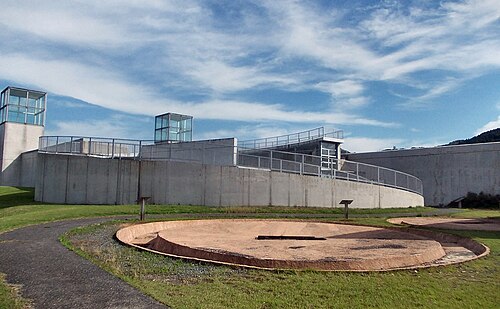
Ando sank the building into the ground so as not to spoil the view of Seongsan Ilchulbong (성산일출봉) or the coast: most of the construction is buried, on one level below ground and one at ground level, with 1,185 m² of floor area, in reinforced concrete, with exposed concrete and basalt as the main materials. He conceived the place in the image of the original nature of Seopjikoji, so that water, wind, light and sound can be felt there.
The entrance pavilion, of exposed concrete and glass, gives onto a small courtyard enclosed by walls. Visitors then walk through three gardens that take up the « three abundances » of Jeju, stone, women and wind: a stone garden, where basalt lies spread in heaps; a women's garden, an oval bed of red flowers; and a wind garden, a square of exposed-concrete walls in which miscanthus grows as tall as a person, with gaps to the south and north that let the wind through.
The building is wrapped in a double wall: exposed concrete inside, basalt outside, laid in the traditional manner of Jeju. This basalt wall is the « stone gate » (돌의 문), the first one meets. Between the two walls, an outdoor ramp descends, turning around the central space. At the entrance, water runs off the sloping roofs as wall waterfalls on either side of the passage; a small strip window then frames Seongsan Ilchulbong, and the ramp, a maze on four sides, leads down to the galleries.
Below ground, three galleries, square except the second, which is round, open off cross-shaped vestibules; the fourth, at ground level, doubles as a rest lounge. The galleries receive little light, through strip windows 20 cm high: this dimness dates from when the place had to be dark to project images.
Use today
Four galleries show glass of the École de Nancy. The Inspiration Gallery takes nature as its theme; the Masterpiece Gallery shows on its own Émile Gallé's mushroom lamp Les Coprins, of which four other examples exist in the world; next comes the Peak of Art Nouveau Gallery; the last, at ground level, is devoted to Art Nouveau and Art Deco lamps.
The works include pieces by Émile Gallé, the Daum brothers, Eugène Michel, René Lalique and Gabriel Argy-Rousseau.
Visiting
The museum is open from 9 am to 6 pm, with a ticket office that closes at 5 pm, and is closed one Tuesday a month. Admission is paid; the audio guide is free, through the QR code on the leaflet. Food, drink and pets are not allowed in the galleries. There is no lift between the basement and ground level, which matters with a pushchair or wheelchair.
Seopjikoji is closed to private cars: leave yours in the car park in front of the Phoenix Island check-in centre and take the resort's free shuttle, about 5 minutes. Address: 107 Seopjikoji-ro, Seongsan-eup, Seogwipo-si (서귀포시 성산읍 섭지코지로 107).
33.43° N, 126.93° E
Greenhouses nearby
Architecture nearby
Sources (16)
- phoenixhnr.co.kr/static/jeju/architecture/yuminart1
- phoenixhnr.co.kr/static/jeju/architecture/yuminart
- phoenixhnr.co.kr/en/static/jeju/architecture/yuminart1
- visitjeju.net/kr/detail/view?contentsid=CNTS_000000000022158
- visitjeju.net/en/detail/view?contentsid=CNTS_000000000022158
- kieae.kr/_PR/view/?aidx=30964&bidx=2739
- jejusori.net/news/articleView.html?idxno=191681
- jejunews.com/news/articleView.html?idxno=2001479
- e-architect.com/korea/yumin-art-nouveau-collection-phoenix-jeju
- en.wikipedia.org/wiki/Tadao_Ando
- ko.wikipedia.org/wiki/유민미술관
- en.wikipedia.org/wiki/Phoenix_Island_Villa_Condo_%26_Club_House
- en.wikipedia.org/wiki/Seongsan_Ilchulbong
- openstreetmap.org/way/375498557
- openstreetmap.org/way/1495676219
- en.wikipedia.org/wiki/Moon_Kyungwon
Affiliate links — booking through Verrière helps fund our research, at no extra cost to you.