Kobe Children's Book Forest (こども本の森 神戸)
Chuo Ward, Kobe, Hyōgo (Higashi Yūenchi Park)
Sources checked October 2026
- Year
- 2022
- Architect
- Tadao Ando
- Type
- Children's library, public facility of the City of Kobe
- Access
- Open to the public, free admission, no reservation on weekdays; on weekends and public holidays, 90-minute time slots with places bookable online and places available on the day (official website, October 2026)
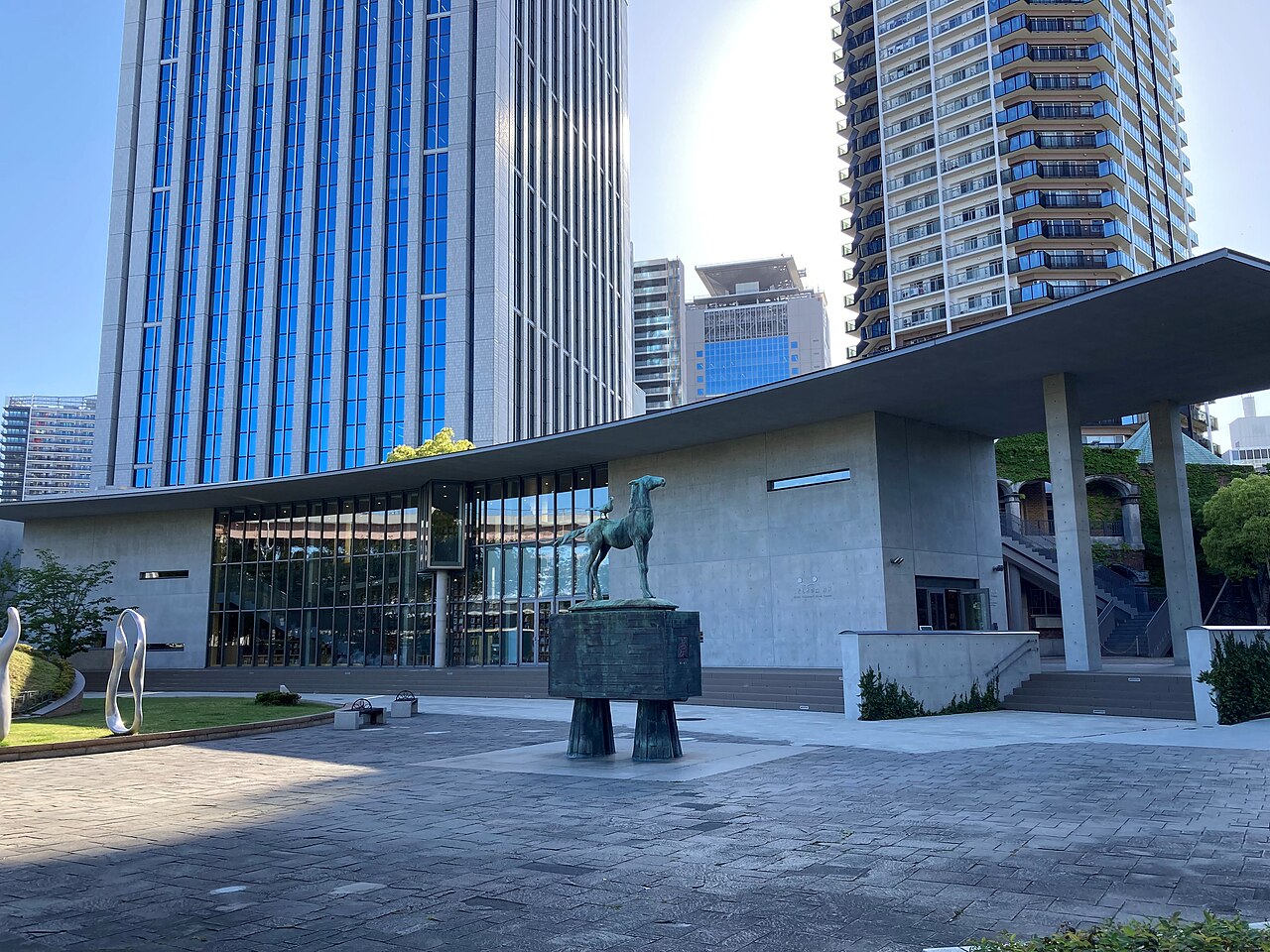
Tadao Ando designed this children's library and gave it to the City of Kobe: a two-storey reinforced-concrete building of about 570 m² in the southern part of Higashi Yūenchi Park, in front of the flower clock. Books cover the walls of a 9 m high void, and a cylindrical rest room is lit by a round skylight. Opened on 25 March 2022, it is free to enter, with no reservation needed on weekdays.
Affiliate links — booking through Verrière helps fund our research, at no extra cost to you.
History
The Kobe Children's Book Forest (こども本の森 神戸) began in September 2019 with a proposal from Tadao Ando: to give Kobe, which has rebuilt itself since the 1995 earthquake, a library where children can come to reading freely. In his message, Ando writes that as a child he could hardly read and later regretted it, and he asks children to halve the time they spend on smartphones so as to read, think and wrestle with their doubts, and so gain the strength to get through life. He also counts on the library to pass the memory of the disaster on to the next generations.
In June 2020 the city council accepted the gift on condition that the place be a public facility meant to develop children's sensibility and creativity. The name was settled in September; work on the building began on 12 November 2020 with a groundbreaking ceremony, was completed on 15 December 2021, and the building was handed over to the city on 28 December. Ando's office (安藤忠雄建築研究所) designed it and gave it. In February 2022 the actress Keiko Takeshita (竹下景子), who since 1999 has read poems by earthquake survivors, became honorary director; the library opened on 25 March 2022. The city received more than 20,000 books from residents, companies and organisations, as well as more than 150 million yen in donations for running costs and book purchases.
The city entrusted operation to a consortium, TRC & 長谷工 meet BACH, led by the company 図書館流通センター (TRC).
Architecture
It is a two-storey reinforced-concrete building of about 570 m² of floor area, in the southern part of Higashi Yūenchi Park (東遊園地), in front of the city's flower clock (こうべ花時計) and near the monument of remembrance and reconstruction (慰霊と復興のモニュメント), dedicated to the victims of the earthquake. It is connected to the first floor of the park's management building (東遊園地管理棟), over about 200 m².
On the ground floor, visitors enter a void 9 m high whose walls are bookshelves. In places, shelves of square bays run from the ground-floor level up to the ceiling of the upper floor, and a large staircase occupies the centre, where one can sit and read. On the first floor there is an aerial walkway (空中回廊). A large space is glazed: by day, the reflection on the glass makes the books hard to see, but after sunset the shelves inside stand out clearly.
The rest room, on the ground floor, is a high-ceilinged cylinder crowned by a round skylight: light from above envelops the room and gives it the solemnity of a church. It is one of the places in the library where the traits of Ando's architecture stand out clearly. It is furnished with church chairs: the box on the back of each seat, made for the Bible, holds books to be read quietly.
The stools and the signs announcing the themes are made of local wood, including trees that grew on Mount Rokkō (六甲山), a symbol of Kobe, crafted one by one. Ando also designed a green apple (青りんご), a symbol of youth.
Use today
It is a reading library with no target age: picture books, illustrated encyclopedias, literature, art books and foreign-language books sit side by side. It does not lend its books, but one book per person may be taken out to the wooden deck or into the park, except in rain.
The books are divided into fifteen thematic "forests", each named with the word 森 (forest): the forest of nature (しぜんの森); the forest of life (いのちの森), which also gathers books on the body, health and disasters; the forest of Kobe (こうべの森), devoted to the city's history and culture and to authors connected with it, with a section "1.17" on the earthquake of 17 January 1995; the forest beyond the sea (うみのむこうの森), with picture books in foreign languages; the forest of play (あそびの森); the forest of food (たべものの森); and even a forest of child-rearing (こそだての森), for parents.
Remembrance of the earthquake is one of the five principles of the place: passing on the value of life and the lessons of the disaster. On the first floor, near the lift, a painting titled "Sea" (海, 1995) by 大石可久也, a painter from Awaji Island (淡路島), given by Ando, is surrounded by picture books about the sea.
Visiting
Admission is free, from 9:30 to 17:00. The library is closed on Mondays (if the Monday is a public holiday it opens, and closes on the following weekday), during the stocktaking of the collections and at the turn of the year; it may also close temporarily in the event of a natural disaster.
On weekdays, entry needs no reservation. On Saturdays, Sundays, public holidays and during the Obon (お盆) holidays, entry is by 90-minute slots with full turnover, with places bookable online and places available on the day. The intended audience runs from infants to primary-school children, but everyone may enter.
Photography is allowed, without tripods or monopods (selfie sticks included); video is refused in principle, photos may not be used commercially, and visitors are asked not to photograph from the aerial walkway on the first floor, which is considered dangerous.
Address: 兵庫県神戸市中央区加納町6丁目1-1, in the park, 6 minutes' walk from exit 4 of Sannomiya-Hanadokeimae station (the municipal subway's Kaigan Line); the Sannomiya stations are 13 minutes' walk away. There is no car park, but there is a bicycle park reserved for visitors.
34.69° N, 135.20° E
Greenhouses nearby
Sources (19)
- kodomohonnomori-kobe.jp/
- kodomohonnomori-kobe.jp/about
- kodomohonnomori-kobe.jp/facility
- kodomohonnomori-kobe.jp/howto
- kodomohonnomori-kobe.jp/admission
- kodomohonnomori-kobe.jp/access
- kodomohonnomori-kobe.jp/book-selection
- city.kobe.lg.jp/documents/40788/20210621_bunka2.pdf
- kobe-np.co.jp/news/kobe/202203/sp/0015156446.shtml
- kobe-np.co.jp/news/sougou/202111/0014877609.shtml
- kobe-np.co.jp/news/sougou/202201/0015014843.shtml
- kobe-np.co.jp/news/sougou/202202/sp/0015031176.shtml
- hyogojapan.com/discover/kobe-childrens-book-forest/
- openstreetmap.org/relation/19508887
- openstreetmap.org/node/13070287716
- openstreetmap.org/way/180367443
- en.wikipedia.org/wiki/Keiko_Takeshita
- en.wikipedia.org/wiki/Mount_Rokkō
- en.wikipedia.org/wiki/Kaigan_Line
Affiliate links — booking through Verrière helps fund our research, at no extra cost to you.