Exhibition Greenhouse (Green Rest Area), Kitayama Botanical Garden (西宮市北山緑化植物園 展示温室/緑の休憩所)
Nishinomiya, Hyōgo Prefecture

Sources checked October 2026
- Style
- Small building with a glazed upper floor over a concrete level, topped by a glass pyramid skylight
- Status
- Open to the public; renovated and reopened in autumn 2022 as a "green rest area"
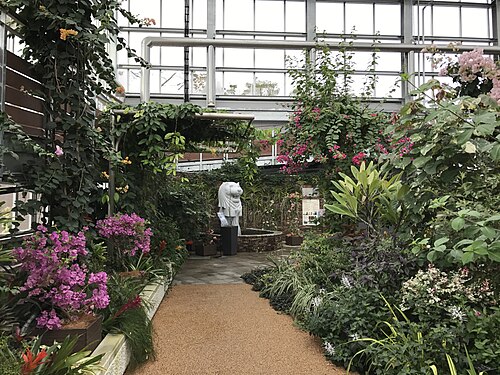
In Nishinomiya's municipal Kitayama Botanical Garden, opened in 1982 on the slopes of Mount Kabuto, the exhibition greenhouse is a small building whose upper floor is fully glazed and which is topped by a glass pyramid skylight. Renovated, it reopened in autumn 2022 as a "green rest area" (緑の休憩所): visitors sit among succulents, carnivorous plants and, depending on the season, streptocarpus and orchids. Japanese Wikipedia credits it with 260 species and 1,500 plants, undated.
Affiliate links — booking through Verrière helps fund our research, at no extra cost to you.
History
Kitayama Botanical Garden is a municipal facility of Nishinomiya, opened in 1982 as a hub for citizen greening. It covers about nine hectares, next to Kabutoyama Forest Park. According to Japanese Wikipedia it brings together an exhibition greenhouse, a gardening consultation office, a Japanese garden, a sukiya-style villa (Kitayama-sansō), replicas of pavilions from Shaoxing, Nishinomiya's sister city, and a plant production research centre that develops varieties suited to the city.
The only date of the exhibition greenhouse (展示温室) is that of its renovation: the City of Nishinomiya's page, updated in November 2023, says it reopened in autumn 2022 as a "green rest area" (緑の休憩所), a place where visitors can sit and spend a quiet moment among plants. The address of that municipal page keeps the old name (tenjionshitsu, "exhibition greenhouse"). In its list of the garden's facilities, the city now names only the green rest area.
Architecture and engineering
Photographs published on Wikimedia Commons (taken in June 2010, before the 2022 renovation) show a two-level building: a lower level in concrete, pierced by glazed doors with green frames and an arched window, and an upper floor whose walls are entirely glass, divided into small panes by a light metal grid. The roof, also glazed, carries a small glass pyramid skylight; vents and ventilation hoods can be seen on the glazing, and ivy climbs the concrete. A rounded concrete element projects from the façade at mid-height.
The building rises above a bank of rockwork and clipped shrubs. Nearby, a larger greenhouse with an inclined glass façade belongs to the plant production research centre. The municipal page shows the exterior, cacti on the windowsills and an interior of foliage plants with benches.
Plant collections
According to the municipal page, the greenhouse shows succulents and carnivorous plants; depending on the season, streptocarpus and orchids bloom there. The photo captions also mention cacti on the windowsills and foliage plants beside the benches. Japanese Wikipedia credits the exhibition greenhouse with 260 species and 1,500 plants of "greenhouse plants", undated and without saying what was kept after the 2022 renovation.
Next door, the Plant Production Research Center (植物生産研究センター) uses biotechnology to create varieties suited to Nishinomiya's climate. Its hall and front yard display plants from its work, such as the fuchsia "Angels' Earring" (エンジェルス・イヤリング), the veronica "Yume-murasaki" (ゆめむらさき), lilies and two cherry trees specific to the city; apart from the cherries and lilies, these plants are sold at the garden's shop.
Visiting
The city states that the garden is open all year, in daytime, with free admission. On the days the greenhouse can be entered, the city gives hours for the garden's facilities (consultation office, garden centre), closed on Wednesdays, whereas the older Japanese Wikipedia article cites only Friday, Saturday and Sunday. It is best to check with the city department before coming.
The Kayandō-chō (柏堂町) bus stop is directly in front of the garden; from Hankyu Shukugawa station, allow about fifteen minutes by bus. After the greenhouse, the walk leads to the Japanese garden, the Kitayama-sansō tea house (paid service), the pavilions inspired by Shaoxing, the rose and hydrangea beds and the medicinal herb garden.
34.76° N, 135.32° E
Greenhouses nearby
More greenhouses — Japan
Do you have a good photo of this greenhouse? Suggest it for this page →
Sources (9)
- nishi.or.jp/kotsu/kankyo/hanatomidori/shokubutsuen/ennaigoannai/garden_sisetu/tenjionshits
- nishi.or.jp/kotsu/kankyo/hanatomidori/shokubutsuen/index.html
- nishi.or.jp/kotsu/kankyo/hanatomidori/shokubutsuen/access_shokubutsu.html
- nishi.or.jp/kotsu/kankyo/hanatomidori/kenkyucenter/center.html
- nishi.or.jp/shisei/mayor/tekuteku_backno/tekuteku-R0507.html
- ja.wikipedia.org/wiki/北山緑化植物園
- en.wikipedia.org/wiki/Kitayama_Botanical_Garden
- wikidata.org/wiki/Special:EntityData/Q6417925.json
- commons.wikimedia.org/wiki/File:Kitayama_Botanical_Garden14n4592.jpg
Affiliate links — booking through Verrière helps fund our research, at no extra cost to you.