Exhibition Greenhouse (展示温室), Kobe Fruit & Flower Park Ōsawa (道の駅 神戸フルーツ・フラワーパーク大沢)
Kobe (Kita-ku, Ōsawa-chō), Hyōgo Prefecture
No freely licensed photo of this greenhouse yet. Do you have one? Suggest it for this page →
Sources checked October 2026
- Style
- Block of greenhouses with glazed walls and roofs, linked by a visitor corridor with a brick base
- Status
- Open to the public (entry to the interior may be refused to protect delicate varieties)
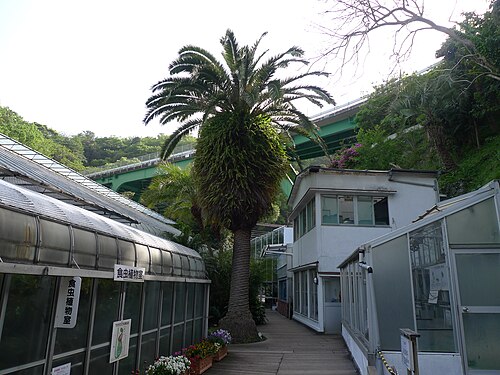
In the municipal park opened in 1993 in northern Kobe and turned into a roadside station (michi-no-eki) in 2017, the exhibition greenhouse is a group of glazed greenhouses clustered near the central shop. A brick-based visitor corridor runs along their glass walls, behind which potted plants and climbers can be seen. The operator says seasonal flowers and fruit plants are grown there all year, and that entry may be refused to protect delicate varieties.
Affiliate links — booking through Verrière helps fund our research, at no extra cost to you.
History
The greenhouse belongs to a park that Japanese Wikipedia and Wikidata date to 20 April 1993, the Kobe Municipal Fruit & Flower Park (神戸市立フルーツ・フラワーパーク), set in the north of the city on a "flowers and fruit" theme. According to Wikipedia, the city first entrusted its operation to the company Kobe Wine, which handed over in April 2014 to a foundation (Kobe Minorino Kōsha) before going into liquidation in July 2014; the same article and the park's own site also name the foundation Kobe Nōsei Kōsha as manager, without explaining how the two names relate. On 30 March 2017 the park became the roadside station Michi-no-Eki Kobe Fruit & Flower Park Ōsawa, with the opening of Farm Circus.
The official page on the greenhouse is dated 19 February 2017, a few weeks before that change. A hotel guide of April 2007 already describes the park as a leisure estate with a biotechnology theme and lists several greenhouses (see "Collections"). The park covers 100 ha according to Wikipedia, about 35 ha according to a tourist website.
Architecture and engineering
On the official photograph on the greenhouse page, a visitor corridor paved with herringbone brick runs along fully glazed walls in light metal frames, under a roof that is also glazed and fitted with pale shading screens; a low brick wall topped by a handrail serves as the base. Behind the glass, potted plants stand on benches and climbers rise toward the roof.
The park's official plan (May 2026) shows, next to the shop of the central garden, a set of adjoining greenhouses labelled "greenhouse" (温室), "event greenhouse" (イベント温室) and "horticultural biotechnology hall" (園芸バイテク館). On the aerial photograph of Japan's Geospatial Information Authority, the group forms a block of about 90 m by 110 m, with several rows of pitched-roof bays on either side of a long glazed central corridor, and four arched-roof bays at the south-east end; the OpenStreetMap outline does not show them. In a June 2026 post, the operator speaks of a "glass greenhouse" (ガラス温室).
Plant collections
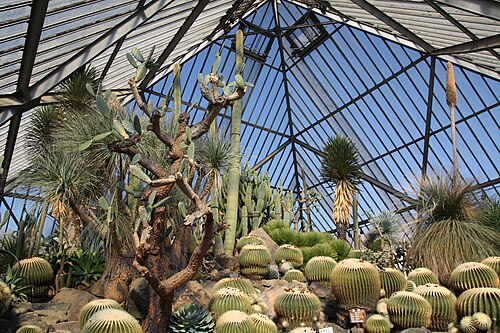
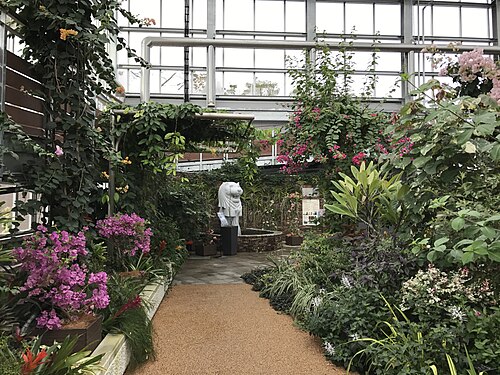
The operator says seasonal flowers and fruit plants are grown in the greenhouse all year, and that delicate varieties may justify refusing entry. Its photograph shows potted plants on benches and climbers, without a caption. A hotel guide of April 2007 says more: tissue-cultured plantlets of strawberry, lily and dahlia, freed of bacteria and viruses and delivered to the city's farmers; tuberous begonias from the Andes, which need more than fourteen hours of light to flower and are therefore grown under electric lighting; cacti and succulents of varied shapes; and a "tropical waterside" greenhouse where fish swim whose lower lip recalls an elephant's trunk. The park also runs workshops (a succulent arrangement on 25 October 2026, moss balls on 27 September) without saying whether they take place in the greenhouse.
Visiting
The greenhouse stands next to the shop of the central garden. Entry to the park is free, but access to the interior of the greenhouse may be refused to protect delicate varieties: it is best to ask at the information desk. Other visits cluster around it: the orchard, where fruit picking changes week by week (apples from 18 October 2026), the winter light show "Kobe Illuminage", announced from 23 October, a hotel with hot-spring baths, the monkey theatre and the amusement park. To get there, Shinki runs a bus line (no. 38) from Sannomiya station in about 35 minutes; from Okaba (Kobe Electric Railway) or Sanda (JR) stations, a taxi takes about 15 minutes.
34.85° N, 135.19° E
Greenhouses nearby
More greenhouses — Japan
Do you have a good photo of this greenhouse? Suggest it for this page →
Sources (8)
- fruit-flowerpark.jp/rdhphs/
- fruit-flowerpark.jp/inquiry/
- fruit-flowerpark.jp/tckcnh/
- fruit-flowerpark.jp/faq/
- fruit-flowerpark.jp/access/
- fruit-flowerpark.jp/wp/wp-content/uploads/2026/05/map_new7.jpg
- ja.wikipedia.org/wiki/%E9%81%93%E3%81%AE%E9%A7%85%E7%A5%9E%E6%88%B8%E3%83%95%E3%83%AB%E3%8
- ryuusenkaku.jp/navi/200705.html
Affiliate links — booking through Verrière helps fund our research, at no extra cost to you.