Museum of Gojō Culture and its Annex
Gojō, Nara Prefecture
Sources checked October 2026
- Year
- 1995
- Architect
- Tadao Ando
- Type
- Municipal local-history museum, semi-underground cylindrical building
- Access
- Open to the public, closed on Mondays and the day after a public holiday (official site, October 2026)
At Gojō, on the foot of the Kongō mountains, Tadao Ando designed a municipal local-history museum that opened in 1995: a semi-underground cylinder, clad in galvanised steel outside and in exposed concrete inside, with a circular plaza at its centre and a large void inside. An annex by the same architect, with a Japanese-style room and a multipurpose room, was completed in 1997. The building's nickname, “ごじょうばうむ” (Gojō Baum), was chosen by public call.
Affiliate links — booking through Verrière helps fund our research, at no extra cost to you.
History
The project grew out of a municipal history-museum construction programme begun in 1991. The museum, 市立五條文化博物館 in Japanese, was to collect and show the heritage handed down in the city of Gojō (五條) and to become the base from which a new “Gojō culture” (五條文化) is conveyed.
Designed by Tadao Ando's office (安藤忠雄建築研究所), it opened on 29 April 1995 as a standalone municipal facility devoted to exhibiting and studying local history. An annex, also designed by Ando, was completed in November 1997 to the west of the main building.
Since 1 April 2024 the museum has been run by a designated operator, an association, 一般社団法人日本文化資産支援機構.
Architecture
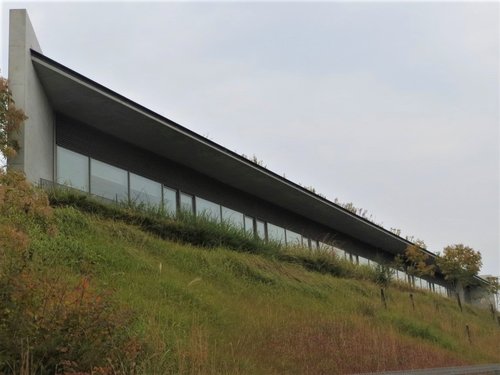
The main building is a semi-underground cylinder. The exterior is clad in galvanised sheet steel; inside, the walls are exposed concrete. A circular plaza occupies the centre of the building, with a large void inside. The structure is reinforced concrete on three levels, with 2,021.4 square metres of floor area.
The nickname “ごじょうばうむ” (Gojō Baum) was chosen by public call after this cylindrical exterior; Baum is German for “tree”. The museum stands at about 300 metres above sea level, on the southern foot of the Kongō mountains, next to the 5万人の森公園 park; the grounds are planted with a variety of trees that give flowers and autumn colour. The visitor route begins on the second floor, where a bridge looks out over the park and, in the distance, to Mount Takami (高見山) and the Ōmine range (大峯).
The annex, to the west, has a Japanese-style room of 14 tatami mats (two rooms of 8 and 6 mats) beside a multipurpose room; it covers 225.62 square metres of floor area.
Use today
The permanent displays tell the history of Gojō over three levels. On the second floor the entrance reconstructs the interior of the Hakkakudō (八角堂, octagonal hall) of Eizan-ji (榮山寺), a temple founded in the Nara period whose hall is a National Treasure, with photographs of its decorative paintings (an Important Cultural Property) and a section cut from a Nara-period cremation tomb. A stage tapestry by 河﨑眞左彌, an artist from Gojō, is also shown. A special exhibition room hosts temporary exhibitions.
On the first floor the route runs from the Palaeolithic to the Middle Ages: “the beginnings of Gojō culture”, “Gojō in the Kofun period”, “the capital and Gojō”, “estates and warriors of the Gojō region”, with separate themes on inscriptions in metal and stone, Buddhist art and the Man'yōshū (万葉). Among the exhibits is a copy of the Uchigawa cliff inscription (宇智川磨崖碑), a sutra and a standing figure of the late Nara period carved in a rock face on a tributary of the Yoshino.
On the ground floor the route covers the early modern period and folklore: old documents, illustrated maps and videos, then “festivals and rites”, with the Dadadō Oni-hashiri (陀々堂の鬼はしり), a fire festival handed down from the Muromachi period and designated an Important Intangible Folk Cultural Property, in which a father demon, a mother demon and a child demon circle the temple's main hall with torches to drive out calamity. Also shown are the okariya (御仮屋) put up for the autumn festivals, the tools of the woodturners (木地師, kijishi) of the Ōto (大塔) area and the Shinohara dance (篠原おどり). The Tenchūgumi incident (天誅組の変), launched in 1863 by a band of rōnin loyal to the emperor and hostile to foreigners around Yoshimura Toratarō (吉村虎太郎), is presented as a forerunner of the Meiji Restoration.
The circular plaza serves as a place to rest and eat; visitors look up at the sky there, and can try the sound from the centre. The third-floor special exhibition room and the annex's Japanese-style room are also open to residents for cultural and training activities.
Visiting
The museum is open from 9:00 to 17:00 (last entry 16:30). It is closed on Mondays, on the day after a public holiday and from 29 December to 3 January, and also closes when a weather warning, such as a storm warning, is in force for northern Gojō. Admission is charged (reduced rate for high-school and university students), free up to junior high school and for holders of a disability certificate with one companion; payment is by cash only.
Address: 930-2 Kitayama-chō, Gojō, Nara Prefecture (〒637-0091). From JR Gojō station it is about 10 minutes by taxi; by car, about 5 minutes from the Gojō interchange of the Keinawa Expressway (京奈和自動車道).
34.38° N, 135.69° E
Greenhouses nearby
Architecture nearby
Affiliate links — booking through Verrière helps fund our research, at no extra cost to you.