Saka no Ue no Kumo Museum
Matsuyama, Ehime
Sources checked October 2026
- Year
- 2006
- Architect
- Tadao Ando
- Type
- Literary and historical museum (Shiba Ryōtarō's novel)
- Access
- Open to the public, closed on Mondays as a rule; paid exhibition rooms, free first floor (official site, October 2026)
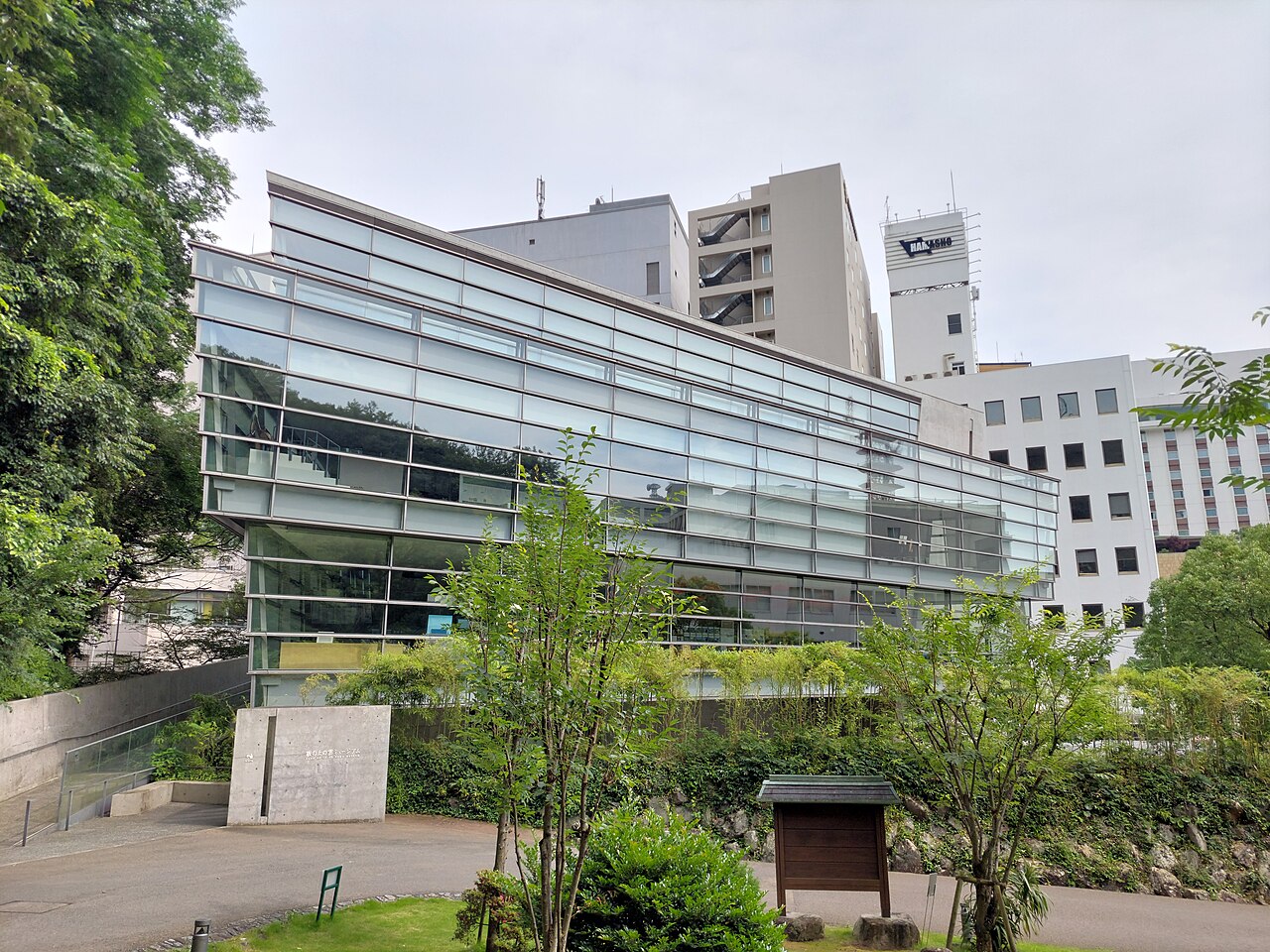
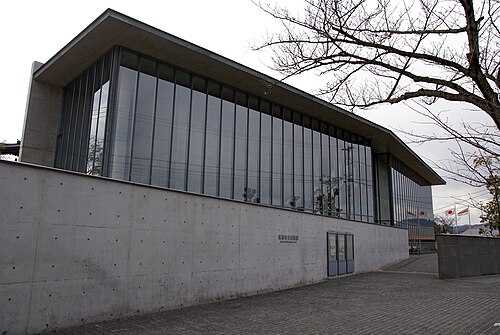
In Matsuyama, on the southern flank of the castle hill, the museum devoted to Shiba Ryōtarō's novel fills a four-storey Tadao Ando building with one basement level, an inverted triangular pyramid that widens by 5 degrees toward the sky. A single slope joins the levels, recalling the novel's heroes who climbed slopes of their own. On the free-access first floor, a corner presents Ando's work, and since 2025 there is a children's library that the architect gave to the city.
Affiliate links — booking through Verrière helps fund our research, at no extra cost to you.
History
The museum opened in April 2007 as the central facility of the City of Matsuyama's “Saka no Ue no Kumo Field Museum” plan (坂の上の雲フィールドミュージアム構想), which treats the whole city as a museum without a roof. Its name is the title of a novel by Shiba Ryōtarō (司馬遼太郎, 1923-1996), serialised in the Sankei Shimbun newspaper from 22 April 1968 to 4 August 1972 in 1,296 instalments. It follows three heroes born in Matsuyama: the brothers Akiyama Yoshifuru (秋山好古) and Akiyama Saneyuki (秋山真之), both soldiers, and the poet Masaoka Shiki (正岡子規), who renewed the haiku. The title, 坂の上の雲, literally means “a cloud above the slope”.
Construction of the building, designed by Tadao Ando's office (安藤忠雄建築研究所), began on 22 December 2004 and ended on 30 November 2006.
In 2022 Ando proposed adding a children's library to the museum, “Kodomo Hon no Mori Matsuyama” (こども本の森 松山). The city and his office signed an agreement in January 2023, work began in April 2024, the building was finished in March 2025 and the library opened on 28 July 2025, a gift from Ando to the city.
Architecture
The museum has four storeys above ground and one basement, in steel-reinforced concrete. It stands between the castle hill and the city centre and seeks harmony with Matsuyama Castle (松山城) and the neighbouring Bansuisō (萬翠荘). Its shape is an inverted triangular pyramid that widens by 5 degrees toward the sky.
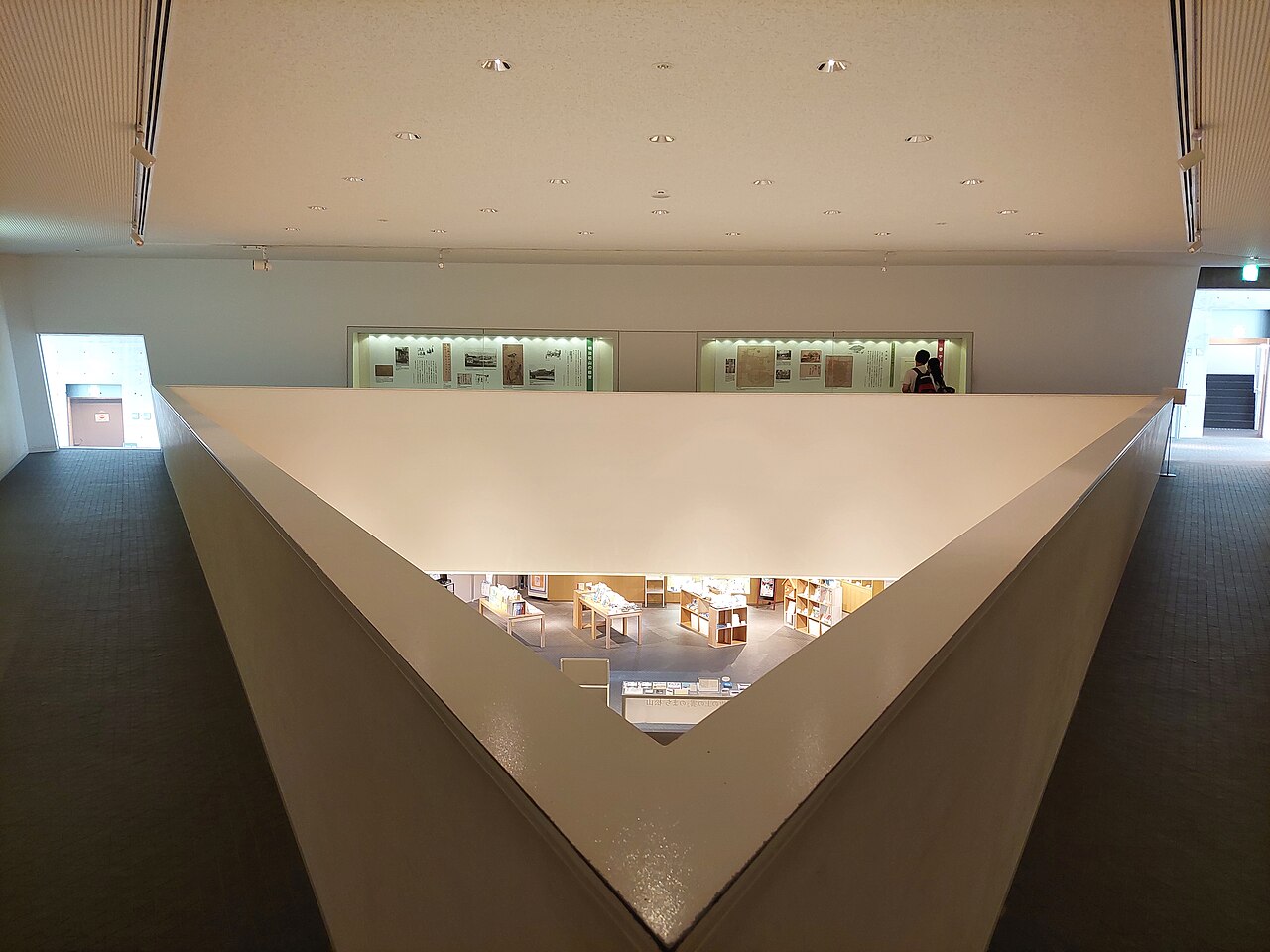
The floors are joined by one continuous slope, designed to evoke the novel's heroes who climbed the slope with the cloud in view. Visitors move upward along it: a “newspaper wall” reproduces all 1,296 instalments of the serial across the wall, and photographs of Meiji-era Matsuyama are shown with Shiki's haiku.
The 2025 children's library is built on the west side, above a garden of water and greenery. Its envelope is a glass wall that leans outward as it rises; it follows the museum's design code but is an ellipse where the museum is a triangle, and this contrast of shapes is meant to form a new landmark for the urban project tied to the novel. The building stands on pilotis because its main level is aligned with that of the museum's library lounge; the oval, single-volume reading room thus connects to the museum's public space. Inside, a green apple designed by Ando symbolises youth, after Samuel Ullman's poem “Youth”.
Use today
The exhibitions occupy the second and third floors. Room 1 presents the novel and the Meiji era, with a chronology, documents and film, and lets visitors stand beside a horse of the height used by Japanese cavalry of the time. Room 2 follows the three heroes and displays objects they used. Room 3 hosts a temporary exhibition on a new theme each year.
The first floor is free: a shop and information desk, a hall used for concerts and readings, a library lounge with books on the novel and the Meiji era, and a café serving only drinks and sweets. In the lounge, a corner devoted to Tadao Ando (“安藤忠雄 建築の軌跡”, Tadao Ando: Trajectory of Architecture) shows a film of about 13 minutes, 18 photographs of his works, the museum's design documents and books about the architect.
The children's library, reached from this lounge, holds about 4,300 books, chosen chiefly by book director Haba Yoshitaka (幅允孝) and sorted into nine themes, one of which, near the entrance, gathers books on modern history that link to the museum. Books cannot be borrowed.
Visiting
The museum is open from 9:00 to 18:30, with last entry at 18:00. It is closed on Mondays as a rule (“原則月曜日”); a calendar gives the details, and each year a closure in February and March allows the exhibitions to be changed. The exhibition rooms are charged, at a reduced rate for people aged 65 and over and for high-school students, and free for junior-high students and younger; the first floor and the children's library need no exhibition ticket. Many visitors spend between 1 hour and 1 hour 30 minutes.
The children's library runs in 90-minute slots with a full turnover, 30 places per slot, of which 20 can be booked online (from 14 days before to the day before) and 10 are given on the day.
The building may be photographed; close-ups of exhibits are refused. There is no visitor car park: the simplest way is the city tram to the Ōkaidō (大街道) stop, then about a 2-minute walk.
Photos
33.84° N, 132.77° E
Greenhouses nearby
Architecture nearby
Sources (16)
- sakanouenokumomuseum.jp/
- sakanouenokumomuseum.jp/about/construction/
- sakanouenokumomuseum.jp/guide/open/
- sakanouenokumomuseum.jp/guide/qa/
- sakanouenokumomuseum.jp/guide/access/
- sakanouenokumomuseum.jp/display/ando/
- sakanouenokumomuseum.jp/inside/floor4f/
- sakanouenokumomuseum.jp/about/story/
- kodomohonnomori-matsuyama.jp/
- kodomohonnomori-matsuyama.jp/about/
- kodomohonnomori-matsuyama.jp/facility/
- kodomohonnomori-matsuyama.jp/guide/
- current.ndl.go.jp/car/256312
- ja.wikipedia.org/wiki/坂の上の雲ミュージアム
- wikidata.org/wiki/Q7402728
- api.openstreetmap.org/api/0.6/way/216404934/full.json
Affiliate links — booking through Verrière helps fund our research, at no extra cost to you.