Tropical Greenhouses of the Conservatoire botanique national de Brest
Brest, Brittany
Entry updated on October 1, 2026
- Style
- Conservation greenhouses with four climate rooms
- Dimensions
- ≈1,000 m² of greenhouses
- Status
- Open to the public at certain times of year, admission charged
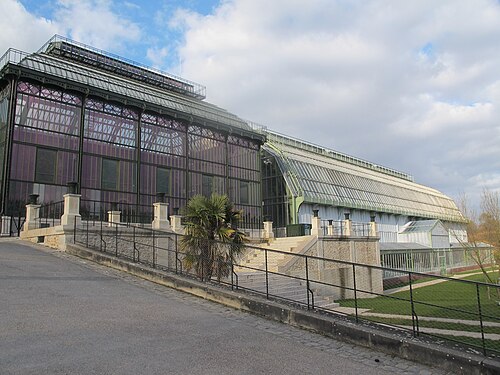
The Conservatoire botanique national de Brest, created in 1975 by Jean-Yves Lesouëf in a former quarry in the Stang-Alar valley, is devoted to saving threatened wild plants. Its greenhouses, of about 1,000 m², are divided into four rooms: humid tropical mountains, subtropical oceanic islands, dry tropical zones and humid tropical forests. They hold more than 200 taxa, 95% of them threatened, among them a titan arum that flowered in 2003 and the Wollemi pine. The surrounding park is free to enter.
Affiliate links — booking through Verrière helps fund our research, at no extra cost to you.
History
1 min
The Conservatoire botanique national de Brest was founded in 1975 by Jean-Yves Lesouëf, in collaboration with the association Bretagne vivante, Brest métropole and the Ministry of the Environment. It was the first French institution devoted to preserving wild plants threatened with extinction. The site chosen was the Stang-Alar valley, a former pasture exploited as a quarry until 1966, then abandoned and bought by the local authority to turn it into a large peri-urban green space.
Brest was chosen for its climate: the oceanic influence, with temperate summers and very mild winters, makes it possible to grow outdoors two to three times as many species as at Rennes or Fougères, according to a presentation of the site. From the start, the seed bank and the conservation garden open to the public were installed. By the 1980s the conservatory was already regarded as a world pioneer in wild-plant conservation, and it celebrated its fortieth anniversary in 2015. The sources consulted give neither the construction date of the tropical greenhouses nor the name of their designer; this information is therefore not put forward here.
Architecture and engineering
1 min
The conservatory's tropical greenhouses total about 1,000 m². They do not form a single volume but are divided into four rooms, each set up to reproduce a different environment: humid tropical mountains, subtropical oceanic islands, dry tropical zones and humid tropical forests. This arrangement by habitat answers the institution's conservation purpose, which has to bring together under one roof plants with sharply contrasting needs, from mountain mists to arid soils.
The greenhouses stand in the Stang-Alar valley, a sheltered site with protected areas and a very mild microclimate, a former quarry redeveloped over 31 hectares for the conservatory, with a further 16 hectares of public park to the north, according to Wikipedia. The sources read do not specify the materials or the dimensions of each room. The conservatory's new headquarters and workshops, buildings separate from the greenhouses, were built between 2019 and 2022.
Plant collections
1 min
The greenhouses hold more than 200 taxa, 95% of them threatened, according to English Wikipedia, which names the titan arum (Amorphophallus titanum), the orchid Angraecum sesquipedale, hibiscus and lavenders among them. These plants come mostly from island and tropical environments. At its first flowering in Brest, in July 2003, the titan arum produced an inflorescence 2.70 m high, according to a local walking-guide website.
The Wollemi pine (Wollemia nobilis), discovered in Australia in 1994 and long thought to have been extinct for millions of years, is also on show; only around a hundred individuals are said to survive in the wild. The same website mentions Ruizia cordata from Réunion, once reduced to three plants and now represented by 1,800 reintroduced individuals. The conservatory as a whole grows about 2,250 species outdoors and under glass according to Wikipedia.
Visiting
1 min
The greenhouses are inside the garden of the Conservatoire botanique, in the Stang-Alar valley in Brest. The park is free to enter, whereas the greenhouses are open at certain times of year and charge admission: it is worth checking the dates on the official website before travelling. Allow about an hour for the greenhouses and one to two hours for the gardens, which present threatened plants from oceanic and island climates around the world.
The visit combines with a walk through the valley's public park, laid out over the former quarry, which together with the conservation garden forms a large green area within the Brest urban area.
48.40° N, 4.45° W
Greenhouses nearby
More greenhouses — France
Do you have a good photo of this greenhouse? Suggest it for this page →