Greenhouses of the Metz Botanical Garden
Montigny-lès-Metz, Grand Est
Entry updated on October 1, 2026
- Year
- 1861 (rebuilt c. 1880-1882)
- Architect
- Pantz (Metz ironworker); Wahn (city architect) according to one source
- Style
- 19th-century iron-and-glass houses with a steel dome
- Dimensions
- About 1,000 m², six climate compartments
- Status
- Open to the public (garden free to enter)
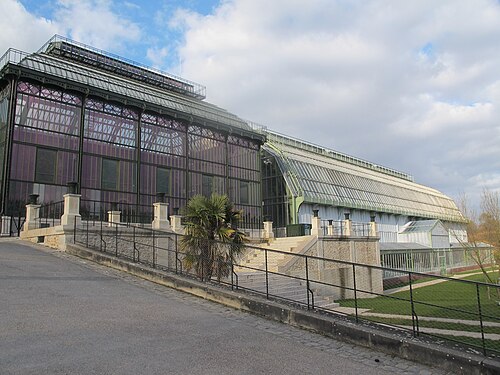
The greenhouses of the Metz botanical garden, on the edge of the city in Montigny-lès-Metz, trace back to the 1861 exhibition held on the Esplanade, where the Metz ironworker Pantz is said to have raised the first version. Dismantled and re-erected in the garden around 1880-1882, they cover about 1,000 m² divided into six compartments with different climates. Sources disagree on the exact origin of the present building: one tourism publication describes a rebuilding under the German annexation from recovered plans. The garden belongs to the City, and a restoration of the roofing, heating and accessibility was launched in 2016-2017.
Affiliate links — booking through Verrière helps fund our research, at no extra cost to you.
History
1 min
The Metz greenhouses are tied to the 1861 exhibition held on the city's Esplanade. The Metz ironworker Pantz is named as their creator, though little is known about him. According to several sources the structure was dismantled and rebuilt in the botanical garden, with dates given as 1880 or 1882. A regional tourism document qualifies this account sharply: the houses seen today are said to have been built during the German annexation (1870-1919) under the city architect Wahn, from recovered plans, the 1861 structures having burned in 1876. The two versions could not be reconciled here, and the safe conclusion is that the present building descends from Pantz's work and dates from the late nineteenth century.
The garden itself, formerly the Frescatelly park, was bought by the City of Metz in 1866 from the Baroness de l'Espée and redesigned by the municipal architect Demoget. From late 2016 the city began a phased restoration: a budget of 170,000 euros was first set aside, including 110,000 euros for a first heating phase voted in January 2017. The programme also covers reroofing, weatherproofing of the glazing and improved accessibility. A public appeal was opened in 2017 with the Fondation du patrimoine.
Architecture and engineering
1 min
The complex is an iron-framed building carrying glazing, in the tradition of nineteenth-century metal greenhouses. It extends over about 1,000 m² and is divided into six "chapels", meaning separate compartments, each with its own climatic conditions. The main house is crowned by a steel dome, which is attributed to Pantz's original design.
The works announced since 2017 target the weak points of an old building: thermal insulation and watertightness of the glazed roof and frames, replacement of the heating and climate-control equipment, and better access for visitors with reduced mobility. The sources consulted give neither the dome's height nor details of the iron sections used, so these are left out, as is the current progress of the works.
Plant collections
1 min
The houses shelter about 4,500 plants belonging to eighty botanical families. Visitors find a tropical and equatorial section, where banana plants and palms grow directly in the soil, and a section devoted to succulents and cacti. Orchids, cacti and palms are among the most noticed groups. Pools hold fish and turtles, and an aviary shows exotic birds, giving the houses as much the character of a pleasure garden as of a conservation collection.
The encyclopedic article consulted adds that the City's green-spaces department produces 490,000 flowers a year for Metz's public spaces, without saying how much of this comes from these houses. The surrounding garden adds a rose garden and a collection of old roses, at their best from June to October.
Visiting
1 min
The botanical garden stands on the rue du Pont-à-Mousson in Montigny-lès-Metz, on the edge of Metz, and entry is free all year. The park, in an English landscape style mixed with formal sections, has a large pond where swans and geese stay all year; an hour is enough to see both the glasshouse compartments and the paths.
The rose season, June to October, is the best moment to combine houses and garden; the eagle sculpted by Christophe Fratin in 1866 is one of the park's landmarks. The garden belongs to the cross-border network "Jardins sans limites", which links some twenty sites in Moselle, Saarland and Luxembourg, and the outing can be extended on foot to the Château de Courcelles or the church of Saint-Joseph.
49.10° N, 6.16° E
Greenhouses nearby
More greenhouses — France
Do you have a good photo of this greenhouse? Suggest it for this page →
Sources (6)
- fr.wikipedia.org/wiki/Jardin_botanique_de_Metz
- en.wikipedia.org/wiki/Jardin_botanique_de_Metz
- atrium-patrimoine.com/restauration-des-serres-du-jardin-botanique-de-metz/70233/
- parcsetjardins.fr/jardins/1033-jardin-botanique-de-la-ville-de-metz
- visitgrandest.com/jardin-botanique-metz
- marcmetzmoselle.eklablog.com/metz-des-serres-du-botanique-a-l-esplanade-de-la-republique-a