The Oasis (L'Oasis), Pairi Daiza's large greenhouse
Brugelette (Cambron-Casteau), Hainaut
No freely licensed photo of this greenhouse yet. Do you have one? Suggest it for this page →
Sources checked October 2026
- Year
- 2000
- Style
- Large tropical greenhouse with an opening roof, free-ranging birds and a restaurant
- Dimensions
- 7,000 m²
- Status
- Open to the public (within Pairi Daiza park)
Opened in 2000 in the zoological park that began as Paradisio on the estate of the former Cistercian abbey of Cambron, the Oasis is a 7,000 m² greenhouse whose roof opens in fine weather or great heat and closes when the weather turns dull or cold. Beneath tropical trees, bananas, vines and bamboo, pools and waterfalls line a walking route where many birds live in semi-freedom. The greenhouse also houses the self-service restaurant of the same name, at the heart of the Cambron-L'Abbaye world.
Affiliate links — booking through Verrière helps fund our research, at no extra cost to you.
History
Pairi Daiza began as Paradisio, a park devoted at first to birds, on the estate of the former Cistercian abbey of Cambron at Cambron-Casteau. The park, created by Éric Domb, opened in 1993 or 1994 and was modelled on the Walsrode bird park. The renaming as Pairi Daiza dates from 2009 or 2010; the name means 'walled garden'.
The Oasis belongs to this first generation of facilities. Its opening dates to 2000. The large greenhouse extends the park's original focus on birds: it takes the form of a tropical forest explored on foot, among birds living in semi-freedom.
The park has grown a great deal since, receiving about two million visitors in 2018. The Oasis now belongs to the Cambron-L'Abbaye world, and the official website presents it mainly through its restaurant. Since 7 February 2026 it has no longer been the park's largest greenhouse: Edenya, opened some 300 metres to the east, covers about four hectares.
Architecture and engineering
The Oasis is a giant greenhouse of 7,000 m², a figure given by the official website. Its distinctive feature is a movable roof: according to the park, it opens in fine weather or great heat and closes when the weather turns dull or cold, so the space can switch from a closed glasshouse climate to an open-air atmosphere.
The interior is laid out as a lush forest. Pools and waterfalls shape a 'walking safari' route along which birds move freely, and the sound of a waterfall accompanies the restaurant, set among exotic trees, cacti and flowers. The comparison with Edenya, a greenhouse of about four hectares opened in 2026 to the east of the park, shows how far the site has developed in a quarter of a century.
Plant collections
The planting combines tropical trees, bananas, vines, bamboo and hibiscus; the official website refers to exotic trees, cacti and flowers around the restaurant.
The fauna is above all made up of birds, many of them living in semi-freedom; the park highlights a hornbill. The park also has Seychelles giant tortoises, silvery-cheeked hornbills, Pesquet's parrots, white-crested turacos, dwarf mongooses, bear cuscuses, cotton-top tamarins, white-faced sakis, gliders, toucanets and southern bald ibises. The exact make-up of the collection changes over time.
Visiting
The Oasis lies in the Cambron-L'Abbaye world, which the park describes as a realm of birds, gardens and relaxation, to the west of Edenya. It fits easily into a day at Pairi Daiza, especially at lunchtime, since the self-service restaurant, serving Belgian dishes, stands among the birds.
The movable roof makes it a shelter for every season: closed in cold or grey weather, the greenhouse opens on fine days and in great heat. A visit combines naturally with the large Edenya greenhouse a few hundred metres away and with the park's other worlds, from the Kingdom of Ganesha to the Middle Kingdom.
50.59° N, 3.89° E
Greenhouses nearby
Architecture nearby
More greenhouses — Belgium
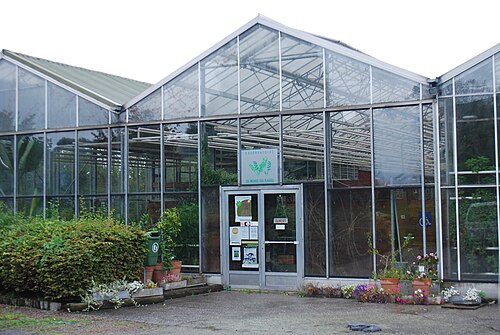
Do you have a good photo of this greenhouse? Suggest it for this page →
Affiliate links — booking through Verrière helps fund our research, at no extra cost to you.