Balat Greenhouse (Balatkas or Kroonserre) of Meise Botanic Garden
Meise, Flemish Brabant
Entry updated on September 30, 2026
- Year
- 1854
- Architect
- Alphonse Balat
- Style
- Octagonal wrought-iron and glass house crowned by a wrought-iron finial
- Dimensions
- Octagonal plan
- Status
- Within the botanic garden, open to the public; restored in 2014-2015
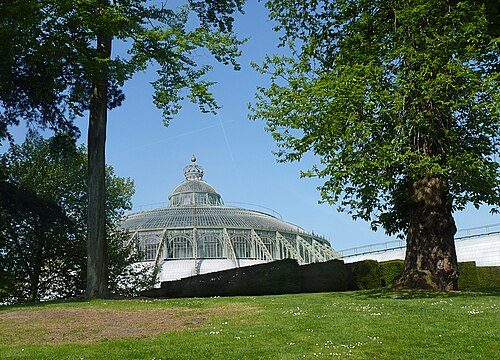
Designed in 1854 by Alphonse Balat, architect to Leopold II, for the Brussels zoo in Leopold Park, this octagonal glass-and-metal house first sheltered the giant water lily Victoria amazonica. It was later re-erected in the botanical garden in Brussels and moved in 1941 to the Bouchout estate at Meise, where it stands in the Cronquist garden. Its wrought-iron crown gives it the name Kroonserre. Sources describe it as a preparatory exercise for the Royal Greenhouses of Laeken. Restored in 2014-2015, it appears in the garden's logo and ranks among the oldest glasshouses in Belgium.
Affiliate links — booking through Verrière helps fund our research, at no extra cost to you.
History
1 min
Alphonse Balat, architect to Leopold II, designed the glasshouse in 1854 (one visitor guide gives 1853) for the Brussels zoo in Leopold Park. It sheltered Victoria amazonica, the giant water lily of tropical America. Sources describe it as a preparatory exercise: Balat tested iron-and-glass construction on it before being entrusted with the far larger Royal Greenhouses of Laeken.
According to the Flemish heritage inventory, the building was dismantled and re-erected in 1878 in the new botanical garden of Brussels, at Saint-Josse. In 1941 it was moved again, to the Bouchout estate where the national botanical garden was being established. It was restored in 1947 and again in late 1983.
By the early 2010s, after some thirty years of insufficient funding, the glasshouse was in very poor condition. A new restoration began in 2014 and was announced as finished in April 2015, at a cost of 68,000 euros according to the press: the metal frame was sandblasted, painted in three coats and reglazed with a putty of linseed oil and chalk. Since 8 October 2021 the Flemish heritage agency has recorded the building as architectural heritage.
Architecture and engineering
1 min
The glasshouse has an octagonal plan, built in glass and metal on a stone base. Between decorative wrought-iron ribs the openings end in pointed arches, and the whole is topped by a wrought-iron crown that gave it the name Kroonserre, crown greenhouse. Glass, metal, wrought iron, brick and natural stone make up the structure, according to the heritage inventory.
The building reflects mid-nineteenth-century horticultural engineering: a light volume, glazed on every side, designed to house a tropical aquatic plant. Balat, whose pupil was Victor Horta, rehearsed here the language he developed in the Royal Greenhouses of Laeken, built between 1874 and 1890, where the ironwork is decorated with plant motifs. The exact dimensions of the glasshouse do not appear in the sources consulted.
Plant collections
1 min
The glasshouse was conceived for a single species, the giant water lily Victoria amazonica, named in 1837 in honour of Queen Victoria, which first flowered in Belgium in 1850, a year after England. The lilies are no longer kept here: the collection passed to the Plant Palace, where Victoria cruziana and V. amazonica are sown every February and grown as annuals in a heated basin of 275,000 litres.
When the restoration was announced in April 2015, the garden planned to fill the renovated house with steppe vegetation. The present planting could not be verified for this entry and may have changed. The building matters as much for its form as for its contents: it is the emblem of the garden, whose logo depicts it, and it provides a scenic backdrop to the Cronquist garden.
Visiting
1 min
The Balat greenhouse stands in the Cronquist garden, south-west of Bouchout castle. It is met on the route between the Plant Palace and the castle, and its crowned silhouette, reproduced in the garden's logo, makes a convenient landmark for finding one's way around the estate. A short stop is enough; the visit is best combined with the nearby large glasshouses, where the giant water lilies now live, and with the castle and the pond. Spring and summer, when the borders of the Cronquist garden are in growth, give the most agreeable setting.
50.92° N, 4.32° E
Greenhouses nearby
More greenhouses — Belgium
All greenhouses — Belgium →
Do you have a good photo of this greenhouse? Suggest it for this page →
Sources (8)
- inventaris.onroerenderfgoed.be/erfgoedobjecten/306606
- plantentuinmeise.be/nl/pQX6GTo/balatkas
- plantentuinmeise.be/en/balat-greenhouse-77w8
- bruzz.be/samenleving/plantentuin-meise-restaureert-balatserre-2015-04-13
- goeiedag.be/meise/2015/04/balatkas-eindelijk-gerestaureerd/
- bruzz.be/samenleving/victor-en-victoria-tussen-de-waterlelies-2010-06-23
- en.wikipedia.org/wiki/Alphonse_Balat
- wonderfulwanderings.com/national-botanical-garden-brussels-belgium/