Glasshouses of the Ghent University Botanical Garden (Plantentuin UGent)
Ghent, East Flanders
Entry updated on September 30, 2026
- Year
- 1970-1972
- Architect
- Unknown
- Style
- 1970s glasshouse complex, successor to the Louis Cloquet houses
- Dimensions
- ≈2,070 m² of public houses; ≈4,000 m² under glass in all
- Status
- Open to the public; about twenty collection houses reserved for research
Established in 1903 beside Citadelpark, the Ghent University botanical garden has a glasshouse complex rebuilt in the early 1970s: a palm house opened in 1970, and the present ensemble was erected in 1971-1972. It succeeds the houses designed by Louis Cloquet around 1900-1903, rebuilt around 1930 and then demolished when the campus expanded. Four public houses, covering about 2,070 m², show tropical and subtropical plants, succulents and giant water lilies; some twenty further houses, closed to the public, hold scientific collections.
Affiliate links — booking through Verrière helps fund our research, at no extra cost to you.
History
1 min
Ghent's botanical garden opened on 19 July 1797, under French rule, following Napoleon's departmental reorganisation, on the Ottogracht, in the former vegetable garden of the Baudelo abbey. It passed to the city in 1804, and the university gained its usufruct in 1818. At the end of 1897 it was decided to move it, to give it a more scientific role, to the Ledeganckstraat at the edge of today's Citadelpark; the transfer was completed in 1902-1903.
The architect Louis Cloquet designed the botanical institute and the first glasshouses, built between 1900 and 1903. They comprised seven houses: a palm house, large and small warm and cold houses, an experimental house and the Victoria house for giant water lilies. The wrought-iron gates of 1903, also by Cloquet, still mark the entrance. Around 1930 Jean Norbert Cloquet, a descendant of Louis, rebuilt the houses on 1,600 m² with an iron skeleton (another text spells his first name Jean-Floret); specialised sections held bromeliads, ferns, succulents, orchids and anthuriums. An alpine garden funded by the Marshall Plan was added around 1950.
In the 1960s the influx of students led to the large Ledeganck building: the glasshouses, judged outdated and badly placed, were demolished, and Cloquet's institute was torn down in 1966. A palm house opened in 1970, and the present complex, built in 1971-1972 further into the grounds, covers 4,235 m² according to UGent Memorie. The garden was recognised as a Flemish heritage museum in 2012.
Architecture and engineering
1 min
The present complex dates from the early 1970s and owes nothing to Louis Cloquet's glasshouses, which were demolished. The sources consulted name no architect or engineering firm for it and do not describe its structure; it is a set of heated glasshouses arranged by climate rather than a monumental building.
Four houses are open to the public, covering about 2,070 m²: the Victoria house, with its pool, the tropical house, a subtropical or Mediterranean house and the succulent house. Texts differ on the exact designation of the last two. Some twenty collection houses, closed to the public, serve teaching and research. The total under glass is put at 4,000 m², and at 4,235 m² in another source, on a garden of about 2.75 hectares. The early twentieth-century houses, whose metal frame Jean Norbert Cloquet rebuilt around 1930, are the direct predecessors of the present ones.
Plant collections
1 min
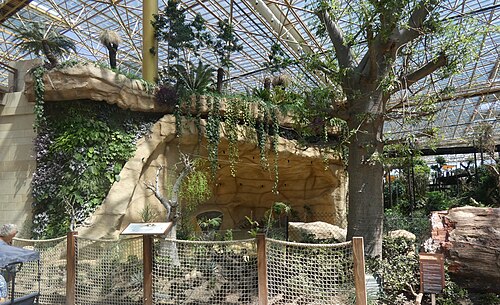
The garden grows some ten thousand taxa, a large share of them under glass. In the Victoria house a pool holds Victoria amazonica in summer, its leaves, according to the garden, able to support a person's weight. The tropical house shelters African baobabs, the subtropical house flowering citrus and ripening bananas, and the succulent house cacti and haworthias. Visitors also meet monstera, bromeliads, alocasias, coffee plants and tall palms.
The oldest plants in the garden, cycads, are older than the garden itself, although their exact origin is unknown because the archives are lost. The oldest trees in the park are about 110 years old and date from the installation on the present site. The herbarium, of about 400,000 specimens, complements the living collections.
Visiting
1 min
The garden borders Citadelpark and lies a quarter of an hour's walk from Ghent Sint-Pieters station. It stands next to GUM, the Ghent University Museum, and to the museum quarter of S.M.A.K. and the MSK, so that half a day is enough to link glasshouses, park and museums. Besides the houses, visitors find an arboretum, a rock garden, a Mediterranean garden and ponds. Not every glasshouse is open at all times, and special arrangements apply during the Floraliën festival in Ghent. The garden can be visited in any season.
51.04° N, 3.72° E
Greenhouses nearby
More greenhouses — Belgium
All greenhouses — Belgium →
Do you have a good photo of this greenhouse? Suggest it for this page →
Sources (7)
- stad.gent/nl/buitenlocaties/plantentuin-ugent
- etwie.be/nl/kennisbank/actoren/plantentuin-ugent
- ugentmemorie.be/artikel/botanisch-instituut
- ugentmemorie.be/plaatsen/plantentuin
- ledeganckstraat.jimdofree.com/geschiedenis/vi-plantentuin-ugent/
- visit.gent.be/en/see-do/ghent-university-botanical-garden
- gruun.be/plantentuin-gent/