Botanical Glasshouse, The Walled Gardens of Cannington
Cannington, near Bridgwater (Somerset), England
No freely licensed photo of this greenhouse yet. Do you have one? Suggest it for this page →
Sources checked October 2026
- Style
- Modern botanical glasshouse with four climate zones, in a monastic walled garden
- Status
- Open to the public Tuesday to Sunday according to the official site (garden run by Cannington College, UCS College Group)
In the village of Cannington, near Bridgwater, the Walled Gardens occupy the enclosure of a former Benedictine priory founded around 1138, now part of Cannington College (UCS College Group). Their Botanical Glasshouse brings together plants from four climate zones: arid, dry temperate, wet temperate and tropical. Officially opened in 2009 by the Earl of Wessex, the gardens are a Royal Horticultural Society partner garden and a learning site for students.
Affiliate links — booking through Verrière helps fund our research, at no extra cost to you.
History
The Walled Gardens of Cannington occupy the enclosure of the former Cannington Priory, founded around 1138 by the de Courcy family, lords of Stogursey, for a community of Benedictine nuns. The priory was dissolved in 1536; the house, later known as Cannington Court, was held by Edward Rogers, and in 1672 Charles II granted Cannington to Lord Clifford of Chudleigh. In 1807 Benedictine nuns expelled from France settled there; after some thirty years it became a Roman Catholic industrial school for boys, which closed in 1917. In 1919 the tenth Lord Clifford leased the estate to Somerset County Council, which adapted it as a college of agriculture and horticulture, the forerunner of Cannington College.
Cannington College merged with Bridgwater College in 2004, and the merged institution then invested in redeveloping the walled gardens. Prince Edward, then Earl of Wessex, opened them officially in 2009; they are also accredited by VisitEngland as a Quality Assured Visitor Attraction. In 2015 the refurbishment of Cannington Court, funded by EDF Energy, gave the garden a new access route and better parking. In 2025 Bridgwater & Taunton College merged with Strode College to form UCS College Group, and Cannington College regained its name.
For the Botanical Glasshouse, photographs taken in 2010 and 2012 and hosted on Wikimedia Commons already show it standing at the east side of the garden, so it existed by May 2010 at the latest.
Architecture and engineering
The Botanical Glasshouse stands in the eastern part of the walled garden, at the far end of a lawn from which it can be seen from a distance. Photographs from 2010 and 2012 show a modern building with a light metal frame: a vertical glazed front wall topped by a large glazed roof slope whose ridge is raised by a lantern light. On OpenStreetMap, a glasshouse area of roughly 1,100 m² is mapped at this spot; this crowd-sourced figure may also include production houses.
The interior is divided into four climate zones. The Royal Horticultural Society names them Arid, Dry Temperate, Wet Temperate and Tropical; the college website lists tropical, arid, and wet and dry temperate zones. This division allows plants with opposite needs to be grown under one roof, including through the cold months. The garden also describes the glasshouse as a place for the professional production of plants, alongside the display of exotic plants from around the world. Around it, the walls of the enclosed garden, largely inherited from the priory, form a sandstone setting.
Plant collections
The collection is divided between four climate zones: arid, dry temperate, wet temperate and tropical. The garden describes it as exotic plants from around the world. In winter the Royal Horticultural Society singles out two scented species first, the Amazon lily (Eucharis × grandiflora) and Pittosporum cornifolium, followed, depending on the season, by Sparrmannia africana, the citron (Citrus medica), clivias and bougainvillea.
The glasshouse is not only for display. The garden nursery sells plants propagated on site by staff, students and volunteers from the plants of the garden and the Botanical Glasshouse; its range includes sub-tropical plants, houseplants, cacti, succulents and tropical plants, and its profits go to the college.
Visiting
The glasshouse is visited together with the garden, in whose eastern part it stands; the tea room, shop and plant sales can be used without a garden ticket. The Royal Horticultural Society recommends it above all in January and February, when the outdoor garden is quiet. The garden also runs family trails at Easter and Halloween and open-air theatre in summer. Next door stand St Mary's church (Grade I, 14th-century tower) and Cannington Court (Grade I); WWT Steart Marshes, Stogursey Castle and Coleridge Cottage lie three to four miles away. Parking beside the garden is very limited; the college points to overflow parking five to ten minutes away on foot.
51.15° N, 3.06° W
Greenhouses nearby
More greenhouses — United Kingdom
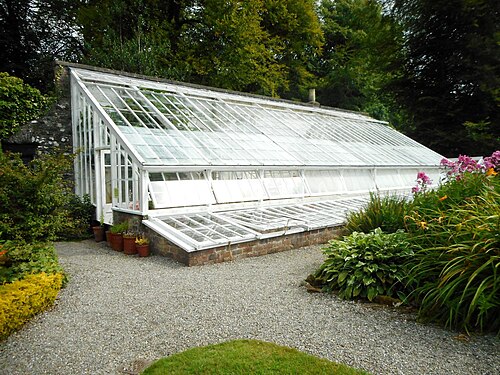
Do you have a good photo of this greenhouse? Suggest it for this page →
Sources (8)
- canningtoncollege.ac.uk/college-life/facilities/the-walled-gardens-of-cannington/
- canningtoncollege.ac.uk/college-life/facilities/the-walled-gardens-of-cannington/a-short-h
- rhs.org.uk/gardens/partner-gardens/articles/gardens-with-glasshouses
- rhs.org.uk/plants/3428/the-walled-gardens-of-cannington/nursery
- ngs.org.uk/gardens/the-walled-gardens-of-cannington-ta5/
- historicengland.org.uk/listing/the-list/list-entry/1344930
- en.wikipedia.org/wiki/Cannington_Court
- britainexpress.com/counties/somerset/gardens/cannington-walled-garden.htm
Affiliate links — booking through Verrière helps fund our research, at no extra cost to you.