Victorian Palm Houses, Royal Botanic Garden Edinburgh
Edinburgh, Scotland
Entry updated on September 30, 2026
- Year
- 1834 / 1858
- Architect
- Robert Matheson (Temperate Palm House, 1858)
- Style
- Victorian, sandstone masonry with a curved iron-and-glass roof
- Dimensions
- Temperate Palm House: 21.95 m high, about 18 × 30 m on plan
- Status
- Reopening to the public on 2 October 2026 after a five-year restoration
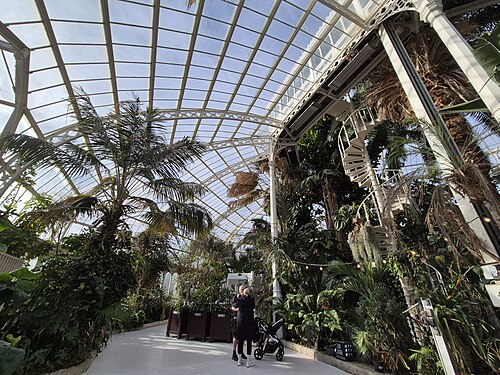
At the Royal Botanic Garden Edinburgh, two Category A listed palm houses stand side by side: an octagonal glasshouse of 1834 and a great hall of sandstone and iron designed by Robert Matheson, whose planting was completed in 1858. At 21.95 m high, the latter is billed by the garden as the tallest traditional palm house in Britain. Emptied of some 800 plants from 2021, the two houses have been restored over five years, with more than 5,000 new panes, repaired ironwork and the removal of the central partition. Public reopening is announced for 2 October 2026.
Affiliate links — booking through Verrière helps fund our research, at no extra cost to you.
History
1 min
The garden's first Palm House, an irregular octagonal structure of 1834, was the largest glasshouse of its kind in Britain when built. A second, taller hall followed, funded by a £6,000 parliamentary grant and designed by Robert Matheson. Building began on 8 April 1856 and planting was completed on 30 April 1858. The principal gardener, James McNab, regarded the bulk of masonry as an advantage, since it cooled slowly and gave the palms some shade.
The two buildings were altered repeatedly. A partition separated them in 1859, a new iron-and-glass roof was fitted to the 1834 house in 1860, and both houses reopened in 1876 after heating and renovation works; in 1892-93 stone pillars were replaced with cast iron and glazed "skirts" added to let in more light. The garden's own chronology records several removals and reinstatements of the partition over the nineteenth century. A restoration of the Temperate Palm House, decided in 2002 and designed by Simpson & Brown with Addyman Archaeology, preceded the present campaign: plants were removed in 2021 and works began in 2022 within the Edinburgh Biomes programme. The sources consulted quote different costs for that programme; reopening is announced for 2 October 2026.
Architecture and engineering
1 min
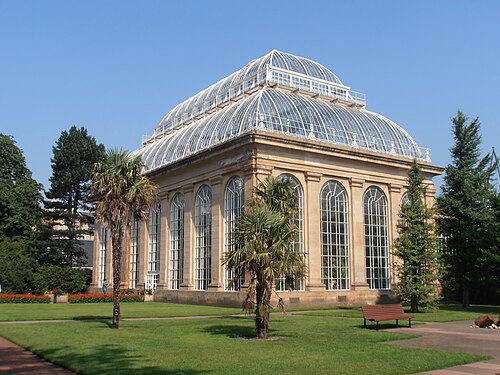
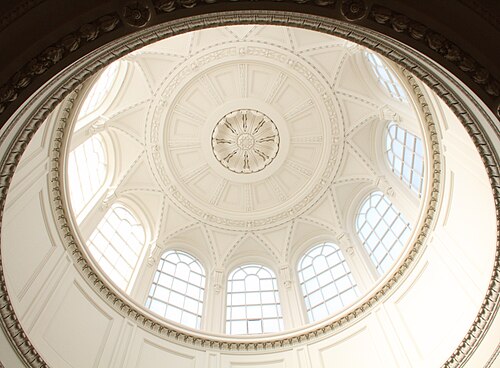
The 1858 Temperate Palm House measures about 18.3 m wide by 30.5 m long and 21.95 m high. Its walls are of sandstone quarried at Bishopbriggs near Glasgow, with a Tuscan-style front, and eighteen tall arched windows, each roughly 6.7 m high, articulate the elevation. Above, a curved roof of iron rafters with a glazed dome covers the hall; inside, the garden describes the cast-iron columns as echoing palm trunks. The house faces west to limit direct sun.
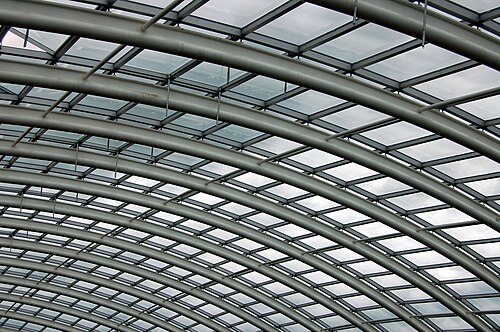
The 1834 Tropical Palm House is an octagon about 18.3 m across and 8.2 m high, the oldest glasshouse on the Inverleith site. Both buildings are Category A listed. The recent restoration replaced more than 5,000 panes from bespoke templates designed with a warmer future climate in mind, repaired about 600 m² of Georgian and Victorian ironwork, and removed the central partition so that the two volumes read as one for the first time in decades. The modernist front-range glasshouses of 1967 complete the group.
Plant collections
1 min
Plants grow in the ground rather than in pots, with ferns and palms forming the core. Specimens highlighted by the garden include a stone gate palm (Trachycarpus princeps) over 8 m tall, described as the tallest in cultivation outside China, and the Wollemi pine (Wollemia nobilis), a threatened Australian conifer. Tree ferns, among them Norfolk Island Sphaeropteris excelsa and Mexican Cibotium regale, reach up to 8 m. About 800 plants were removed during the works and roughly 600 were due to return; many of these species are threatened in the wild.
A young sabal palm, raised from a tree said to be about 200 years old when it was felled in 2021, has been replanted. Around 1,000 ladybirds have been released to control insect pests. In the nineteenth century the early plantings included bananas, bamboo, date palms, sugar cane, figs, allspice and mahogany.
Visiting
1 min
The two Palm Houses stand in the heart of the Royal Botanic Garden Edinburgh at Inverleith, north of the city centre. They reopen on 2 October 2026 with timed tickets to book in advance; members and patrons enter free. Visitors should leave time to explore the garden's other glasshouses afterwards, including the modernist 1967 range (Rainforest Riches, Arid Lands and the Wet Tropical House, among the garden's listed displays). The Rock Garden and Woodland Garden make a full day of it, in any season.
55.97° N, 3.21° W
Greenhouses nearby
More greenhouses — United Kingdom
Do you have a good photo of this greenhouse? Suggest it for this page →
Sources (8)
- rbge.org.uk/palm-houses-history/
- rbge.org.uk/news/articles/historic-palm-houses-to-reopen-after-5-year-restoration/
- rbge.org.uk/palmhouses/
- stories.rbge.org.uk/archives/28717
- stories.rbge.org.uk/archives/6163
- simpsonandbrown.co.uk/architecture/museums-galleries-visitor-centres/the-temperate-palmhou
- edinburgharchitecture.co.uk/royal-botanic-garden-edinburgh-palm-houses
- theedinburghreporter.co.uk/2026/02/botanics-palm-house-is-steadily-coming-back-to-life/