Fata Morgana Greenhouse (skleník Fata Morgana)
Prague, Troja

Sources checked September 2026
- Year
- 2004
- Architect
- Zdeněk Deyl
- Style
- Contemporary ribbon-like glasshouse, S-shaped plan set against the rock
- Dimensions
- 1,800 m², 130 m long
- Status
- Open to the public within the Prague Botanical Garden
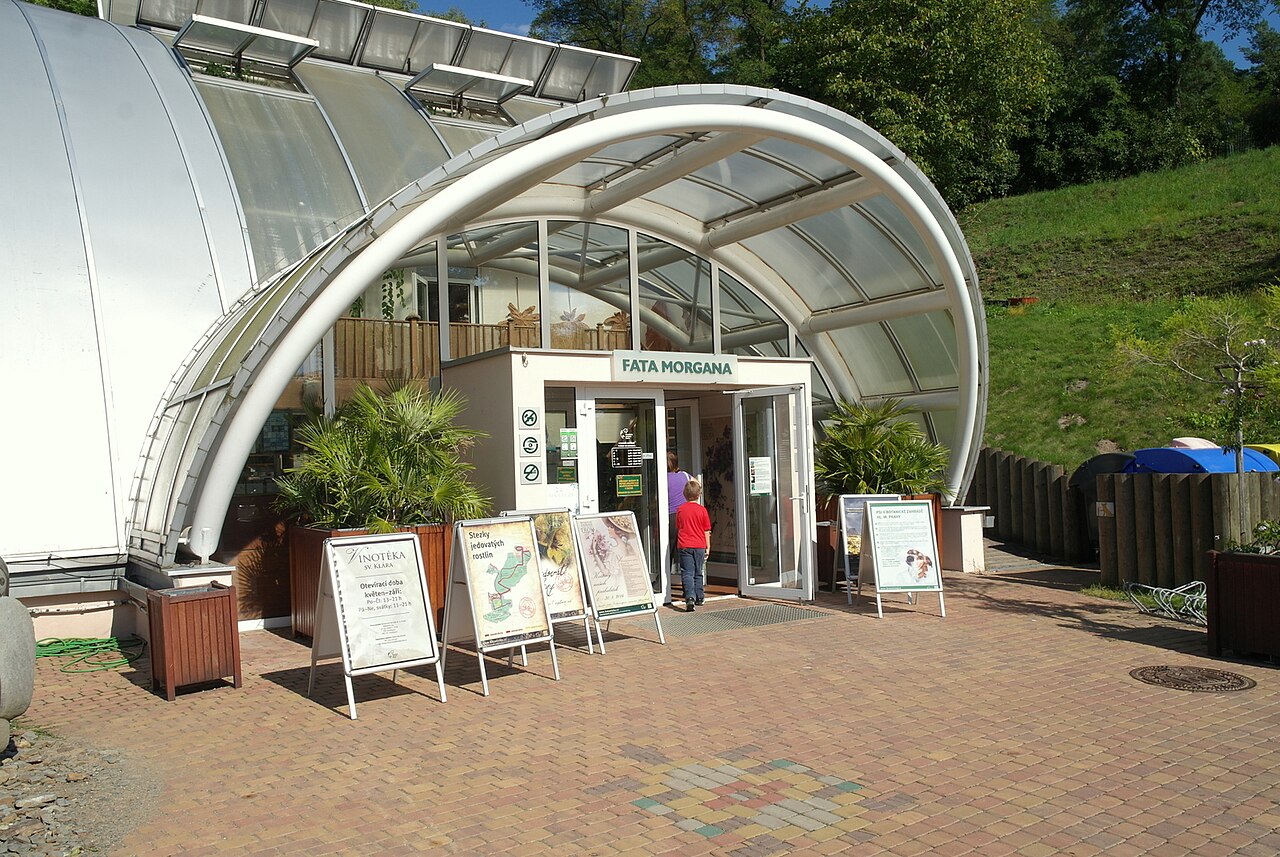
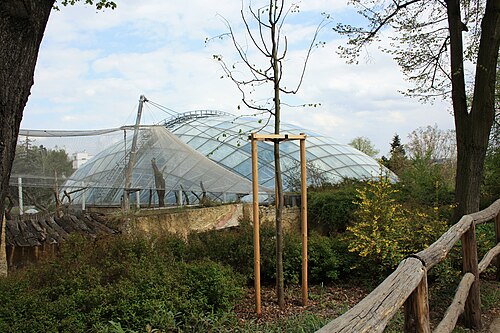
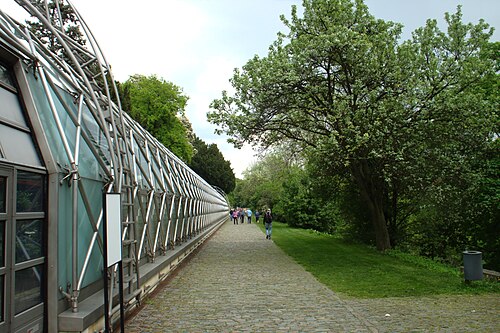
Opened in June 2004 at the Prague Botanical Garden in Troja, the Fata Morgana greenhouse follows an S-shaped plan some 130 metres long that hugs a sunny, rocky hillside, using the natural rock as its back wall. Designed by Zdeněk Deyl, winner of the 1995 competition, it shelters three successive climates beneath steel ribs and polycarbonate cladding: an arid zone, a lowland tropical forest and a cooled tropical-mountain section. The garden favours plants gathered on botanical expeditions, and a waterfall almost 6 metres high, a pond 4 metres deep and freshwater aquariums punctuate a fully accessible 225-metre route.
Affiliate links — booking through Verrière helps fund our research, at no extra cost to you.
History
The city's botanical garden was created by Resolution No. 111 of the Prague National Committee on 30 April 1968 and officially came into being on 1 January 1969. Other sites, including Průhonice Park and the Šárka valley, were considered before Troja-Podhoří was chosen; there, in 1922, Alois Svoboda had given land and Troja Castle to the Czechoslovak state for educational use. Property issues were only settled under director Evžen Pechman (1989-1993), and the garden opened year-round from August 1992.
The idea of a large tropical greenhouse came from Jiří R. Haager, director from 1994 to 2001 according to the garden, whose expeditions to the tropics had inspired him. Zdeněk Deyl won the architectural competition held in spring 1995, and zoning approval followed in October 1997. Construction ended in May 2003; it began in 1999 according to the Czech Academy of Sciences' art-monuments database. The greenhouse opened to the public in June 2004.
The project weighed heavily on the city's budget: the initial estimate was not to exceed 20 million koruna, the final cost went beyond 200 million, a fine of 500,000 koruna was imposed in 2001 for work carried out without a building permit, and running costs stood at around 10 million koruna a year in 2003. Between 2019 and 2021, the studio AND redesigned the entrance facilities.
Architecture and engineering
The greenhouse unwinds over roughly 130 metres on an S-shaped, almost ribbon-like plan that follows rocky ground facing south-west; the hillside's natural rock serves as its back wall. Segmented steel ribs anchored in reinforced-concrete foundations form a semi-cylindrical vault clad in four-layer polycarbonate panels. Four rows of opening windows and digitally controlled ventilation regulate the atmosphere.
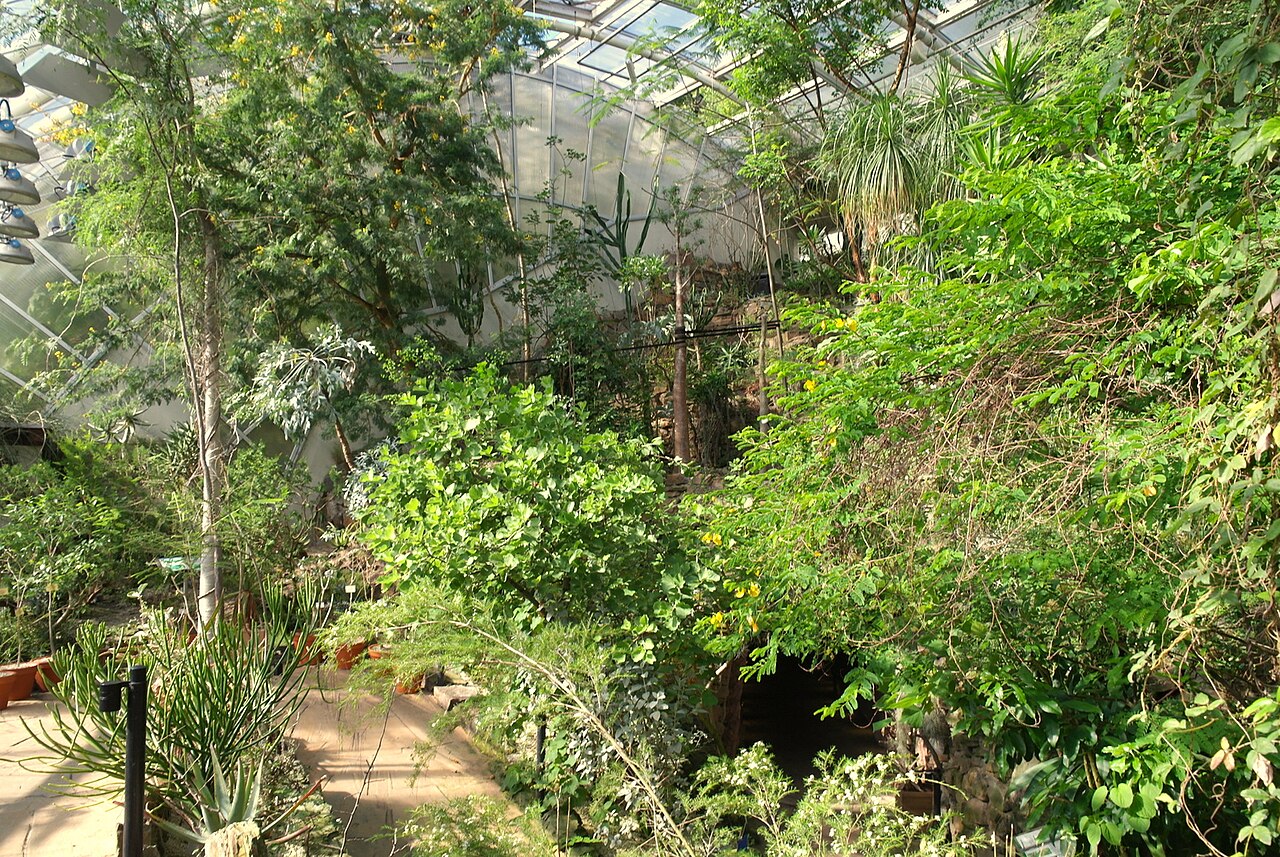
Fan-shaped glazed partitions divide the interior into four parts: a two-storey entrance hall at the eastern end, followed by three climate zones. The succulent section ranges from 20 to 30 °C by day and 16 to 20 °C at night, with 35 to 55 per cent humidity; the lowland forest stays at 22 to 30 °C by day and 20 to 26 °C at night under 90 to 95 per cent humidity; the cooled mountain section drops from 18-25 °C by day to 10-15 °C at night.
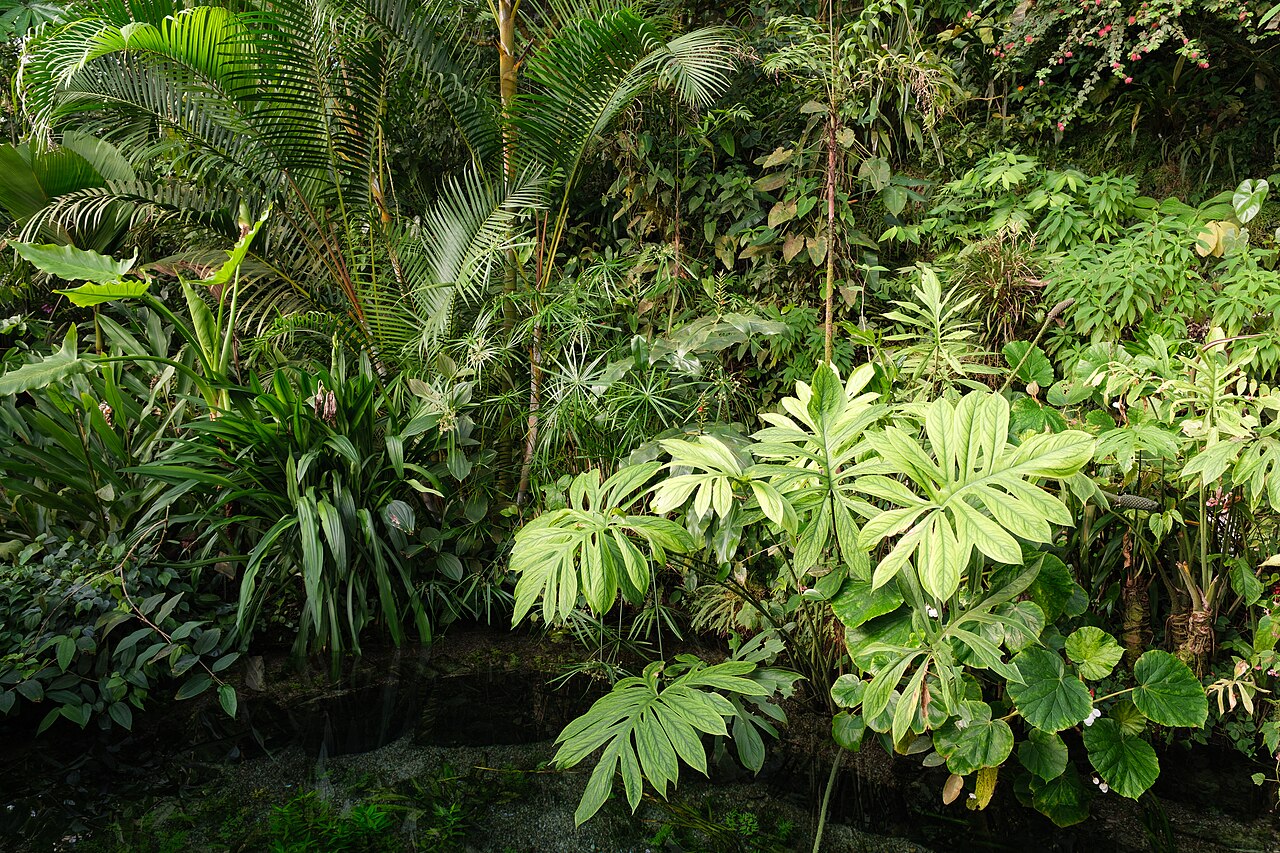
The garden gives an area of 1,800 m² and about 225 metres of fully accessible paths. In the rainforest, a waterfall almost 6 metres high feeds a stream and a pond 4 metres deep holding 200 m³. An underground tunnel links the succulent section to two large freshwater aquariums divided by a glass wall.
Plant collections
The route follows a phytogeographical layout. The first, arid zone pairs Australian bush and the dry flora of Madagascar with xeric vegetation from southern Mexico and African regions such as Namaqualand and the Little Karoo. The lowland tropical forest, the largest section, gathers floras from South and Central America, Australia and Oceania, Africa and Madagascar, Vietnam, the Sunda Islands and the Philippines. The last, cooler section evokes the tropical mountains: the Andes, continental and island Asia, subtropical southern Africa and the rare vegetation of Venezuela's tepuis.
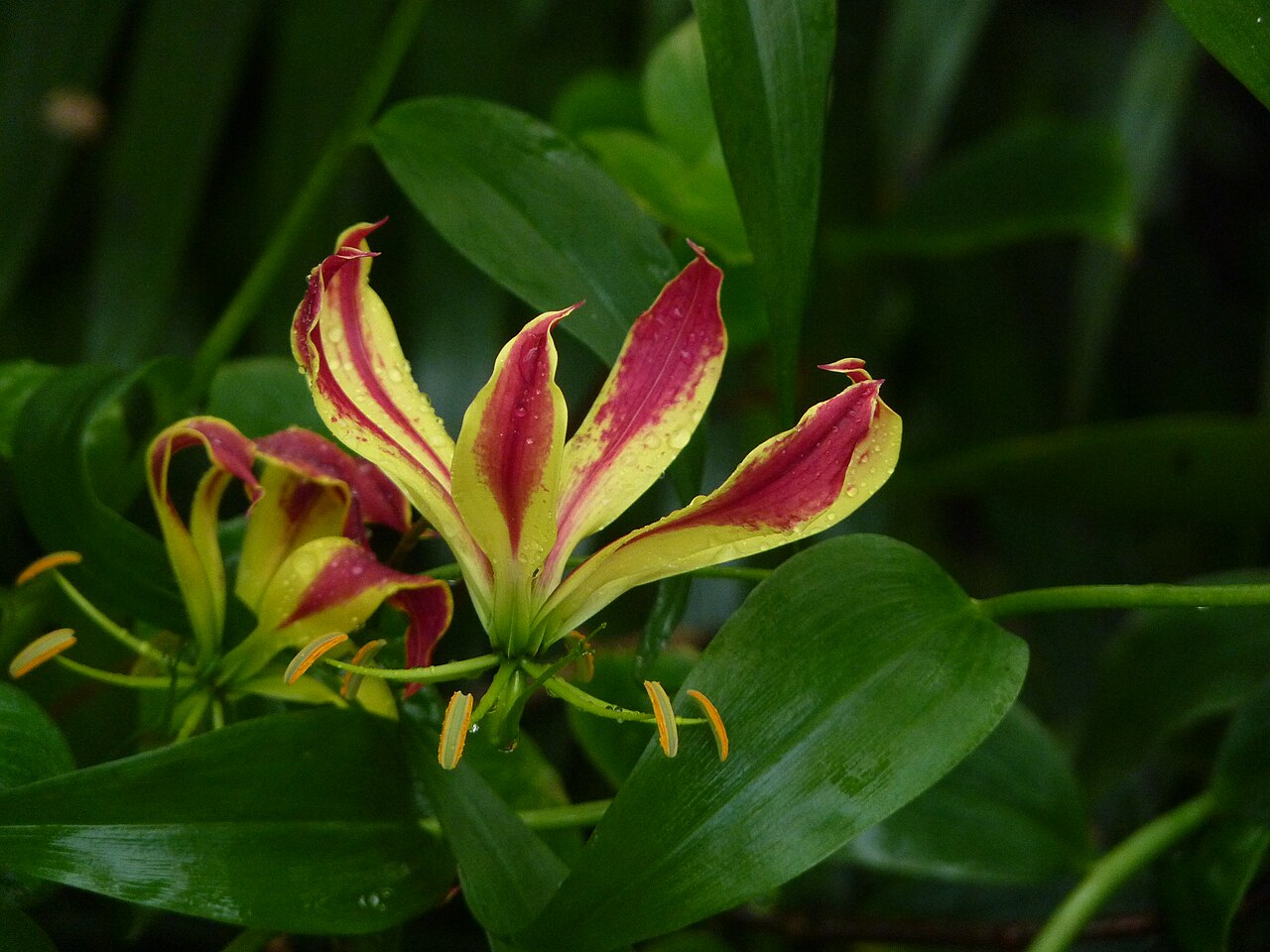
The garden emphasises plants of known provenance, collected on botanical expeditions, rather than common horticultural varieties. Species named in the sources include Anthurium andraeanum, Hibiscus grandidieri and Hibiscus schizopetalus, Gloriosa superba, Medinilla speciosa, Columnea glabra, Nepenthes eymae and Heliamphora, and Strongylodon macrobotrys has grown here since 2003. The two aquariums contrast the aquatic life of South America with that of the Old World tropics.
Visiting
The greenhouse stretches along the sunny side of the Troja slope and is walked in one continuous sequence of some 225 metres, from desert to the humid cool of the tropical mountains; the entire route is wheelchair accessible. Its controlled climate makes it a year-round visit, and a particularly welcome one in the Prague winter.
The garden also stages temporary shows, such as the pumpkin exhibition of October-November 2026. Close by, the St Clare vineyard, a protected vineyard documented since at least the 13th century and open to visitors since April 2004, and the Japanese garden, opened in May 1997, extend the walk, while Prague Zoo lies a few hundred metres away.
50.12° N, 14.41° E
Greenhouses nearby
Architecture nearby
More greenhouses — Czech Republic
Do you have a good photo of this greenhouse? Suggest it for this page →
Sources (7)
- botanicka.cz/en/for-visitors/our-expositions/sklenik-fata-morgana
- botanicka.cz/en/about-us/history
- umeleckepamatky.udu.cas.cz/objekt/712-sklenik-fata-morgana
- cs.wikipedia.org/wiki/Fata_Morgana
- cs.wikipedia.org/wiki/Botanick%C3%A1_zahrada_hl._m._Prahy
- cs.wikipedia.org/wiki/Strongylodon_macrobotrys
- openstreetmap.org/way/23607681
Affiliate links — booking through Verrière helps fund our research, at no extra cost to you.