ELE Tropenparadies (tropical hall of the Asia world), ZOOM Erlebniswelt Gelsenkirchen
Gelsenkirchen, North Rhine-Westphalia

Sources checked October 2026
- Year
- 2010
- Style
- Zoo tropical hall, translucent film envelope on a steel structure (an architecture file speaks of steel-and-glass construction)
- Dimensions
- Hall of about 4,500 m² (132 m by 40 m according to the press; 120 m long according to an architecture file)
- Status
- Open with zoo admission; the zoo is open 365 days a year
At the heart of the Asia world, opened on 4 March 2010, the ELE Tropenparadies is a hall of about 4,500 m² where a tropical climate prevails all year. Its outer envelope is made, according to the 2010 press, of a translucent film that almost gives the illusion of an open sky. Beneath this vault grow rubber trees and banana plants, while a family of Sumatran orangutans, otters and free-flying birds live there; a covered playground, the Drachenland, also occupies the building.
Affiliate links — booking through Verrière helps fund our research, at no extra cost to you.
History
Gelsenkirchen's Ruhr-Zoo, opened in 1949, was converted into the ZOOM Erlebniswelt in stages: Grimberger Hof in 2004, Alaska in 2005, Afrika in 2006, Grimberger Hof (second phase) in 2007 and Asien in 2010, according to German Wikipedia. Parkscout, reporting on the March 2010 inauguration, speaks of a roughly five-year building programme costing nearly 100 million euros for the whole, and says "Asien" opened about a year late, after Alaska and Afrika. The Erlebniswelt Asien opened on 4 March 2010; Wikipedia makes the ELE Tropenparadies, of about 4,500 m², the centre of this five-hectare sector.
In 2010 the hall also housed the themed restaurant "Pangung", open until 11 p.m., which the paper describes as dining "under palms". The following years added an Amur tiger enclosure (May 2013) and then, in 2026, a 400 m² Philippinenhaus cited by Wikipedia and by the zoo's site. An architecture file from a smoke-ventilation manufacturer presents the hall as the culmination of the zoo's transformation.
Architecture and engineering
According to Parkscout (2010), the outer envelope of the hall, 132 m long and about 40 m wide, is made of a translucent film ("lichtdurchlässige Folie") that almost gives the illusion of an open sky; the article cites, for the whole Asia area, 150 tonnes of steel and 4,700 m² of film. An architecture file from the manufacturer D+H speaks instead of a "steel-and-glass hall construction" 120 m long, whose roof carries 112 ventilation flaps, for an air volume of 40,000 m³; the two descriptions diverge, the second possibly referring to the supporting structure. In Wikimedia Commons photographs from 2011, the hall appears as a long volume with a ribbed vault roof of translucent appearance, and the interior as a garden beneath a light-coloured cover held up by steel masts.
The same file sets a target climate of 22 to 24 °C and 60 to 70 % humidity, maintained by an 850 kW combined heat and power plant and mechanical ventilation with a heat exchanger; Parkscout noted temperatures of up to 33 °C in 2010. The official site gives the hall a height of 15 m above the playground. In OpenStreetMap the building named ELE Tropenparadies, with a round roof, covers about 3,130 m²: a map measurement, below the announced 4,500 m².
Plant collections
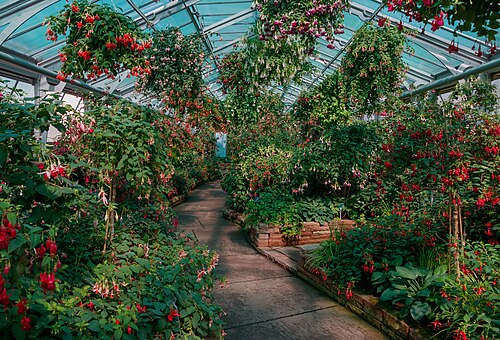
In 2010 Parkscout described lush vegetation, numerous free-flying birds and, among the hall's animals, a family of seven orangutans and short-clawed otters; German Wikipedia speaks of a shared enclosure of Sumatran orangutans, langurs and dwarf otters. An architecture file names rubber trees and banana plants as plants of the hall, and the 2011 photograph does show broad banana leaves, trees with dense foliage and red-leaved plants beside the paths. The official site invites visitors to explore "the rainforest of Sumatra", beneath a canopy through which animal calls filter.
Parkscout counts more than 3,600 plants for the whole Erlebniswelt Asien, an overall figure not limited to the hall.
Visiting
The hall stands on the 1.3 km route of the Erlebniswelt Asien, which also includes a treetop path five metres up, a floating jetty with a bamboo houseboat, a restaurant, the Ryokan Imbiss, with its tropical garden, and the new 400 m² Philippinenhaus. The official site promises a tropical climate all year whatever the weather, which makes the hall a welcome stop on rainy or cold days.
It is also lively: the Drachenland, a covered playground, climbs over several floors right up under the 15 m roof. The zoo is open 365 days a year. Allow an hour or two for the hall and the Asian sector, more for Alaska and Afrika, the other two worlds of the ZOOM Erlebniswelt.
51.54° N, 7.11° E
Greenhouses nearby
More greenhouses — Germany
Do you have a good photo of this greenhouse? Suggest it for this page →
Sources (8)
- zoom-erlebniswelt.de/erlebniswelt-asien/
- zoom-erlebniswelt.de/
- parkscout.de/magazin/zoom-erlebniswelt-asien-ruft
- heinze.de/architekturobjekt/zoom-erlebniswelt-im-ruhr-zoo/12709581/
- de.wikipedia.org/wiki/Zoom_Erlebniswelt_Gelsenkirchen
- commons.wikimedia.org/wiki/File:Gelsenkirchen_-_Zoom_-_Asien_09_ies.jpg
- commons.wikimedia.org/wiki/File:Gelsenkirchen_-_Zoom_-_Asien_17_ies.jpg
- api.openstreetmap.org/api/0.6/way/54653779/full.json
Affiliate links — booking through Verrière helps fund our research, at no extra cost to you.