Tropenhaus and Show Glasshouses, Botanical Garden of Ruhr University Bochum
Bochum, North Rhine-Westphalia
Entry updated on October 5, 2026
- Year
- 1976–1977
- Style
- University glasshouse complex (1976–2001) linked by a shared entrance hall
- Dimensions
- Tropical house of 713 m², 17 m clear height; ≈1,700 m² of display space
- Status
- Open to the public
At the heart of Ruhr University's botanical garden, open to the public since 1971 on the southern slope of the Bochum campus, four show glasshouses are grouped around a shared entrance hall. The tropical house, completed in 1976 and opened on 4 April 1977, covers 713 m² under a clear height of 17 m; the desert house followed in 1988 and, in 2001, two houses devoted to the dry regions of Australia and South Africa. Renovated in 2004-2005, the tropical house saw the Ruhr region's first titan arum bloom in 2017.
Affiliate links — booking through Verrière helps fund our research, at no extra cost to you.
History
1 min
The botanical garden grew up with Ruhr University, whose foundation the North Rhine-Westphalia state parliament decided in 1961 and which was inaugurated in 1965. Preparatory work began in October 1966. Carried out by the planning partnership Bödeker, Boyer and Wagenfeld, the garden was meant to ease the transition from the university's concrete teaching blocks to the recreational landscape of the Lottental and Ruhr valleys. The botanist Karl Esser was appointed founding director in 1967. A first glasshouse was occupied in October 1969, and the garden opened to the public on 15 June 1971 with three glasshouses.
Work on the large show houses started in May 1975. The tropical house was completed in 1976 and opened on 4 April 1977, together with an information centre in its foyer; its roof covering was renewed as early as 1985. The 400 m² desert house was finished in September 1988 for the garden's twentieth anniversary, and in autumn 2001 a demonstration house for the dry regions of Australia and South Africa, known as the savannah houses, was added. The tropical house was renovated between August 2004 and September 2005 and then reopened.
In September 2017 it saw the first flowering of a titan arum in the Ruhr region. Karl Esser died in December 2019, aged 95. In May 2022 the Westphalian heritage service (LWL) named the garden its monument of the month, as a well-preserved example of post-war garden design.
Architecture and engineering
1 min
The four show houses form a compact group at the centre of the garden. The tropical house, the desert house, the Australia house and the South Africa house open off a central entrance hall fitted with display panels and an information desk. The garden gives about 1,700 m² of display space for the complex (German Wikipedia says about 1,900 m²), out of some 3,500 m² of glasshouses, part of which is used for cultivation and closed to visitors.
The tropical house is the largest, with 713 m² of floor space and a clear height of 17 m, enough for large trees. A small stream runs through it, and a basin of floating plants fills one corner. The desert house covers 400 m², while the two savannah houses, the last to be built, sit between the tropical and desert houses.
A public corridor leading off the tropical house serves the growing houses that visitors cannot enter; it is lined with palms and cycads and with display cases of orchids, bromeliads and succulents. Each summer a steppe and desert landscape of about 400 m² is recreated around the desert house by sinking container-grown succulents into the sandy ground.
Plant collections
1 min
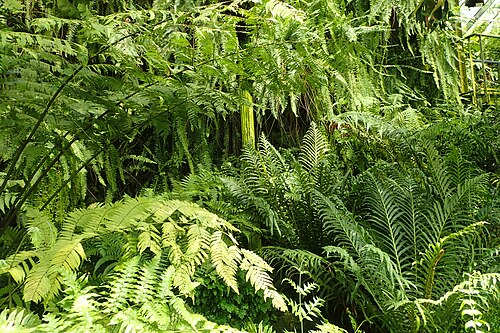
The tropical house brings together plants from the rainforests of America, Africa and Asia: wild figs, mangroves, palms, ferns, bromeliads and orchids, alongside crops such as cocoa (Theobroma cacao), vanilla, coffee, star fruit and black pepper. Visitors can also find the miracle berry (Synsepalum dulcificum), whose miraculin makes sour food taste sweet, and Aristolochia arborea, whose flowers mimic a small mushroom to attract the gnats that pollinate them. In summer a titan arum stands at a corner of the basin, and small tropical birds roam freely across the floor.
The desert house, arranged by geographical region, sets American cacti beside the African euphorbias that resemble them, and grows Welwitschia mirabilis from the Namib desert. The Australia house shows hard-leaved plants such as acacias, banksias and eucalyptus, along with Wollemia nobilis, discovered in 1994 near Sydney, and the grass tree Xanthorrhoea australis. The South Africa house features Protea cynaroides, Strelitzia reginae and Strelitzia nicolai. According to English Wikipedia, the glasshouses also hold a collection of some 350 species of succulent Euphorbia.
Visiting
1 min
The garden covers 13 hectares on the southern slope of the campus, in the Querenburg district of south-east Bochum (Universitätsstraße 150), and holds more than 10,000 species. The garden itself suggests starting with the glasshouse complex before exploring the outdoor areas, which are arranged by region: North American, Asian and European woodlands, dunes, heath and wetlands. The Tertiary pond, the medicinal plant garden and a perennial border inspired by Piet Oudolf punctuate the walk.
A visit naturally extends to the Qian Yuan Chinese Garden, a 1,000 m² scholar's garden in the restrained style of southern China, given in 1990 by Tongji University in Shanghai for the university's 25th anniversary. The colourful summer bedding displays are among the highlights of the warmer months.
51.44° N, 7.27° E
Greenhouses nearby
More greenhouses — Germany
Do you have a good photo of this greenhouse? Suggest it for this page →
Sources (5)
- boga.ruhr-uni-bochum.de/bg/garten/index.html.de
- boga.ruhr-uni-bochum.de/bg/garten/geschichte/index.html.de
- de.wikipedia.org/wiki/Botanischer_Garten_der_Ruhr-Universit%C3%A4t_Bochum
- en.wikipedia.org/wiki/Botanical_Garden_of_Ruhr_University_Bochum
- lwl-dlbw.de/de/denkmaeler-entdecken/denkmal-des-monats/bochum-botanischer-garten-ruhr-univ