Palm House (Pálmaház) of the Mátra Museum
Gyöngyös (Orczy Garden), Heves County

Sources checked October 2026
- Year
- 2009 (pavilion inaugurated at the end of 2008)
- Architect
- Grafit 37 Építész Iroda Kft. (Kelemen Tamásné, Eperjesi László, Kurta Zsolt)
- Style
- Modern pavilion in concrete, glass, stone and timber; vivarium greenhouse with largely glazed walls
- Dimensions
- 240 m² (pavilion page) or about 300 m² (palm house page), on two levels
- Status
- Open to the public within the museum grounds
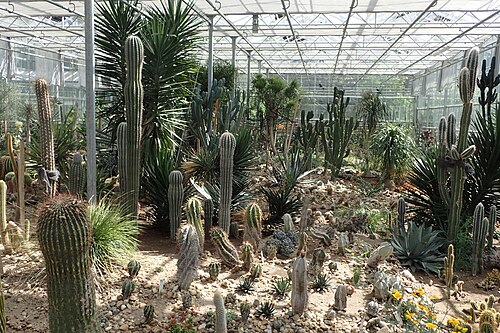
In the Orczy Garden at Gyöngyös, the natural science pavilion of the Mátra Museum, open to the public since 2009, houses a two-level pálmaház. This greenhouse with largely glazed walls, 240 to 300 m² depending on the museum's pages, gathers tropical and subtropical plants, an aviary, a small pond, aquariums and terrariums: it works both as a small plant garden and as a live-animal exhibit. It was conceived to evoke the neo-Gothic orangery of the Orczy park, now vanished.
Affiliate links — booking through Verrière helps fund our research, at no extra cost to you.
History
The greenhouse recalls a vanished building. In the English-style park of the Orczy mansion, rebuilt in 1826 according to Építészfórum, a very graceful neo-Gothic orangery stood in the north-east, used to overwinter lemon and orange trees and other southern plants; it was put up after 1826 and demolished during the garden's decline. A 2023 article by the museum places it where the pavilion stands today.
The modern project began with a design competition in 2001, won by the practice Grafit 37. The restoration of the mansion and garden was carried out in three stages. The second (2007-2008), financed by a state grant of the order of 1.2 to 1.3 billion forints, built the new natural science pavilion and revitalised the garden; the third laid out the park as an arboretum. An August 2009 article says the pavilion was inaugurated at the end of 2008, while the exhibition and the pálmaház were announced for 28 October 2009. The whole project received the Europa Nostra conservation award in 2009.
According to the official page, the pálmaház evokes the old orangery, and since May 2015 it has worked as a live-animal exhibit on the model of a small zoo.
Architecture and engineering
The pálmaház occupies part of the natural science pavilion, a work of Grafit 37 (Kelemen Tamásné, Eperjesi László, Kurta Zsolt). Építészfórum describes it as an assembly of simple cubes, discreet yet varied, which can be called "modern classicist": rows of reinforced-concrete columns 10 and 6 m high paraphrase the Doric colonnade of the mansion, while glass, stone and timber surfaces fit the volume into the park; a 2009 article also cites Scots pine and granite. On the Commons photograph the glazed facade stands behind a row of pillars under a large timber canopy, flanked by a stone drum. The museum counts about 1,200 m² of exhibition space on three levels, the 2009 press about 2,500 m² of usable floor.
The greenhouse is described by the museum as an enclosed part "largely glass-walled", on two levels: 240 m² on the pavilion page, about 300 m² on the palm house page, a gap left unexplained. An aviary and a small pond are surrounded, on both levels, by terrariums and aquariums; each aquarium holds 1,300 litres. An automatic irrigation system can release a sudden mist, hence damp floors. The microclimate differs from the rest of the museum: the museum speaks of a small enclosed island.
Plant collections
As for plants, the museum speaks of tropical and subtropical plants from several regions that thrive in damp soil and humid air. A 2023 article by the museum cites palms, ficus relatives and other unusual species, which give the lower level a jungle atmosphere; the official page names only one plant, the flamingo flower (flamingóvirág), and adds that rose leaves feed the stick insects.
The animals come from around the world rather than from Hungary, because they are easier to keep, and show the morphology and behaviour of each group. The museum counts 35 to 40 species on one page, 40 to 45 on another: zebra finches and other finches in the aviary, tropical cichlids, large catfish, schooling fish and axolotls in the aquariums, a musk turtle, guinea pigs roaming among the plants, bearded dragon, green iguana, anoles, milk frog, a chameleon, snakes including Philodryas baroni, stick insects, the grasshopper Tetrataenia surinama and the tarantula Acanthoscurria geniculata. Some reptiles can be handled during workshops; mammals are announced for later.
Visiting
The pálmaház stands in the northern part of the Orczy Garden, inside the natural science pavilion of the Mátra Museum, about 130 m from the mansion (according to OpenStreetMap). The website lists the greenhouse among the museum's exhibitions: it is wiser to ask at the desk. The garden of about 2 ha, with its pond, Mediterranean terrace and insect hotel, extends the visit pleasantly. As the greenhouse is enclosed, visiting it does not depend on the weather; the floor is damp because of the mist. Dogs and other pets are not allowed on the museum grounds.
47.79° N, 19.93° E
Greenhouses nearby
More greenhouses — Hungary
Do you have a good photo of this greenhouse? Suggest it for this page →
Sources (8)
- matramuzeum.nhmus.hu/hu/palmahaz
- matramuzeum.nhmus.hu/hu/termeszetrajzi_kiallitas
- matramuzeum.nhmus.hu/hu/kert
- matramuzeum.nhmus.hu/hu/belepodijak
- epiteszforum.hu/az-ujjaszuletett-matra-muzeum
- mult-kor.hu/20090813_europa_nostratablat_avattak_a_gyongyosi_matra_muzeum_falan
- kekesonline.hu/2023/08/22/tropus-a-muzeumban/
- hunguesthotels.hu/hu/oktober_28an_megnyitja_kapuit_a_gyongyosi_matra_muzeum_uj_termeszettu
Affiliate links — booking through Verrière helps fund our research, at no extra cost to you.