Palm House and Glasshouses of the Vácrátót National Botanical Garden (Nemzeti Botanikus Kert)
Vácrátót, Pest County
Entry updated on October 5, 2026
- Year
- 1985–1987
- Style
- Glasshouse with a 15 m main nave and three side aisles
- Dimensions
- Main nave 15 m high; 480 m² cactus house
- Status
- Open to the public all year
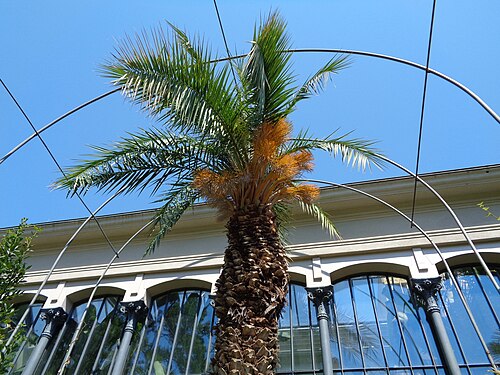
The National Botanical Garden at Vácrátót, a former estate of the Vigyázó counts bequeathed to the Hungarian Academy of Sciences, lost all the glasshouses of the counts' era; the botanical institute set up in 1952 began building new ones in 1953. The present Palm House, raised in 1985-1987 on the site of a 1967 display house, has a main nave 15 m high. Together with the 480 m² cactus and succulent house opened in 2009 and the orchid and bromeliad house, it shows a collection of more than 3,000 taxa that can be visited all year.
Affiliate links — booking through Verrière helps fund our research, at no extra cost to you.
History
1 min
The garden at Vácrátót goes back to the late 18th century or the first third of the 19th, when István Géczy laid it out on his estate; the first written mention dates from 1827. Sold in the autumn of 1846 to Count Sándor Nákó and in 1852 to the Scottish Benedictines of Vienna, the estate was bought in 1871 by Count Sándor Vigyázó. Work resumed in the spring of 1872 under the Czech gardener Henrik Band, head gardener from 1873 to 1913. By a will of 1921, Ferenc Vigyázó left the estate to the Hungarian Academy of Sciences, which inherited it on his death in 1928.
The following decades were hard: the mansion was demolished in the 1930s and every glasshouse of the counts' era was lost. Placed in 1946 in the care of the Hungarian Natural History Museum, the site became on 1 January 1952 the seat of the Academy's botanical research institute, whose first task was to build glasshouses fit for a tropical collection. A small half-sunken house was built in 1953 and a second in 1955; the first large house heated with hot water was completed in January 1958, followed in 1961 by a propagation house and an orchid house. The garden opened to the public on 1 May 1961. A display house was fitted out in 1967, and the cold house, finished in the autumn of 1969, was renovated and enlarged in 1997.
The present Palm House replaced the 1967 display house between 1985 and 1987. The cactus and succulent house was handed over in the spring of 2009, and the orchid and bromeliad house was fitted out shortly afterwards. Since January 2012 the garden has been run by the Centre for Ecological Research (Ökológiai Kutatóközpont).
Architecture and engineering
1 min
The Palm House of 1985-87 combines a main nave 15 m high with three side aisles. It stands on the site of the 1967 display house. Around it, the garden's glasshouses record several decades of building: the cold house of 1969, described as the largest overwintering house in the country and renovated and enlarged in 1997; the 480 m² cactus and succulent house, handed over in the spring of 2009; and the orchid and bromeliad house, fitted out shortly afterwards.
Heating has followed changing technology. Coke-fired in the 1970s, it later switched to oil and then to thermal water: under the Geoterm project the glasshouses are now heated by a closed thermal-water circuit. Three of the buildings, the Palm House, the cactus and succulent house and the orchid and bromeliad house, are open to visitors throughout the year.
Plant collections
1 min
The glasshouse collection holds more than 3,000 species, varieties and forms. It is especially rich in bromeliads, aroids and the ginger family, and in tropical orchids. The Palm House presents plants of warm climates: palms, figs and crops such as banana, coffee and turmeric.
The orchid and bromeliad house also holds the garden's collections of begonias, wax plants (Hoya) and passion flowers, together with vanilla orchids and carnivorous plants, among them the Venus flytrap. The cactus and succulent house recreates desert and semi-desert habitats with cacti, aloes, agaves and elephant's foot trees. These houses complement the outdoor collections of a garden that holds nearly 13,000 species and varieties, including some 3,300 woody taxa.
Visiting
1 min
Vácrátót lies in Pest County, north of Budapest. The three glasshouses open to the public, the Palm House, the cactus and succulent house and the orchid and bromeliad house, can be visited all year and make a stop of about an hour within a 27-hectare garden that is a protected nature area (the Vácrátót Arboretum) managed under the Duna-Ipoly National Park. In winter they are the core of the visit; from late summer to early autumn the grounds are at their best, with the Indian lotus and crape myrtles in flower and the systematic beds in bloom.
47.71° N, 19.23° E
Greenhouses nearby
More greenhouses — Hungary
All greenhouses — Hungary →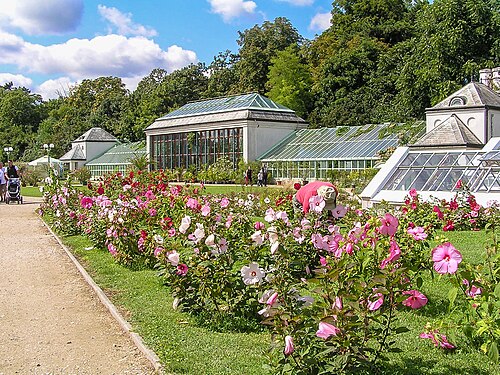
Do you have a good photo of this greenhouse? Suggest it for this page →