Palm House of the University of Pécs Botanical Garden (PTE Botanikus Kert)
Pécs, Baranya County

Entry updated on October 5, 2026
- Year
- 1953-1954
- Architect
- Unknown
- Style
- Half-sunken teaching glasshouse with metal frame
- Dimensions
- Footprint of 10 × 5 m (1954 palm house)
- Status
- Open to the public
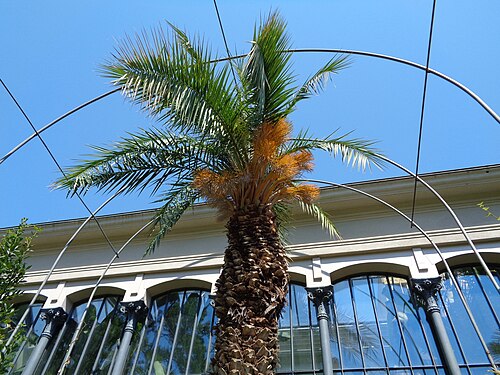
The University of Pécs botanical garden was founded in 1952 in the former grounds of the Jesuit Pius college, inheriting two heated glasshouses. Its palm house, begun in autumn 1953 and opened on 1 May 1954, was built half below ground to keep costs down. Its timber frame was replaced by a metal one in the 1970s; it was fully modernised in 1996 and renovated again in 2011. More than 600 tropical species grow there around 10–12 m palms, bananas and fig trees, within a glasshouse complex that also includes a cactus house.
Affiliate links — booking through Verrière helps fund our research, at no extra cost to you.
History
1 min
The Pécs botanical garden grew out of the grounds of the former Jesuit Pius college. When the university took the site over, it inherited in 1950 two heated glasshouses measuring 11 × 2.5 m and 10 × 5 m, which became the nucleus of the indoor collections. The garden itself was established in 1952, driven by its director Gábor Uherkovich, the senior lecturer György Pásztor and the assistant Jenő Tihanyi.
Resources were scarce at first: that same year the staff built a small 9 × 2.5 m succulent house themselves from salvaged materials. With funding from the Ministry of Education, work on the palm house began in autumn 1953 and it opened on 1 May 1954. By 1965 the garden had six glasshouses, devoted to propagation, useful plants of warm regions, epiphytes and ferns, succulents, palms and experiments.
Around 1976 the palm house's timber frame was replaced by a metal structure and ferns were given a home there; that year a new succulent house was also built, and the old 1934 palm house inherited from the college reopened under a new roof as an epiphyte house. The palm house was completely renovated and modernised in 1996, the cactus house in 1998. The garden has been a protected site since 1989. In 2011 some 180 million forints went into rebuilding the glasshouses, and a second programme of about 215 million, announced in 2014, upgraded their equipment among other works.
Architecture and engineering
1 min
The Pécs palm house is a post-war building shaped by a tight budget. To save money it was sunk halfway into the ground: the footprint is 10 × 5 m and the average height 6 m. Partial burial reduced the amount of glass to heat while still giving tall plants enough room indoors.
The original timber frame was replaced around 1976 by a metal one, better suited to the humid air of a tropical house. A full modernisation in 1996 and the reconstruction funded in 2011 focused on climate control and on lowering energy use.
The palm house does not stand alone. It belongs to a cluster of glasshouses at the heart of the garden, next to the cactus house, the epiphyte houses and the propagation houses, and a small pond lies in front of its south-west front. The group is modest in size, yet it traces the step-by-step growth of a university garden, from the Jesuit glasshouses of the interwar years to the renovated facilities of the 2010s.
Plant collections
1 min
According to the figures published for its 70th anniversary, the garden holds about 9,000 species, some 350 of them protected or strictly protected; a 2014 report already counted 2,500 species under glass. The palm house alone contains more than 600 tropical species. Palms of 10 to 12 metres and large fig trees form the canopy, above textile bananas, anthuriums, philodendrons, pepper plants and ferns.
The other glasshouses round out the visit, with more than 1,200 cacti and succulents, citrus from the Mediterranean region, and cold-tolerant eucalyptus and acacias. The houses serve visitors, university teaching and conservation alike.
Visiting
1 min
The garden covers about 6.8 hectares on the university campus on Ifjúság útja in Pécs. The glasshouses keep shorter hours than the outdoor garden and open mainly on weekdays, so it is worth checking the days before a visit. One to two hours is enough for the houses and the themed outdoor collections, which include a Japanese garden with its pond and Asian, Mediterranean, American and Australian plantings. Spring and early summer show the outdoor garden at its best, while the palm house can be visited in any season.
46.08° N, 18.21° E
Greenhouses nearby
More greenhouses — Hungary
Do you have a good photo of this greenhouse? Suggest it for this page →