Glasshouses of the Tuzson János Botanical Garden, University of Nyíregyháza (Pálmaház, Kaktuszház, tropical useful-plants house)
Nyíregyháza, Szabolcs-Szatmár-Bereg County
No freely licensed photo of this greenhouse yet. Do you have one? Suggest it for this page →
Sources checked October 2026
- Year
- 1984-2005
- Architect
- Nyírterv and forestry designers (palm house)
- Style
- Teaching glasshouse complex built in stages: domed palm house, succulent house, tropical house (2005) and a plastic-film Mediterranean tent
- Dimensions
- Palm house dome 12 m high; about 1,000 of the garden's 2,500 taxa grown under cover (2008)
- Status
- Open to the public on weekdays, free entry (published hours cover the outdoor area; guided tours suspended)
Beside the Sóstó forest, the botanical garden of the University of Nyíregyháza, begun in 1973 and named since 2002 after the botanist János Tuzson, built its glasshouses in stages: the first part of the palm house in 1984, the cactus house in 1992, a Mediterranean house in 1997, then in 2005 a tropical useful-plants house where visitors can see the Amazon water lily Victoria amazonica. The glass circuit leads from a 12-metre domed palm house to cacti, carnivorous plants and epiphytes. The garden grows more than 2,500 species.
Affiliate links — booking through Verrière helps fund our research, at no extra cost to you.
History
The idea of a botanical garden arose when the Nyíregyháza teacher-training college was founded in 1962. In November 1970 the national and county authorities approved the plan; in 1972 the local forestry enterprise handed over 4.5 hectares of forest, and works began in 1973 according to the garden's website (1974 according to Hungarian Wikipedia). The garden's plans were drawn up at the botany department of the University of Szeged, those of the palm house by the Nyírterv design office and forestry designers. Until 1984 the garden formed part of the botany department, of which it remains the "living laboratory".
The glasshouses came in stages: the first part of the palm house was handed over in 1984, the cactus house in 1992 and the Mediterranean house in 1997. A foundation set up in 1990 around the cactus house still supports the garden. In 1998 the site was declared a locally protected natural area and grew from 4.5 to 5.6 hectares; in 2002 it took the name of János Tuzson (1870-1943), a botanist whose research made the flora of the Nyírség known, and its main building was extended. The newest wing, in 2005, is a tropical useful-plants house where visitors can see the Amazon water lily Victoria amazonica. The garden now grows more than 2,500 species, and its official website reports more than 20,000 visitors.
Architecture and engineering
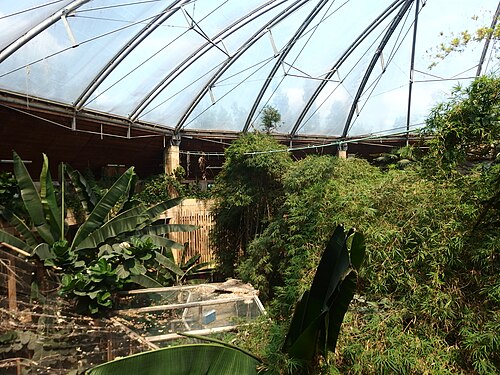
The palm house (Pálmaház) is a domed hall 12 metres high, planned by the Nyírterv office and forestry designers; according to Hungarian Wikipedia, its modern equipment allows plants to be kept in houses with different heat, humidity and light conditions, and aquariums complete the complex. The glasshouses follow one another in a circuit: tropical useful-plants house, cactus house (Kaktuszház), a small pool of carnivorous plants, palm house, subtropical and ornamental plants, epiphytes.
The newest wing (2005) holds a tropical pool; its side glazing is shaded in summer by climbing passion flowers, and its entrance has a green lattice door in summer, with a glass door added in winter. The Mediterranean house (1997) is not glass: it is a double-walled plastic-film tent, taken down in summer, which a water curtain protects in winter.
Plant collections
The palm house gathers plants from hot, humid equatorial regions. According to the garden, its oldest and most precious specimen is a male sago palm (szágópálma, Cycas circinalis) about a hundred years old, a gift from the Košice botanical garden; there are also screw pines, figs, papayas, a coffee shrub, a pepper vine and anthuriums. The tropical useful-plants house shows the giant water lilies Victoria amazonica and Victoria cruziana, whose leaves measure 2 to 3 metres across and whose flowers last only two days, together with lotus, papyrus, cacao (in flower every year since 2005), vanilla, banana, sugar cane, cotton, avocado and more than ten kinds of passion flower.
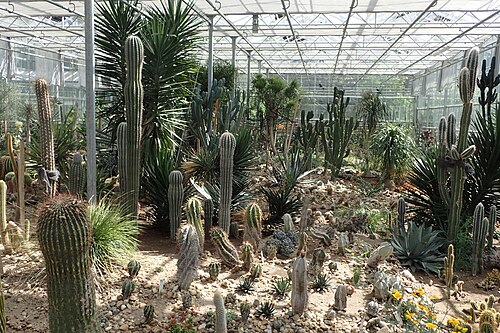
The cactus house, also called the succulent house, holds nearly 2,500 plants, most spectacular in May. A neighbouring pool presents carnivorous plants (sundews, pitcher plants, Venus flytrap), and the epiphyte section brings together hundreds of bromeliads, orchids and ferns. The sensitive plant, the garden says, is where visitors linger longest.
Visiting
The garden is at Sóstói út 31/b, beside the Sóstó forest and the university campus; city buses (lines 8 and 8/a from the railway station) serve it. The official website leads visitors under glass in this order: tropical useful-plants house, cactus house, carnivorous plants, palm house, subtropical and ornamental plants, then epiphytes. The published hours (Monday to Friday, closed at weekends and on public holidays, free entry) concern the outdoor area, and guided tours are suspended. Combine the visit with the Japanese garden, the rose garden, the rock garden, the lake and the thuja maze planted in 2009, all within the garden's 5.6 hectares. May suits the flowering of the cacti.
47.97° N, 21.71° E
Greenhouses nearby
More greenhouses — Hungary
Do you have a good photo of this greenhouse? Suggest it for this page →
Affiliate links — booking through Verrière helps fund our research, at no extra cost to you.