Pálmaház of the Füvészkert (Budapest Botanical Garden)
Budapest

Sources checked September 2026
- Year
- 1865
- Architect
- József Diescher
- Style
- Historic octagonal greenhouse, iron and glass, with a dome
- Status
- Restored after World War II damage, in operation
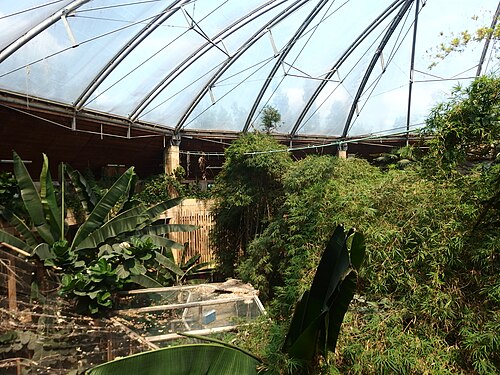
Built in 1865 to plans by architect József Diescher, the Pálmaház at Budapest's Füvészkert — Hungary's oldest botanical garden — is distinguished by its octagonal plan, topped with a dome toward which the fronds of an old cycad, nearly eighteen meters tall, still reach today. Originally conceived more as an orangery for overwintering plants than as a true permanent palm house, it has housed Hungary's only Victoria pool since the 19th century, where the giant Amazonian water lily thrives. Damaged by World War II bombing, the greenhouse remained closed for nearly twenty years before returning to full use. It owes part of its popular fame to Ferenc Molnár's novel The Paul Street Boys, in which young Nemecsek hides in the greenhouse's goldfish pool. Still in operation today, the Pálmaház continues to house orchids, flowering citrus, and tropical plants, just a few kilometers from Budapest Zoo and its own, much more recent, Pálmaház.
Affiliate links — booking through Verrière helps fund our research, at no extra cost to you.
History
The botanical garden of the University of Pest was founded in 1771 by Professor Jakab Winterl to train medical students. It moved several times before settling, in the mid-19th century, on the former Festetics estate in Budapest's Eighth District. Between 1851 and 1853 Rudolf Glaser drew up several schemes for a large glasshouse, one with a Gothic central block, but none was built, most likely for lack of funds.
The project finally went ahead after Ferenc Xavér Linzbauer became director in 1863, when an imperial decree authorised a heated orangery for exotic plants sent from the gardens of Schönbrunn. Plans were settled at the end of October 1863, the hot-water heating was tested in February 1865 and the building was formally accepted in July 1865. It is attributed to the architect József Diescher (1811–1874), although his original drawings have never been found.
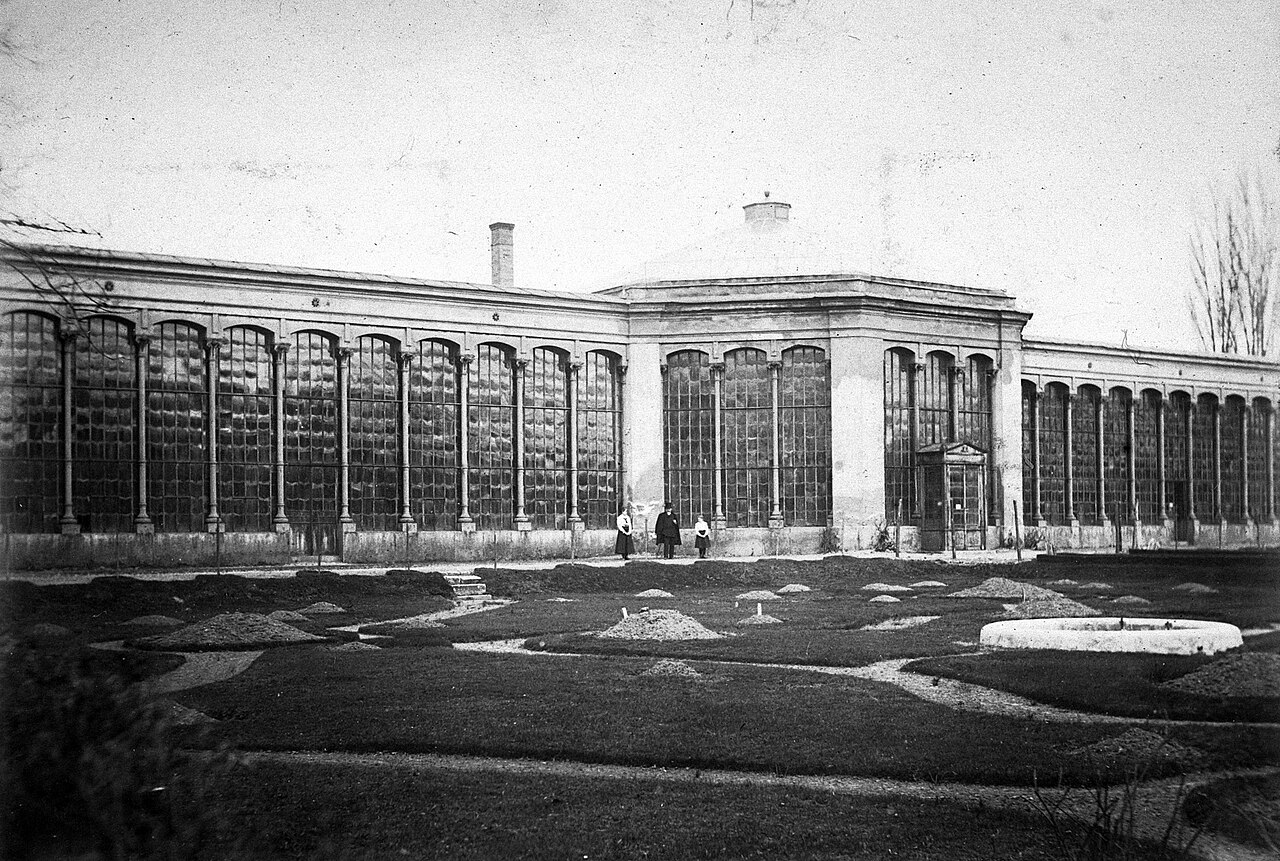
Badly damaged during the siege of Budapest in 1944–45, the glasshouse was out of use for many years. Listed as a historic monument in 1958, it was rebuilt in the 1960s to designs by Iván Kotsis, with work completed in 1966. A full restoration by the Mányi István Építész Stúdió followed, and the house reopened in 2011.
The garden owes much of its fame to Ferenc Molnár: in The Paul Street Boys, young Nemecsek hides in the glasshouse pool, a soaking that seals his fate. A ceramic statue of the character by András Zsigó was unveiled in August 2019.
Architecture and engineering
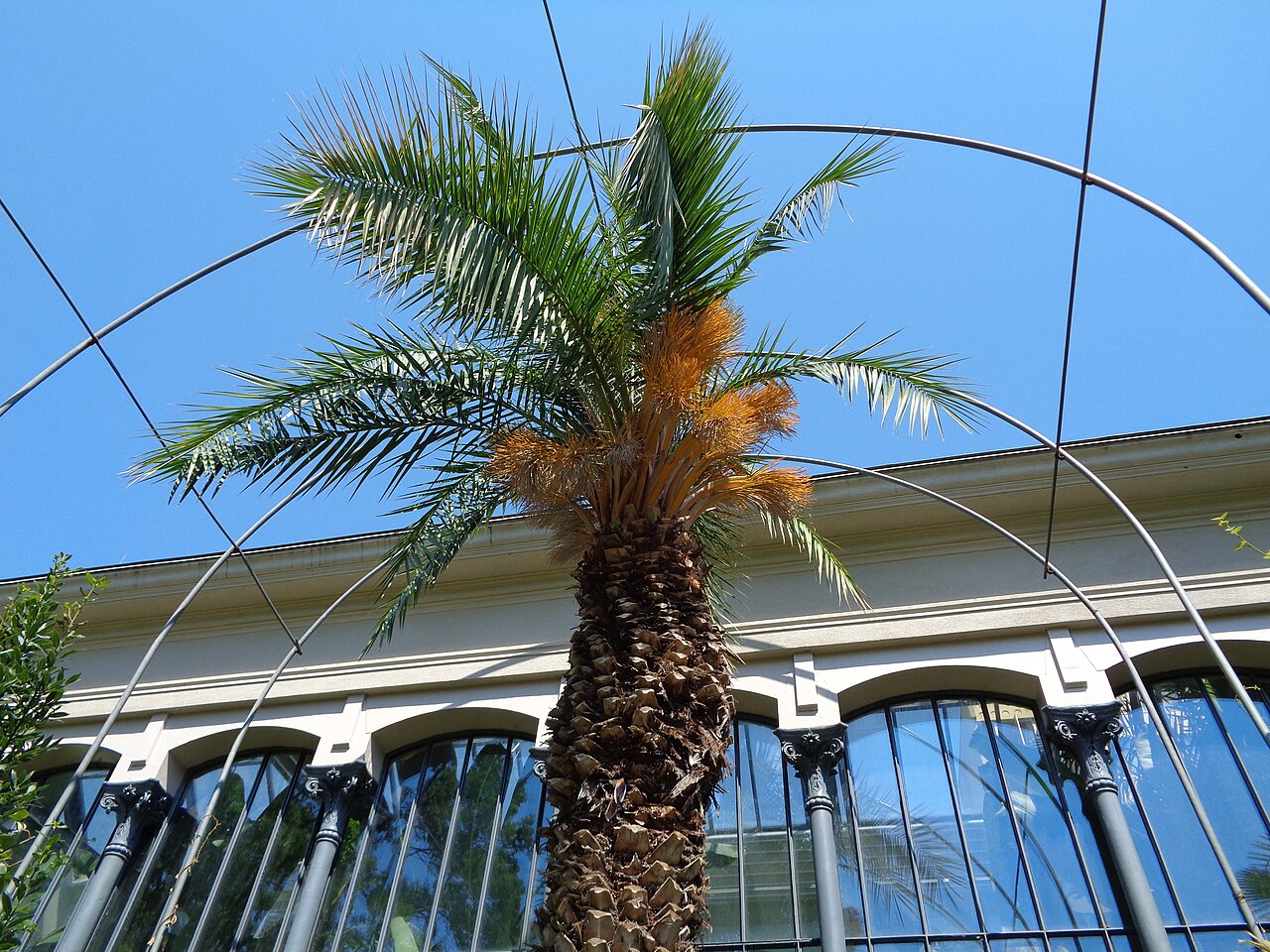
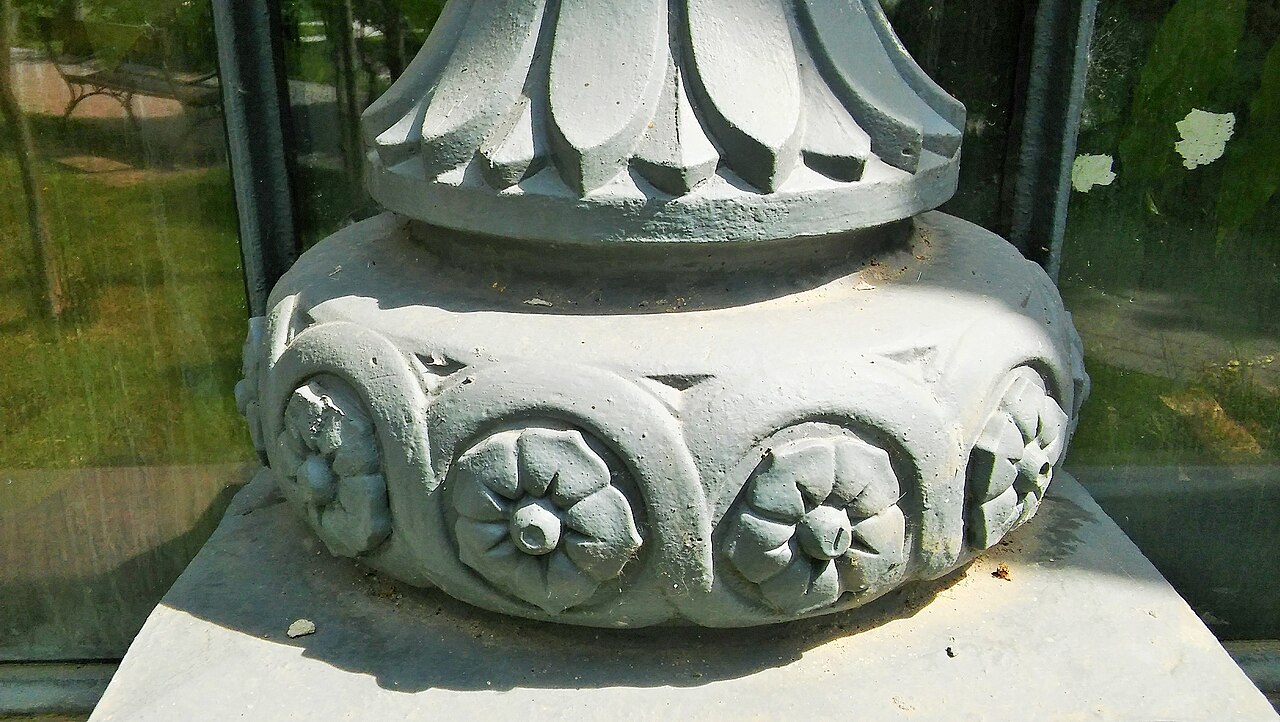
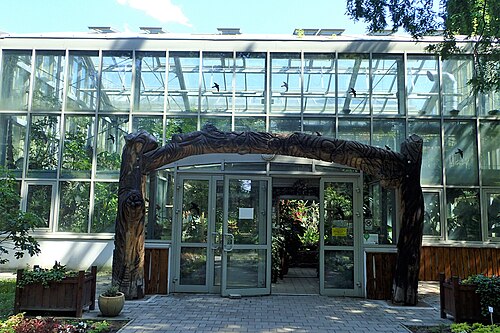
The building is made up of three sections in a row, about 62 metres long in total — the "33 fathoms" given in 19th-century records. At its centre stands an octagonal pavilion crowned by an eight-sided glass dome, flanked by two rectangular glass-roofed wings. Cast-iron columns with Corinthian capitals carry the structure, and tall segmental-arched windows run from plinth to cornice.
The 1960s reconstruction raised the interior of the central section to almost 20 metres so that tall palms could grow there. The 2011 restoration put conservation first: the original metal frame, the stone-edged planting beds and the foundations were kept, the cast-iron columns were repainted in their original mid-grey, and the new insulated double glazing was given a slightly darker tint to set it apart from the historic fabric. The building services were replaced entirely, with underfloor, wall and radiant ceiling heating and a humidification system.
The palm house connects to the Victoria-ház, a small building added in 1893 around a heated pool.
Plant collections
The Pálmaház holds the garden's tropical and subtropical collections: palms, orchids, pitcher plants and aquatic species. Its most striking plant is a sugar palm some 18 metres tall whose leaves brush the dome; it cannot be topped, since cutting the growing tip would kill it. Cycads roughly 150 years old are among the oldest residents.
The neighbouring Victoria-ház, built in 1893, was Hungary's first glasshouse devoted to the giant Amazon water lily (Victoria) and is still the only one. The 2011 renovation allowed the tropical, subtropical and Mediterranean collections to grow by 10–15 per cent. Across the garden, some 250 species on the IUCN Red List are on display, and further glasshouses are given over to cacti, citrus, Australian flora and subtropical plants.
Visiting
The Füvészkert covers about three hectares in the middle of the Eighth District, close to Semmelweis klinikák metro station — what remains of grounds that once extended over roughly ten. The Pálmaház is its best-known building and is seen together with the adjoining Victoria-ház. An hour or two is enough for the glasshouses and the tree-lined paths, which still shelter some very old trees.
Readers of Molnár will recognise the settings of the novel and can look for the Nemecsek statue. The cactus and citrus houses, along with themed exhibitions held through the year, round off a visit.
47.49° N, 19.08° E
Greenhouses nearby
Architecture nearby
More greenhouses — Hungary
Do you have a good photo of this greenhouse? Suggest it for this page →
Sources (7)
- fuveszkert.org/gyujtemenyeink/
- magyar-muveszet.hu/upload/userfiles/2/publications/202109/pdf/MM2021_1belivek_06_rozsnyai_
- epiteszforum.hu/megujult-palmahaz-es-fuveszkert
- welovebudapest.com/en/article/2021/05/12/active-a-green-eden-deep-in-district-viii-the-sec
- welovebudapest.com/cikk/2023/10/25/szabadido-edenkert-a-nyolcker-melyen-a-fuveszkert-torte
- pestbuda.hu/cikk/20190816_nemecsek_erno_uj_szobra_a_fuveszkert_medencejebe_kerult
- greendex.hu/fuveszkert/
Affiliate links — booking through Verrière helps fund our research, at no extra cost to you.