Tegarayama Greenhouse Botanical Garden (姫路市立手柄山温室植物園)
Himeji, Hyōgo Prefecture

Sources checked October 2026
- Year
- 1980
- Style
- Two display greenhouses, the larger a dome ringed by glass panels, set in an open-air garden
- Dimensions
- Large house 660 m², small house 180 m²; garden of 11,334 m²
- Status
- Open to the public; relocation to another site under study, no date announced
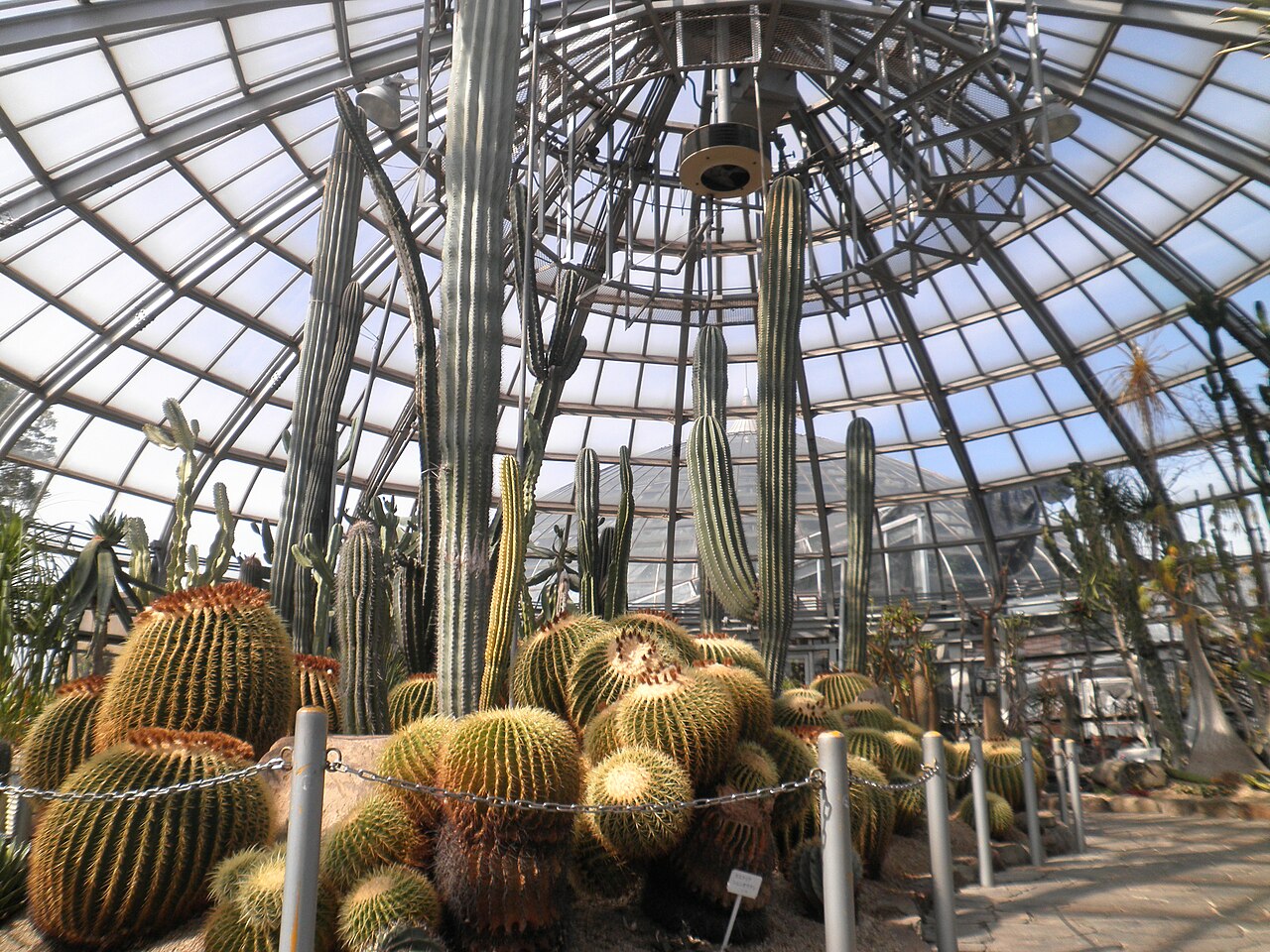
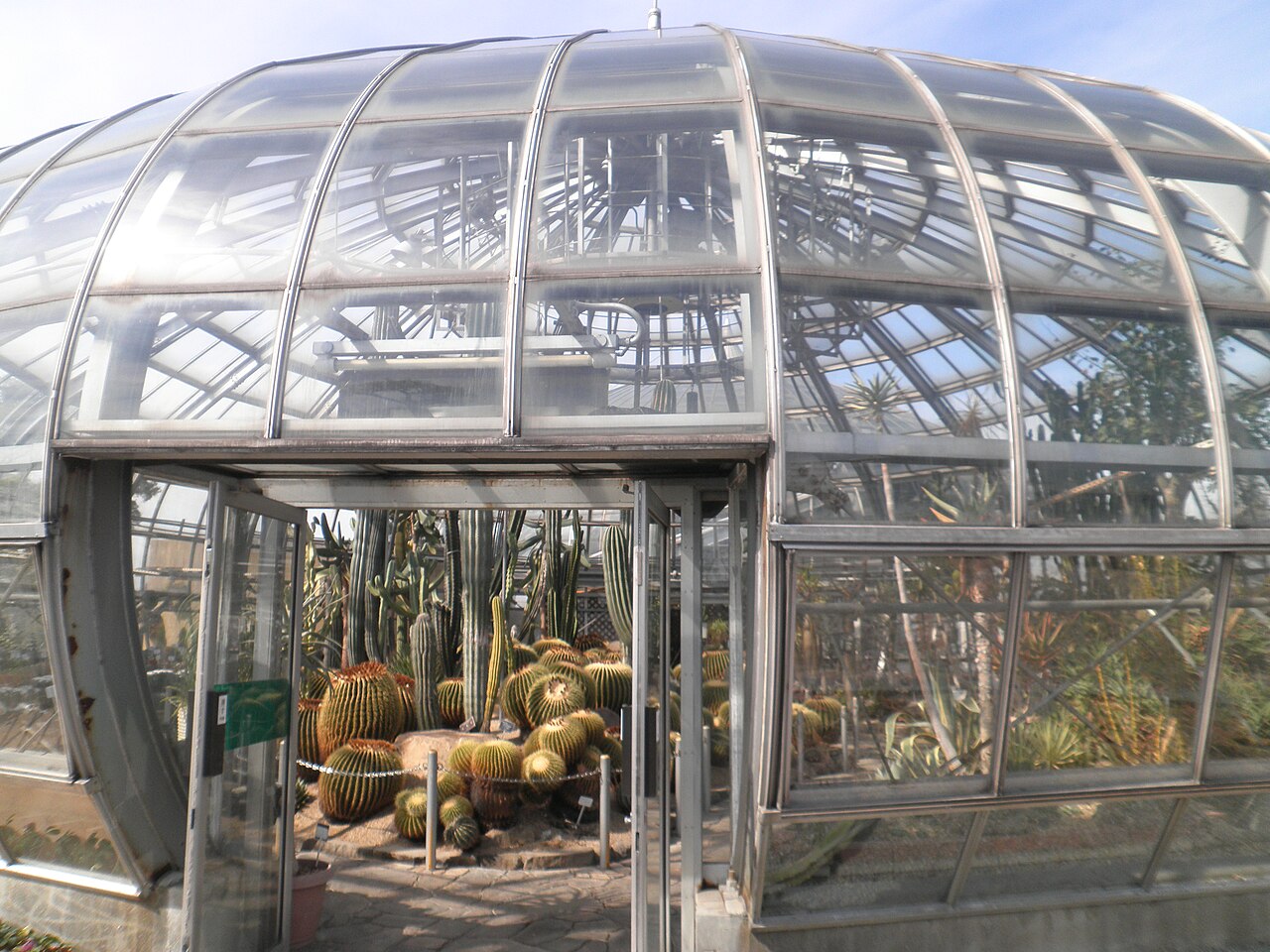
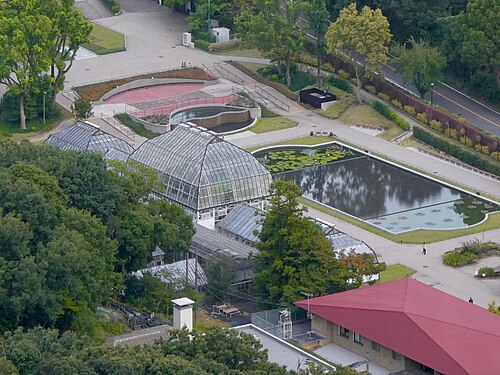
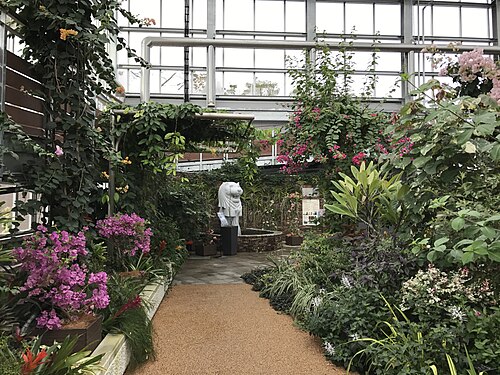
Opened on 2 May 1980 on the southern hill of Tegarayama Peace Park in Himeji, this municipal garden is built around two display greenhouses: a 660 m² large house, whose dome is ringed by glass panels, devoted to palms, tropical fruit trees, orchids and carnivorous plants, and a 180 m² small house for cacti and succulents. Cultivation houses, an Australian rock garden, a herb garden and a panoramic terrace complete the 11,334 m² site, where the sagisō, the city's emblem flower, is also grown. The displays change more than ten times a year.
Affiliate links — booking through Verrière helps fund our research, at no extra cost to you.
History
The Tegarayama Greenhouse Botanical Garden opened on 2 May 1980 on the southern hill (minami-yama) of Tegarayama Peace Park in Himeji. The park, founded in 1942 and renamed Central Park in 1953, was the main site of the 1966 Himeji Grand Exposition and has carried its present name since April 2025. The 1980 date comes from the official site, Wikidata and the Japanese Wikipedia; the English Wikipedia page gives 1990.
The municipal regulation quoted on the official site gives the establishment three purposes: to display tropical, subtropical and desert plants, to spread botanical knowledge, and to offer residents a place to relax. Management is delegated by the city, under a mandate running from fiscal 2024 to fiscal 2026.
In March 2003 the garden added a rock garden, a wooden deck terrace and a cultivation house for the sagisō, the orchid the city adopted as its emblem flower in August 1966 as a fitting match for Himeji Castle, nicknamed the White Heron Castle. In 2025 the Japanese Association of Botanic Gardens gave its Kimura Prize to a staff member, citing among other things a technique for flowering the plant all year round and the discovery of new wild sites; the 2024 prize honoured work on rare wild plants.
According to a local news site reporting a city council session of December 2019, the park development plan of January 2017 foresees moving the garden to the former cultural centre site in a second phase starting in fiscal 2026. The garden remains open.
Architecture and engineering
The garden has two display greenhouses: the large house (660 m²) and the small house (180 m²). Two cultivation houses (240 m² in total) and the sagisō house (40 m²), closed to visitors to hold its temperature but with flowers visible from outside, complete the group, along with an entrance hall and an exhibition room on the brick plaza.
The Kobe Shimbun described the large house in August 2026 as a dome ringed by glass panels; the Japanese Wikipedia places the garden in its "glass architecture" and "circular buildings in Japan" categories without detailing the plan. Ceiling sprinklers were used for a daily "jungle squall" experience until 31 August 2026.
The route through the large house includes a waterfall and a staircase ("course 2") leading to its highest point. Part of the circuit is by steps, the rest by slope or ramp, and wheelchairs are lent at reception. The garden stands at the top of a rise; a wooden deck terrace looks out over the south of the city, and large coaches cannot drive up to the summit.
Plant collections
The greenhouses permanently display about 25,000 plants of 1,500 species in 120 families, according to the official site. The large house, where the Kobe Shimbun counts about 530 tropical and subtropical species, holds palms, tropical flowering trees, mango, banana, orchids and carnivorous plants; the Japanese Wikipedia illustrates the latter with mujinamo (Aldrovanda vesiculosa), fukuro-yukinoshita (Cephalotus) and tanukimo (Utricularia japonica). The ogibashō (扇芭蕉, "fan banana"), the tallest plant in the garden, grows there; in September 2026 the garden's blog reported fruit on its pinpon-no-ki (ピンポンノキ).
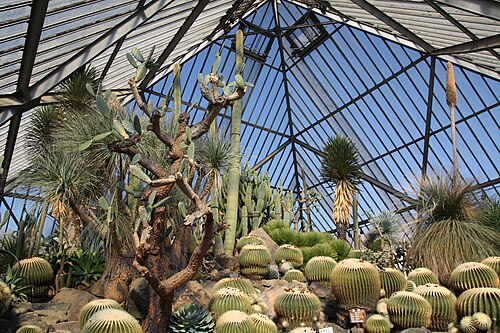
The small house holds cacti and succulents arranged by region of origin, among them the benkeibashira, the kinshachi and pachypodiums. Outdoors, the rock garden is made up mostly of Australian plants (grevilleas, banksias, callistemons) and the herb garden of lavender, sage and thyme. The aristolochia (ウマノスズクサ) is planted for the caterpillars of the jakō-ageha, Himeji's emblem butterfly.
The plantings change more than ten times a year; autumn 2026 runs through cacti and succulents, begonias, then an orchid show billed as new.
Visiting
The garden occupies the top of the southern hill in Tegarayama Peace Park. The climb starts from JR Tegarayama Heiwa-Kōen station, one stop after Himeji (about 15 minutes on foot), or from Tegara station on the Sanyō Electric line (about 10 minutes). The circuit links the large house, the small house, the rock garden, the herb garden and the terrace. In autumn, Halloween decorations and cactus, begonia and orchid shows set the pace; summer 2026 brought an artificial downpour in the large house. The "Hana no Ie" pavilion, where flowers and gardening supplies are sold, is open without a garden ticket, and the municipal aquarium stands in the same park.
34.82° N, 134.68° E
Greenhouses nearby
More greenhouses — Japan
Do you have a good photo of this greenhouse? Suggest it for this page →
Sources (8)
- himeji-machishin.jp/midori/greenhouse/history.html
- himeji-machishin.jp/midori/greenhouse/sisetu.html
- himeji-machishin.jp/midori/greenhouse/info.html
- ja.wikipedia.org/wiki/%E6%89%8B%E6%9F%84%E5%B1%B1%E6%B8%A9%E5%AE%A4%E6%A4%8D%E7%89%A9%E5%9
- kobe-np.co.jp/news/himeji/202608/0020719838.shtml
- ja.wikipedia.org/wiki/%E6%89%8B%E6%9F%84%E5%B1%B1%E5%B9%B3%E5%92%8C%E5%85%AC%E5%9C%92
- himeji.jp/botanical-garden/
- jabg.or.jp/wp-content/uploads/2025/07/%E4%BB%A4%E5%92%8C7%E5%B9%B4%E5%BA%A6_%E5%8D%94%E4%B
Affiliate links — booking through Verrière helps fund our research, at no extra cost to you.