Large Greenhouse, Hyogo Prefectural Flower Center (兵庫県立フラワーセンター 大温室)
Kasai, Hyōgo Prefecture

Entry updated on October 5, 2026
- Architect
- Unknown
- Style
- Seven-room display greenhouse complex, renovated in 2012
- Dimensions
- 1,971 m² (seven rooms); 2,212 m² of display greenhouses according to the prefecture
- Status
- Open to the public
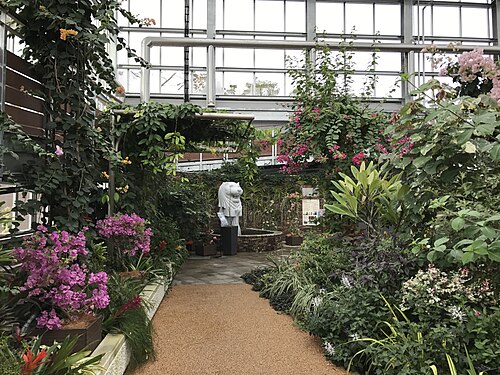
At the heart of the Hyogo Prefectural Flower Center, a 46-hectare park opened in Kasai in the mid-1970s, the large greenhouse runs through seven display rooms totalling 1,971 m²: seasonal flowers, tuberous begonias, tropical plants, gesneriads, orchids, carnivorous plants and a flower hall. Renovated between May and October 2012, it holds begonia, gesneriad and carnivorous-plant collections ranked among the finest in Japan, and in 2022 one of its Nepenthes truncata pitchers, 55.5 cm long, was certified as a world record.
Affiliate links — booking through Verrière helps fund our research, at no extra cost to you.
History
1 min
The prefecture created the Hyogo Flower Center to spread knowledge of flowers, raise standards of cultivation and give residents a place to unwind. Sources differ on when it opened: the official website describes a free opening in September 1974, with paid admission from April 1976, the date the prefecture and Japanese Wikipedia give as the inauguration. A supporting foundation was set up in January 1977, and in January 1980 the centre formed a sister partnership with the Singapore Botanic Gardens. The park kept growing into the early 1980s, adding a main gate, a floral clock, a display hall and azalea and camellia gardens, and in 1985 it opened a branch, Awaji Farm Park, which closed in September 2000.
Renamed Hyogo Prefectural Flower Center in April 2001, the site has been run since 2006 by the prefecture's horticulture and parks association. A full renovation in 2012 first closed the southern part of the park, which reopened in April; work on the greenhouse began on 7 May, and the 'grand opening' of 14 October 2012 put it back into service. An exhibition hall of ancient bronze mirrors, a branch of the prefectural archaeology museum, followed in 2017. Between fiscal 1976 and fiscal 2023 the park welcomed more than 16 million visitors; it marks its fiftieth anniversary in 2026, the year a café opened inside the greenhouse.
Architecture and engineering
1 min
None of the sources consulted names an architect or describes the greenhouse's structure or materials. The facilities inventory published by the prefecture in 2024 does, however, convey its scale: it lists four display greenhouses, an L-shaped house of 409 m², a 'large greenhouse' of 672 m², a 'small greenhouse' of 605 m² and a fourth of 527 m², 2,212 m² in all. The name 'large greenhouse', which the centre uses for the whole circuit, thus refers in the inventory to just one of these units. Out of public view, nine growing houses totalling 1,195 m² handle propagation and the upkeep of the collections.
For visitors the complex forms a continuous route through seven rooms, covering 1,971 m² according to the centre. The tropical plant room is the largest at 672 m², ahead of the Flower Hall (527 m²) and the orchid room (260 m²); then come smaller rooms of 114 to 142 m² devoted to carnivorous plants, tuberous begonias, seasonal flowers and gesneriads. The carnivorous plant room occupies the former tropical flowering-shrub room, extensively remodelled, while the seasonal flower room hosts temporary displays.
Plant collections
1 min
The centre counts its begonia, gesneriad and carnivorous plant collections among the richest in Japan. According to the official website, the begonia room shows some 700 varieties, the gesneriad room about 1,200, Streptocarpus among them, and the orchid room about 1,300 orchids and bromeliads, while the tropical room combines tropical fruit trees with some 300 foliage plants. In 2020 the Japan Association of Botanical Gardens recognised its Nepenthes species and its Streptocarpus as national collections, 188 taxa in all.
The greenhouse also has horticultural achievements to its name. In 2006 Saintpaulia goetzeana was raised here from seed, described as a first for Japan, and went on to flower eleven years running; that same year an artificial hybrid of the Seychelles pitcher plant was produced, followed in 2010 by an interspecific cross named 'Momogasa', both world firsts according to Japanese Wikipedia. On 20 August 2022 a Nepenthes truncata pitcher measuring 55.5 cm was certified by Guinness as the largest in the world, beating the previous record of 43 cm. The orchids are at their best from January to April.
Visiting
1 min
The 46-hectare park, laid out around Kamenokura pond, takes an hour to an hour and a half to explore, or two hours including the hillside trails and the lookout. The large greenhouse, close to the pond, offers shelter on rainy days and in winter. The seasons set the rhythm of a visit: around 220,000 tulips in spring, 10,000 sunflowers in summer, dahlias and chrysanthemums in autumn, and an illuminated evening festival in August; the rose garden holds 230 varieties and the cherry garden about twenty. Nearby, the Tamaoka historic park preserves a group of ancient burial mounds designated a national historic site.
34.91° N, 134.86° E
Greenhouses nearby
More greenhouses — Japan
Do you have a good photo of this greenhouse? Suggest it for this page →
Sources (6)
- flowercenter.jp/
- flowercenter.jp/map/%e5%9c%92%e5%86%85%e6%a1%88%e5%86%85
- flowercenter.jp/%e3%83%95%e3%83%a9%e3%83%af%e3%83%bc%e3%82%bb%e3%83%b3%e3%82%bf%e3%83%bc%e
- web.pref.hyogo.lg.jp/nk12/documents/furawasenntasiryousyuu.pdf
- ja.wikipedia.org/wiki/%E5%85%B5%E5%BA%AB%E7%9C%8C%E7%AB%8B%E3%83%95%E3%83%A9%E3%83%AF%E3%8
- gardenstory.jp/gardens-shops/15419