Awaji Green Kan (あわじグリーン館), Awaji Yumebutai Greenhouse
Awaji, Hyōgo Prefecture
Entry updated on October 3, 2026
- Year
- 2000
- Architect
- Tadao Ando (安藤忠雄); exhibition and planting design: 辻本智子 (Tomoko Tsujimoto)
- Style
- Contemporary conservatory within a Tadao Ando complex
- Dimensions
- 6,700 m² of floor space, 20 m-high interior
- Status
- Open to the public (reopened in March 2025 after renovation)
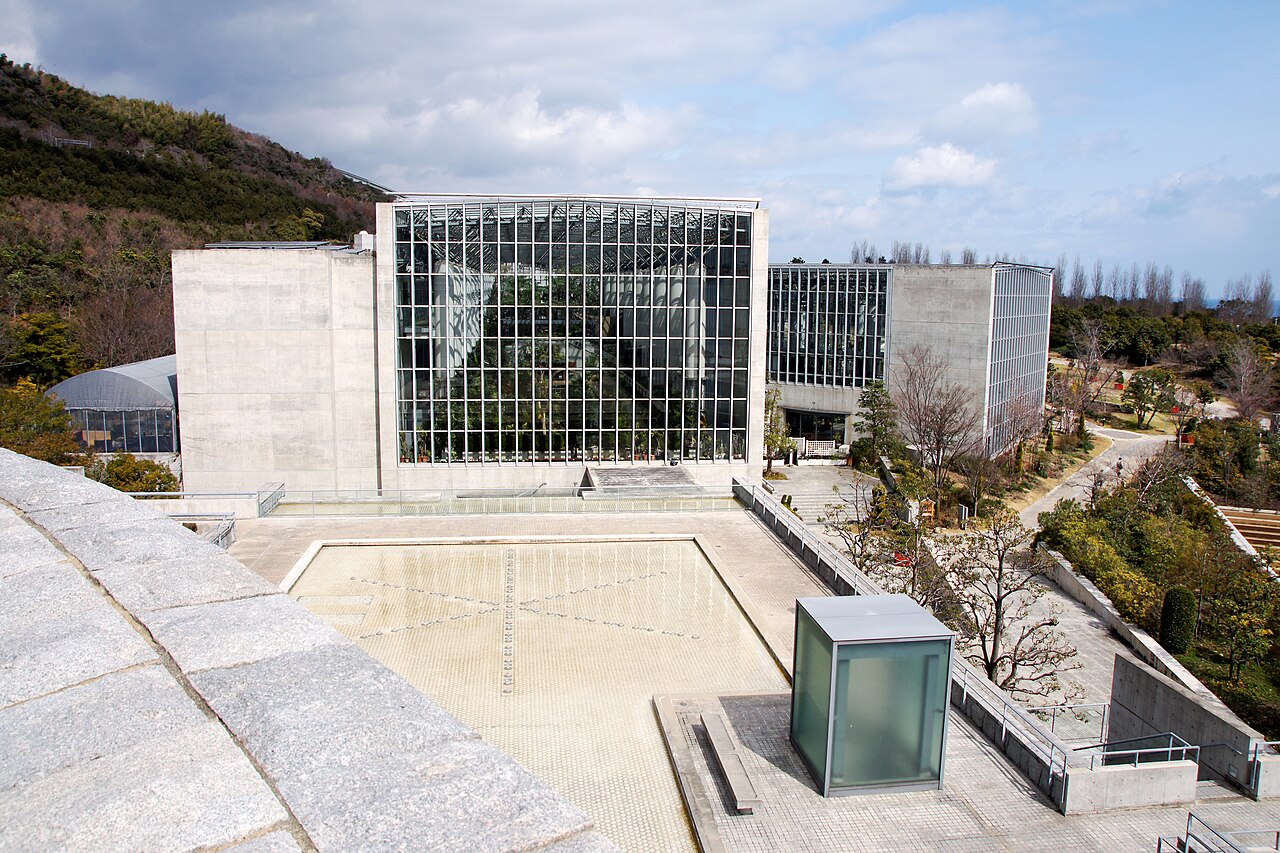
Opened on 18 March 2000 as the 'Kiseki no Hoshi no Shokubutsukan' (奇跡の星の植物館), this Hyōgo Prefecture greenhouse is part of Awaji Yumebutai, the complex Tadao Ando designed on a hill whose earth had been used to build Kansai International Airport. With 6,700 m² of floor space it ranks just behind Osaka's Sakuya Konohana Kan. Renamed Awaji Green Kan in 2021, then renovated and reopened in March 2025, it combines rare plants and works of art across five themed rooms.
Affiliate links — booking through Verrière helps fund our research, at no extra cost to you.
History
1 min
The greenhouse belongs to Awaji Yumebutai, a large complex designed by Tadao Ando on Awaji Island. The site was once a hill, Nadayama, about 160 metres high, whose earth was dug out to build Kansai International Airport. Ando led a project to restore the natural environment there, and the complex opened on 9 March 2000, hosting the international horticultural exposition Japan Flora 2000 (ジャパンフローラ2000).
Owned by Hyōgo Prefecture, the greenhouse opened on 18 March 2000 as the 'Kiseki no Hoshi no Shokubutsukan' (奇跡の星の植物館), roughly 'the plant museum of the miracle planet'. It was conceived as a new kind of exhibition space, combining art with flowers and greenery around the theme of 'creating emotion' (感動創造).
On 18 September 2021, to coincide with the flower fair marking the 20th anniversary of the Awaji exposition, it was renamed Awaji Green Kan and given new display features, including a 'Garden Castle'. It later closed for a major renovation made necessary by its ageing facilities, and reopened on 20 March 2025, the day the 25th-anniversary flower fair began.
Architecture and engineering
1 min
The building is the work of Tadao Ando, who designed the whole of Yumebutai, a complex of about 28 hectares and some 109,000 m² of floor space that received the 42nd BCS Prize in 2001. The exhibition greenhouse has 6,700 m² of floor space, making it the second-largest greenhouse in Japan after Osaka's Sakuya Konohana Kan (6,900 m²). Its main interior volume rises to about 20 metres.
Exhibition planning, interior landscaping and planting design were entrusted to 辻本智子 (Tomoko Tsujimoto). The interior is split between two zones, one called the 'symbiotic culture' zone (共生文化ゾーン) and the other devoted to flowers and greenery in daily life. They lead to five exhibition rooms, complemented by a shade garden, a terrace, an atrium and a room for temporary exhibitions. The 2021 transformation added a new display feature, the 'Garden Castle'.
Plant collections
1 min
Sources differ on the size of the collection: the official website announces more than 600 species of rare plants, while an article published for the 2025 reopening speaks of about 3,000 species. Each of the five rooms follows a theme: 'green sculpture' (みどりのちょうこく) for succulents, 'garden of colours' (しきさいのにわ) for tropical and subtropical species, 'greenery of daily life' (くらしのみどり) for plants in domestic settings, 'garden of evolution' (しんかのにわ) for Australian trees nicknamed 'Jurassic trees', and finally the 'lively garden' (にぎわいのにわ).
The official website mentions heliconias, billbergias and orchids among the plants on show. Highlighted specimens include an Aloe dichotoma described as 360 years old. True to its original concept, the greenhouse pairs plants with art: in 2026 it is showing driftwood sculptures by James Doran-Webb, exhibited in Japan for the first time.
Visiting
1 min
The greenhouse is part of Awaji Yumebutai in Awaji, Hyōgo Prefecture, reached by bus from Kobe: the ride takes about an hour from Shin-Kobe station, via Sannomiya or Maiko, to the Awaji Yumebutai-mae stop. An hour or two is enough for the greenhouse alone, but it is worth allowing more time for the rest of Tadao Ando's complex: the terraced Hyakudan-en garden, the 'shell beach' (貝の浜), the circular and elliptical forums and the open-air theatre. The greenhouse also hosts temporary exhibitions and seasonal events.
34.56° N, 135.01° E
Greenhouses nearby
More greenhouses — Japan
Do you have a good photo of this greenhouse? Suggest it for this page →