Insectopia Butterfly Greenhouse, Tama Zoological Park (多摩動物公園 昆虫生態園)
Hino, Tokyo
Entry updated on October 5, 2026
- Year
- 1987-1988
- Architect
- Nihon Sekkei (淺石優, 白江龍三, 瀬谷渉)
- Style
- Butterfly-plan glass-domed greenhouse in reinforced concrete and steel
- Dimensions
- About 2,500 m² floor area; 16 m high
- Status
- Exhibit suspended since 1 August 2026 (zoo website); no reopening date announced
Completed in December 1987 by the firm Nihon Sekkei at Tama Zoological Park in Hino, this butterfly house places a glass dome over an existing valley. Sixteen metres high, it forms a butterfly in plan, with display rooms in its two wings. Around fifteen species fly freely inside, including the Ōgomadara, one of Japan's largest butterflies. The building won the Architectural Institute of Japan Prize in 1989. The zoo's website states that the exhibit has been suspended since 1 August 2026.
Affiliate links — booking through Verrière helps fund our research, at no extra cost to you.
History
1 min
Tama Zoological Park opened on 5 May 1958 on some 60 hectares of the Tama hills in Hino, within metropolitan Tokyo. Insects have long had a place there: as early as 1966 a grasshopper and butterfly greenhouse, which the Japanese Wikipedia describes as the forerunner of today's insect biotope, was completed in the insectarium area.
The present large greenhouse, Insectopia (昆虫生態園), was designed by the firm Nihon Sekkei and completed in December 1987; the Japanese Wikipedia gives 1988 for the completion of the complex. The design team credited by the Architectural Institute of Japan comprised 淺石優, 白江龍三 and 瀬谷渉. The building received the Tokyo Creation Award in 1988, then the Architectural Institute of Japan Prize for design works, published in the journal Kenchiku Zasshi in July 1989, and the AACA Award in 1991. The Japanese Wikipedia records a refurbishment of the insectarium in 2002.
In 2025 the Tokyo Metropolitan Government's children's magazine still devoted a feature to the greenhouse and its butterflies. As of August 2026, the zoo's official website states that the Insectopia exhibit has been suspended since 1 August, giving neither a reason nor a reopening date.
Architecture and engineering
1 min
Seen from above, the building traces a butterfly: the large greenhouse sits at the centre and display rooms occupy the two wings. Rather than levelling the site, the designers set a glass dome over an existing valley, making use of the natural terrain; the greenhouse rises to 16 metres.
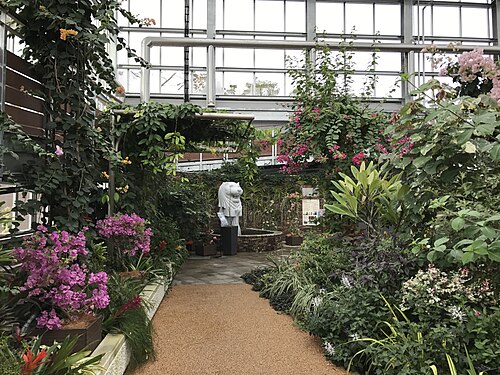
Nihon Sekkei describes the aim as a greenhouse that gives butterflies everything they need while staying as close as possible to a natural state, so that visitors feel they are outdoors even though they are inside. The glazed volume relates to the surrounding forest of kunugi and konara oaks, and sloping paths let visitors follow butterflies flying among the treetops while seeing insect behaviour from changing viewpoints.
The structure combines reinforced concrete and steel on one storey above ground and one below, with a floor area of 2,486 m² according to the firm. The design was recognised three times: the Tokyo Creation Award in 1988, the Architectural Institute of Japan Prize in 1989 and the first AACA Award in 1991.
Plant collections
1 min
According to the Tokyo Metropolitan Government's children's magazine, the greenhouse shows about fifteen butterfly species, with some 1,200 adults released each month. They include the Ōgomadara (オオゴマダラ), one of Japan's largest butterflies, with a wingspan of more than 10 cm, which the zoo describes as a slow and graceful flier, as well as the tsumabeni-chō (ツマベニチョウ), shirōbi-ageha (シロオビアゲハ), benimon-ageha (ベニモンアゲハ), ryūkyū-asagimadara (リュウキュウアサギマダラ) and tsumamurasaki-madara (ツマムラサキマダラ). As the light fades towards evening, the butterflies settle on the leaves.
The insectarium's other rooms complement the greenhouse: luminous larvae of an Australian fly, the glowworms, which hang curtains of sticky threads to catch prey; leaf-cutter ants farming a fungus on leaf fragments; and migratory locusts showing the changes in colour and wing shape between their solitary and gregarious phases.
Visiting
1 min
Insectopia stands in the insectarium area of Tama Zoological Park in Hino, next to the insectarium's main building (昆虫園本館). Mornings are the best time to see the butterflies in flight, as they settle once the light begins to fade. Check the zoo's website before going, however: the greenhouse exhibit has been suspended since 1 August 2026, with no reopening date announced. The rest of the park, spread over some 60 hectares of hills, presents animals by major world regions, and the insectarium's main building is worth a stop in its own right.
35.65° N, 139.40° E
Greenhouses nearby
More greenhouses — Japan
Do you have a good photo of this greenhouse? Suggest it for this page →