Green Dome Nettaikan, Itabashi Tropical Environment Botanical Garden (板橋区立熱帯環境植物館)
Itabashi, Tokyo

Entry updated on October 5, 2026
- Year
- 1994
- Architect
- Unknown
- Style
- Museum-style glasshouse under a glazed dome, on three levels
- Dimensions
- About 3,000 m², of which 1,000 m² planted
- Status
- Open to the public (reopened April 2021 after works)
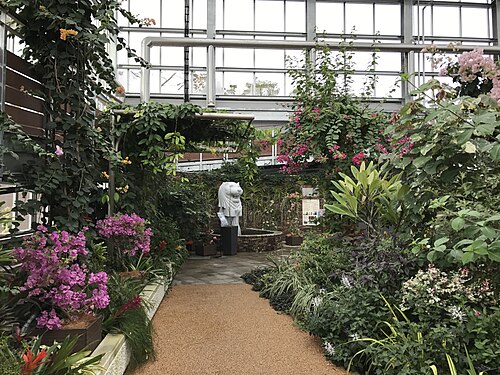
Opened by Itabashi City in northern Tokyo in September 1994, this 'museum-type botanical garden', nicknamed Green Dome Nettaikan, recreates the tropical rainforest of Southeast Asia using waste heat from the adjacent incineration plant. Across three levels, visitors move from mangrove to lowland forest, a Malay village landscape and, in a refrigerated room, the high-altitude cloud forest, with a small aquarium in the basement. Around 700 plant species are on display.
Affiliate links — booking through Verrière helps fund our research, at no extra cost to you.
History
1 min
Green Dome Nettaikan, the popular name of the Itabashi Kuritsu Nettai Kankyō Shokubutsukan, opened in September 1994 (Heisei 6) in the Takashimadaira district of Itabashi City, in north-western Tokyo. It was designed from the outset as an energy-saving facility: it stands beside the Itabashi incineration plant and uses that plant's waste heat to keep its tropical temperatures.
The building belongs to the city, which has entrusted it to designated managers since 2005. It is currently run by a consortium called Nettaikan Partners, led by the landscaping company Seibu Landscape and including Yokohama Hakkeijima, operator of the Hakkeijima Sea Paradise aquarium — a pairing of landscaper and aquarium operator reflected in a visit that combines plants and fish.
The facility closed in September 2020 for renovation and reopened on 20 April 2021. None of the sources consulted name the architect of the 1994 building.
Architecture and engineering
1 min
The building covers about 3,000 m², of which roughly 1,000 m² are planted. It is arranged from the basement to the second floor around a single large space open through its full height, roofed by a glazed dome that brings in natural light; the dome gave the place its nickname, Green Dome.
The layout follows an ecological transect from sea to mountain. The ground floor holds the glasshouse proper, divided into three vegetation zones: the tidal shore, the lowland tropical forest and a village landscape. On the second floor a refrigerated room recreates the cloud forest of high tropical altitudes, and a reading corner there looks down over the glasshouse. The basement houses a small aquarium covering marine, brackish and freshwater habitats. In the mangrove zone, a large glass-fronted tank of public-aquarium proportions carries the planted scene on below the waterline.
Plant collections
1 min
The garden shows around 700 species and 2,000 specimens. The tidal zone brings together mangroves and nipa palms; the dense lowland forest features large trees, timber-producing dipterocarps and strangler figs. The village landscape is built around a Malay house thatched with nipa palm, surrounded by tropical fruit trees and useful plants.
The cool cloud-forest room holds rhododendrons, orchids and pitcher plants. In the basement, the mini-aquarium displays about 150 species and 2,500 fish and other creatures, mainly from Southeast Asia; Japanese Wikipedia notes that it keeps the world's largest freshwater ray. A temporary exhibition room and a permanent display on rainforest ecosystems round off the visit.
Visiting
1 min
The glasshouse is in Takashimadaira, in north-western Tokyo, next to the incineration plant that supplies its heat. An hour to an hour and a half is enough to follow the whole route, from the basement to the cloud forest, with time to pause at the large mangrove tank.
The programme includes workshops, such as pressed-flower classes, talks and themed exhibitions, among them one devoted to the culture of Borneo. A café, Café Clea, serves Asian-inspired food at weekends only. In cold weather the contrast between a Tokyo winter and the humid air inside is especially striking.
35.79° N, 139.66° E
Greenhouses nearby
More greenhouses — Japan
Do you have a good photo of this greenhouse? Suggest it for this page →