Shinjuku Gyoen Large Greenhouse (新宿御苑大温室)
Shinjuku, Tokyo
Entry updated on September 30, 2026
- Year
- 2012 (rebuilding of a 1958 greenhouse)
- Architect
- Nippon Design (日本設計)
- Style
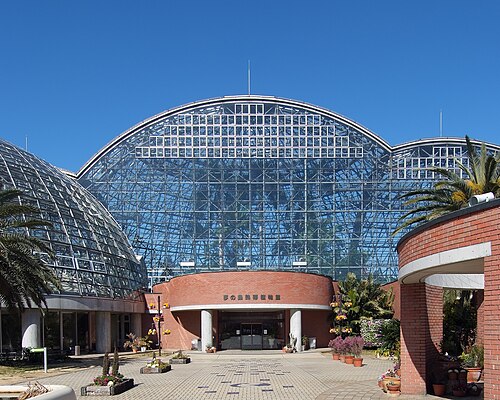
- Single-layer triangulated steel lattice dome, fully glazed
- Dimensions
- ≈2,750 m², ≈15 m high
- Status
- Open to the public
Set in the Shinjuku Gyoen National Garden, the large greenhouse continues a horticultural tradition that goes back to the late nineteenth century and a first heated building of 1892. Its 1958 successor, billed at the time as the largest in the Far East, was demolished and replaced by a glazed dome designed by Nippon Design, opened on 20 November 2012. The 2,750 m² building brings together rainforest, wetland, tropical mountain, Okinawan and arid plantings, and includes a conservation section for endangered species and historically significant orchids.
Affiliate links — booking through Verrière helps fund our research, at no extra cost to you.
History
1 min
Glasshouses stood at Shinjuku Gyoen long before the grounds opened to the public. According to the garden's own presentation, a small glazed structure of about 100 m² dates from 1875; by 1892 a heated, Western-style greenhouse was in place, and by the early twentieth century the establishment was known for its orchids, with 800 or more species recorded in 1914, a figure that comes from the official source.
Wartime destruction, notably the air raids of May 1945 that badly damaged the garden's facilities, opened a new chapter. The former imperial garden passed to the state and opened to the public as a national garden in 1949. In 1958 a large greenhouse with a 17-metre dome for palms was completed, then regarded as the largest in the Far East; additional houses for subtropical specimens and rare orchids followed between 1965 and 1975.
The ageing complex closed on 13 May 2007 for complete reconstruction. The Ministry of the Environment gives a project cost of roughly 3.5 billion yen, including demolition and archaeological investigations, and the work lasted five and a half years. The new greenhouse, designed by the firm Nippon Design, reopened on 20 November 2012 with a stated mission of conserving endangered species.
Architecture and engineering
1 min
The 2012 greenhouse is a single fully glazed volume about 15 metres high, with a total floor area of 2,750 m². An architectural review consulted describes the frame as a single-layer dome of triangular steel members laid out on a spherical surface, which keeps vertical supports to a minimum and leaves the interior open. The curving plan follows the garden's existing paths, and large openings on the south side connect the interior with the landscaped plaza outside.
The Ministry of the Environment lists several energy-saving measures: composite glazing with good thermal insulation, efficient intake of outside air, and underground cooling tubes that temper the air in summer. The main hall covers 1,660 m²; a separate 180 m² compartment, visible through glass, isolates the cultivation of endangered species and historically significant orchids. Walkways and changes of level allow the vegetation to be seen from above as well as from the side.
Plant collections
1 min
Sources differ on how many plants are on show. The 2012 opening announcement speaks of about 500 species and varieties, including around 100 large trees and 400 shrubs or ground-cover plants, while the garden's current page gives more than 1,000 species on display and about 2,700 when behind-the-scenes cultivation is counted.
The display is organised by habitat: tropical lowlands and mountains, a tropical wetland where the giant waterlily Victoria amazonica floats, a corner devoted to Okinawan flora, and plants of arid regions. Staghorn ferns greet visitors at the entrance, and pitcher plants (Nepenthes) are among the carnivorous species shown. The greenhouse also serves as an ex situ conservation site for endangered plants within the Japan Botanical Gardens Association network. An orchid exhibition is held there every November.
Visiting
1 min
The greenhouse lies near the Ōkido Gate inside Shinjuku Gyoen, a garden of more than 58 hectares that combines an English landscape garden, a French formal garden and a Japanese garden. About an hour allows an unhurried circuit, longer for those who join the guided tours or the behind-the-scenes tours the garden offers.
The November orchid exhibition is a good moment to come, as is the cold season, when the heated interior contrasts sharply with the garden outside. A visit pairs naturally with a walk across the lawns and along the cherry-lined paths, celebrated in blossom season.
35.69° N, 139.71° E
Greenhouses nearby
Do you have a good photo of this greenhouse? Suggest it for this page →