Shibuya City Botanical Garden Fureai (渋谷区ふれあい植物センター)
Shibuya, Tokyo
Entry updated on October 5, 2026
- Year
- 2005 (renewed 2023)
- Architect
- Unknown; renewal: SUPPOSE DESIGN OFFICE
- Style
- Double-height glazed greenhouse atrium reshaped into curved soil terraces
- Status
- Open to the public (reopened 29 July 2023)
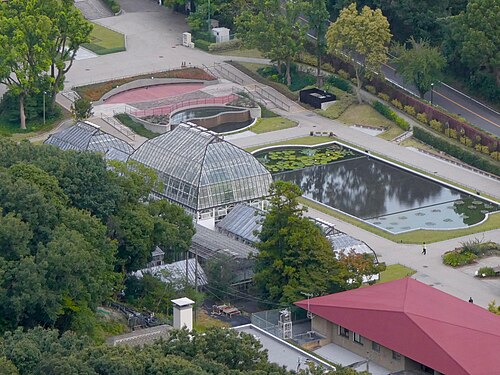
Opened by Shibuya ward in 2005, between Shibuya and Ebisu stations, as a facility given back to the neighbours of the adjacent incineration plant, whose waste heat supplied the electricity for its air conditioning and lighting, this botanical centre is, by area, the smallest member garden of the Japan Association of Botanical Gardens. Closed on 28 December 2021 because it had aged, it was reshaped by SUPPOSE DESIGN OFFICE and reopened on 29 July 2023 around the theme of growing and eating: behind the glazed front, curved soil terraces hold citrus, mango, guava and banana plants.
Affiliate links — booking through Verrière helps fund our research, at no extra cost to you.
History
1 min
The Fureai botanical centre opened in 2005 in the Higashi district, halfway between Shibuya and Ebisu stations. It was conceived as a facility given back (還元施設) to the residents living around the Shibuya incineration plant, its immediate neighbour: the electricity for its air conditioning and lighting came from the heat released by burning waste. The project also set out to evoke Shibuya's natural past, hence the indoor re-creation of the Kōhone stream (河骨川), a vanished brook that served as the model for the song 'Haru no Ogawa'. By area it is the smallest member garden of the Japan Association of Botanical Gardens, a distinction it displays on a sign.
For sixteen years the centre showed some 500 species, mostly tropical, held evenings for watching fireflies raised on site, and ran workshops prepared by around forty volunteers, some of them there since opening day. With no research or conservation remit, it saw itself as a go-between for people and plants, readily pointing visitors towards other gardens around the country.
The ageing of the building led to its closure on 28 December 2021. The ward entrusted the redesign to SUPPOSE DESIGN OFFICE, and the works were completed in April 2023. The centre reopened on 29 July 2023 with a new purpose, shifting from a garden to look at to a garden where people grow and eat, run under contract from the ward by Urban Farmers Club, a non-profit devoted to urban agriculture.
Architecture and engineering
1 min
The building has four levels. In its first form the lower two made up a double-height greenhouse warmed by the waste heat of the neighbouring plant; an upper terrace let visitors look down on the foliage, and the re-created stream, fed by rainwater stored in a large underground tank and recirculated, ran out of the building into the garden.
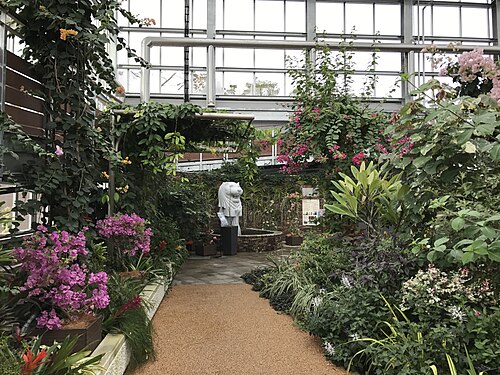
The renovation kept the glazed front and the atrium, very tall and flooded with daylight at the back of the building. To make up for the small planting area, the architects raised the ground into large undulations: these rounded 'soil stages' of varying heights multiply the growing surfaces and bring visitors close to the plants. The finishes recall terracotta, and a large mushroom-shaped mass pierced by a tunnel can be crossed on all fours.
Tunable LED lighting follows the course of the day, cooler at midday and warmer in the evening, supplementing daylight in the second-level exhibition room, where it falls short in places, and setting the mood in the café next door. Spotlights shine down on the plants from a high catwalk. The third level houses a multipurpose gallery and the fourth leads out to the cultivated roof.
Plant collections
1 min
Before the renovation the centre held about 500 species. A baobab served as its main tree, staghorn ferns (ビカクシダ) propagated by division hung from the upper level, and many plants with patterned or coloured leaves had been chosen for the view down from the terrace, while the outdoor planting followed the seasons.
Since 2023 the emphasis has been on plants people eat. The ground floor grows citrus (lime, yuzu, lemon, mandarin), mango, pineapple, guava, passion fruit, coconut palms, bananas and miracle fruit, and a round table is planted with a 'Satonishiki' cherry. Behind glass, a hydroponic unit under LED light produces lettuce, rocket, komatsuna and bok choy, served as salads in the café, which also offers water infused with herbs from the outdoor garden, where lavender, mint and lemon verbena grow. On the roof, open only for events, tea and hops grow beside beehives. In 2023 an exhibition showed specimens collected in Shibuya by the botanist Tomitarō Makino, and in October 2024 the centre announced the birth of a 'Shibuya cacao'.
Visiting
1 min
The centre is about ten minutes on foot from Shibuya Station towards Ebisu, at the foot of the incineration plant. Its small size makes for a short stop, easily extended at the café on the second level, the library beside it or the third-level gallery, which hosts talks and screenings, including a film night every other month since April 2025. The centre also stays open into the evening, when the plants are lit. On Saturday afternoons the 'Saturday Farm' sessions focus on the herb garden, and vegetable-growing classes extend to a riverside plot on the Shibuya River two minutes away. Around it, the Shibuya East district keeps the feel of an old neighbourhood where people live and run their businesses.
35.65° N, 139.71° E
Greenhouses nearby
More greenhouses — Japan
Do you have a good photo of this greenhouse? Suggest it for this page →