Vlinders aan de Vliet (tropical butterfly garden)
Leidschendam (Leidschendam-Voorburg), South Holland
Entry updated on October 5, 2026
- Year
- 2006
- Architect
- Unknown
- Style
- Former plant-growing greenhouse converted into a tropical butterfly garden
- Dimensions
- 1,600 m² since 2019 (850 m² before)
- Status
- Open to the public in season (mid-February to late October in 2026)
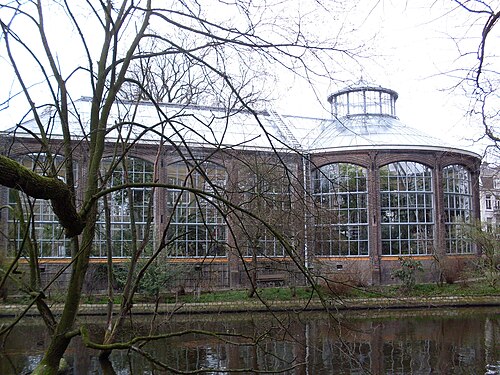
Beside the Vliet canal in Leidschendam, an old plant-growing greenhouse was converted in two months into a tropical butterfly garden. It opened in 2006 on a temporary use permit, because the building is on the demolition list for the Duivenvoorde green corridor. Licensed as a zoo in 2008, the garden doubled in size in 2019, from 850 to 1,600 m². At least 1,500 tropical day-flying butterflies fly freely among bananas, ornamental gingers and figs, sharing the space with small birds, fish and turtles.
Affiliate links — booking through Verrière helps fund our research, at no extra cost to you.
History
1 min
Vlinders aan de Vliet grew out of an amateur's passion. Before opening a garden to the public, its owner, Jan Kienjet, was already rearing butterflies in a hobby greenhouse of about fifty square metres; a profile written at the end of October 2005, reproduced in the site's timeline, shows him getting that greenhouse ready for winter. The garden's own introduction describes the business as a hobby that got out of hand.
The project changed scale in spring 2006, when an old plant-growing greenhouse on the Veursestraatweg was turned into a tropical butterfly paradise within two months. The site's timeline and Dutch Wikipedia date the opening to 2 May 2006, while the introduction page gives March 2006. From the start the business ran on a temporary use permit, because the greenhouse is on the list of buildings to be demolished for the Duivenvoorde corridor; a new fire-safe, energy-saving roof was nevertheless put on.
In 2008 the Dutch agriculture ministry (LNV) granted the garden a zoo licence, citing the variety of butterflies and small animals it keeps. On 2 May 2019, thirteen years to the day after the opening, a municipal alderman (wethouder) officially opened the extension that took the garden from 850 to 1,600 m².
Architecture and engineering
1 min
The garden does not occupy a purpose-built exhibition pavilion but an ordinary horticultural glasshouse: an old plant-growing greenhouse that the owner refitted in a matter of weeks. No architect or builder is named, and the construction date of the original greenhouse has not been published. Its position remains precarious, since the operating permit is temporary; this did not prevent the fitting of a new roof, described as fire-safe and more energy-efficient.
The extension opened in 2019 doubled the space open to visitors, from 850 to 1,600 m², and, according to the site's timeline, came with a renovation of the old greenhouse. The building outline that OpenStreetMap takes from the Dutch national buildings register (BAG) covers about 1,580 m², which matches that figure. Inside, the garden describes itself as an 'ecodisplay', a recreated jungle in which plants, butterflies, birds and aquatic animals share one volume, with a large pond and terrariums for reptiles.
Plant collections
1 min
The garden advertises at least 1,500 tropical day-flying butterflies in free flight, and Dutch Wikipedia describes an atmosphere modelled on the Central American jungle. Their activity follows the light: most fly when the sun breaks through outside, while some species stay settled in dull weather.
The planting is chosen to feed both caterpillars and adults. Each species has its own host plant, on which the female lays and the caterpillar feeds: Passiflora for the passion-flower butterflies, Aristolochia for the birdwings, palms and bananas for the blue morpho, bananas and Strelitzia for the owl butterflies. The garden also holds Strelitzia nicolai, seven kinds of banana, many Hedychium and Alpinia, or ornamental gingers, and plenty of figs; Hibiscus, Lantana, Pentas and bromeliads provide nectar.
The butterflies share the space with small seed-eating birds and other free-flying tropical birds, reptiles in terrariums, turtles and a large pond stocked with arowanas.
Visiting
1 min
The garden stands on the Veursestraatweg in Leidschendam, beside the Vliet, the canal that gives it its name; a bus stop called 'Vlindertuin' is close by. It opens for only part of the year: in 2026 the butterfly season runs from mid-February to late October.
A bright day is the better choice, since most butterflies become active when the sun breaks through and some species stay still under cloud. The density of insects makes it popular with macro photographers, and the garden also receives groups and school classes, with activities on the butterfly life cycle. The banks of the Vliet, used by cyclists and boaters, offer a way to extend the outing outdoors.
52.10° N, 4.42° E
Greenhouses nearby
More greenhouses — Netherlands
Do you have a good photo of this greenhouse? Suggest it for this page →