Tropical House and Cactus House, Inverness Botanic Gardens
Inverness, Highland, Scotland

Entry updated on October 5, 2026
- Year
- 1993
- Architect
- Unknown
- Style
- Modern linked glasshouses on split levels
- Status
- Open to the public
Opened by Prince Edward on 14 May 1993 as the Inverness Floral Hall, Inverness Botanic Gardens fill the former walled garden of Bught House, an 18th-century mansion pulled down in the 1960s, on the west bank of the River Ness. Built by the Highland Council at a cost of £500,000, the site has two connected glasshouses: a humid tropical house with a waterfall and a koi carp pool, and a cactus house where hundreds of species are set among 75 tonnes of rock and sand.
Affiliate links — booking through Verrière helps fund our research, at no extra cost to you.
History
1 min
The garden stands on the grounds of Bught House, an 18th-century mansion whose walled garden now forms the heart of the site. The house itself was demolished in the 1960s, partly to make room for a new ice rink.
The glasshouse complex was built as a Highland Council facility at a cost of £500,000. Prince Edward opened it on 14 May 1993 as the Inverness Floral Hall and Gardens, and it drew around 80,000 visitors a year from the start. One travel blog gives 1992 as the opening year, but local press and other guides agree on 1993.
Now renamed Inverness Botanic Gardens, the site describes itself as the most northerly botanic garden in the United Kingdom. It is run by High Life Highland, a charitable body. Training has long been part of its purpose: the Gazetteer for Scotland records short- and long-term horticultural work placements and a partnership with golf clubs and Elmwood College in Fife to train greenkeepers. Today the GROW Project (Garden, Recycle, Organic and Wildlife), a community gardening scheme, looks after part of the outdoor grounds, alongside a plant nursery and a team of volunteers.
Architecture and engineering
1 min
The complex consists of two linked glasshouses: the larger recreates the hot, humid conditions of a rainforest, while the smaller is given over to plants from arid regions. None of the sources consulted names a designer or gives the buildings' dimensions.
The tropical house is laid out on two levels joined by steps. Three paths run through it: on the right, the route passes the koi carp pool, a waterfall and an artificial cave; in the centre, a staircase climbs to an upper floor with seating that looks down over the planting; on the left, a passage opens directly into the cactus house. A fountain adds to the water features.
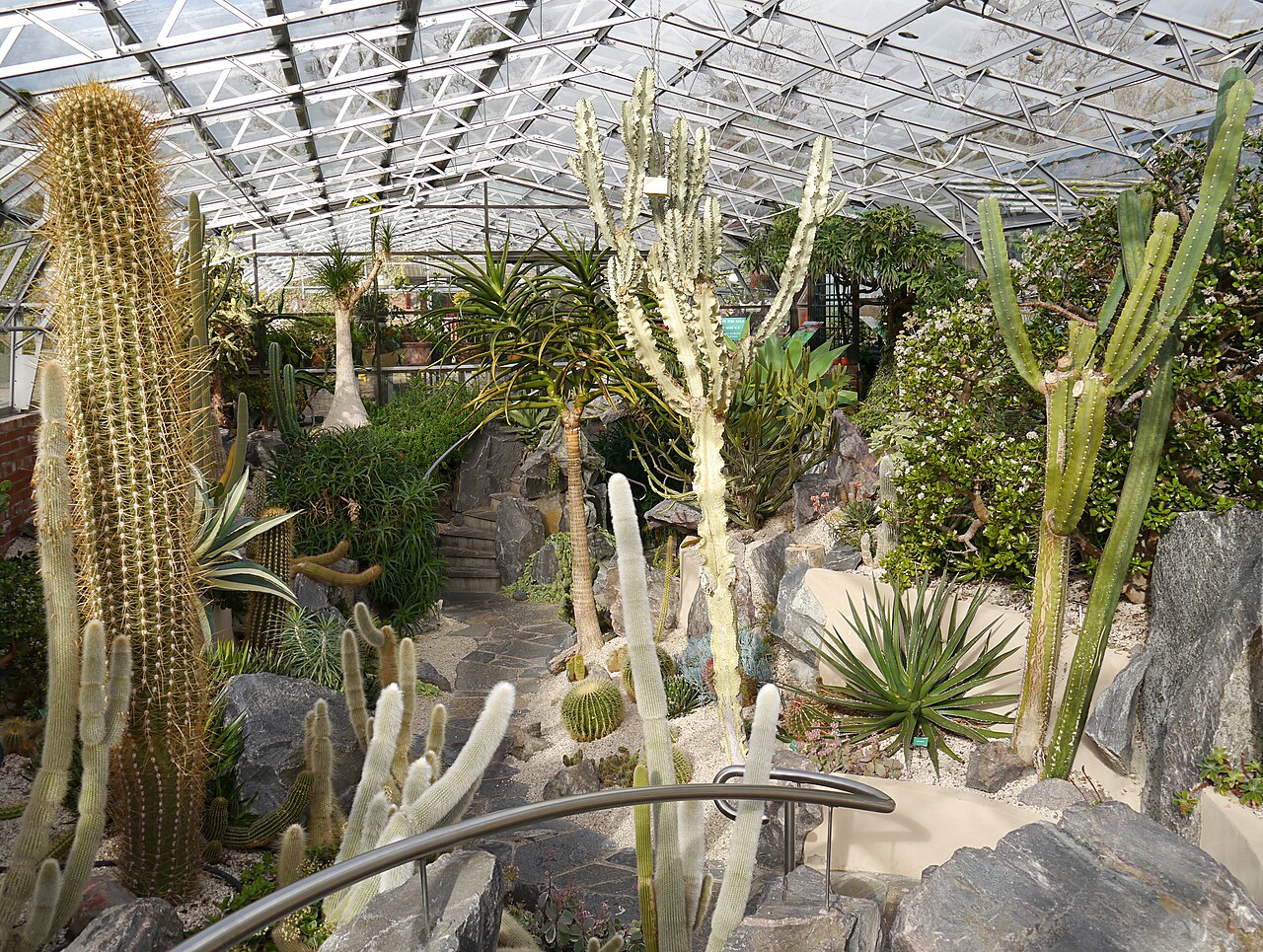
The cactus house is designed as a rocky desert gully: about 75 tonnes of rock and sand make up the setting, explored by flights of stairs. Its lower level is not wheelchair accessible, although most of the display can be seen from the upper gallery. Further glazed structures complete the site: a glasshouse housing the café, with palms and a fountain, and a large glasshouse used for events.
Plant collections
1 min
Many of the tropical house's plants come from Brazil, Mexico and the Bahamas: coffee, ginger, pineapple and banana grow alongside bird of paradise plants, bougainvillea and tender orchids around the pool. A group of carnivorous plants brings together the Venus flytrap, sundews, North American pitcher plants and monkey cups.
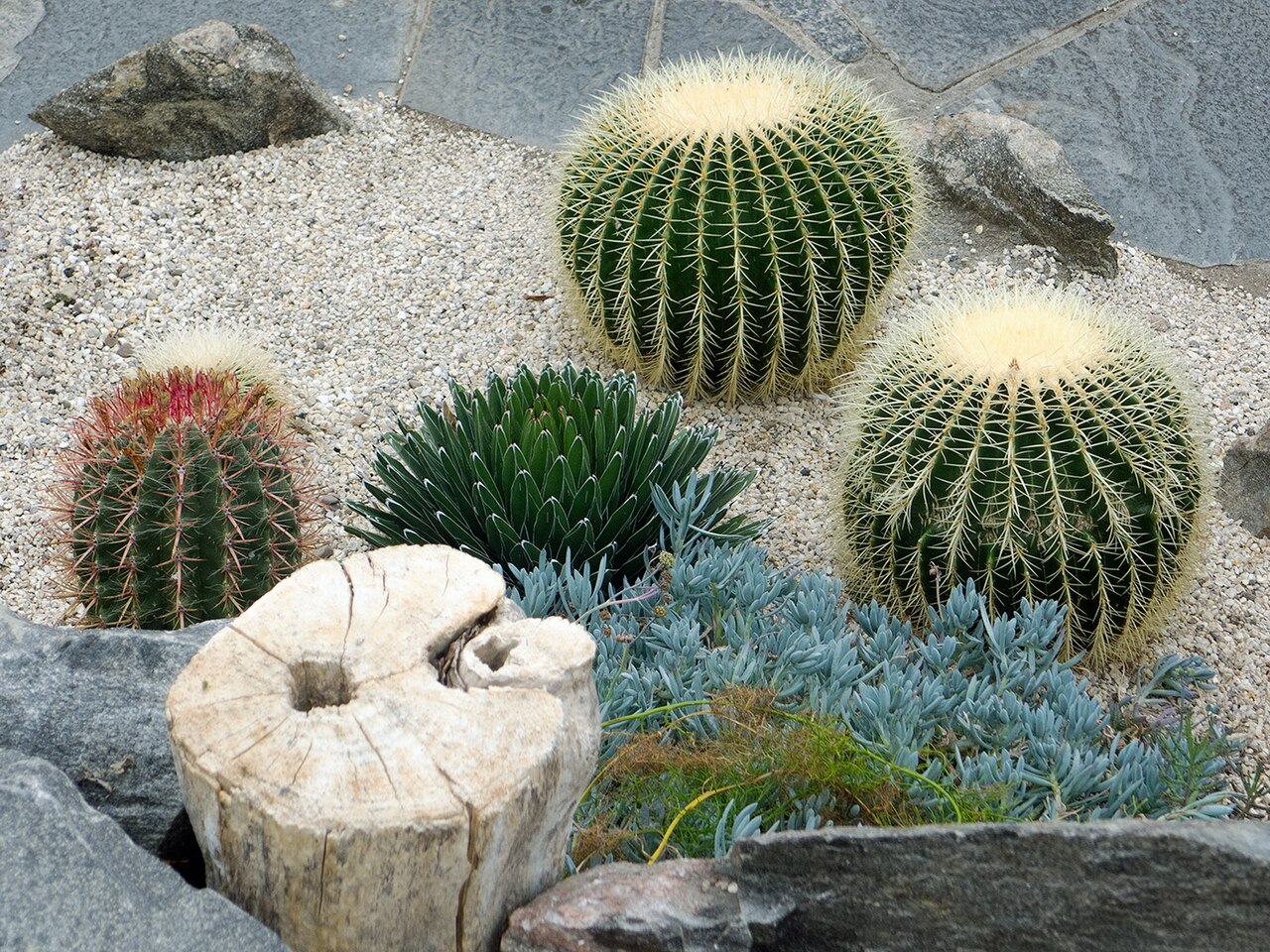
The cactus house displays hundreds of species of cacti and succulents, including agaves, aloe vera, crassulas and euphorbias, a Silver Torch cactus native to Bolivia and Argentina, and aeoniums from the Canary Islands. The Gazetteer for Scotland also described an insect and reptile area with snakes, giant millipedes, hissing cockroaches, scorpions and tarantulas.
Outside, the glasshouses are framed by seasonal bedding, herbaceous borders, rhododendrons, a heather garden, a herb garden, a formal Japanese garden and a sensory garden, while a Himalayan birch stands out among the specimen trees.
Visiting
1 min
The gardens lie in Bught Park on the west bank of the River Ness, about 2 km south-south-west of Inverness city centre, opposite the Inverness Leisure Centre on Bught Lane, close to the A82. The site suggests allowing an hour to an hour and a half.
The glasshouses can be enjoyed in any season, and the outdoor gardens are planted for year-round interest, with wildflower meadows and the GROW Project's secret garden extending the walk. Paths mix bark, grass and gravel, with some uneven ground; a wheelchair can be borrowed on request, and only assistance dogs are admitted. Café Botanics, set under glass, makes a natural stop before heading on to the riverside.
57.46° N, 4.24° W
Greenhouses nearby
More greenhouses — United Kingdom
Do you have a good photo of this greenhouse? Suggest it for this page →
Sources (6)
- highlifehighland.com/inverness-botanic-gardens/
- en.wikipedia.org/wiki/Inverness_Botanic_Garden
- scottish-places.info/features/featurefirst8967.html
- britainexpress.com/scotland/Highlands/gardens/inverness-botanic-gardens.htm
- livebreathescotland.com/inverness-botanic-gardens/
- pressandjournal.co.uk/fp/past-times/5324497/inverness-floral-hall-botanic-gardens/